Post View Unavailable »
New Website Launched »

Exploring Moral Dilemmas in Unique Thesis, Linking Dostoyevsky and Star Wars

Jackson Miller ’24 was drawn to a research topic as he approached his 1st Class year with strong philosophical and religious themes. The recent Virginia Military Institute graduate, who majored in English, has always had aspiration in the medical field, along with potential military service. He presented his research “Dostoyevsky and Star Wars: Understanding How Narratives Can Help Us Deepen Our Moral Awareness” during Honors Week in the spring semester. 

“The question is, do the ends justify the means? Is it okay to do bad things for the greater good?” Miller explained. This central question, often debated in historical and military contexts, resonated deeply with him.

“I watched ‘Star Wars: Andor’ after finishing ‘Crime and Punishment’ and was struck by how both works addressed the same ethical questions but arrived at different conclusions,” he said.  

This juxtaposition sparked his interest in exploring the narratives further. 

During his thesis process, Miller was guided by Dr. Curry Kennedy, formerly of VMI, now teaching at Texas A&M, and later by Dr. Reshef Agam-Segal, associate professor of English, rhetoric, and humanistic studies. 

Both advisors played essential roles in shaping his research.  

“Dr. Kennedy initially helped me frame my project, while Dr. Agam-Segal provided further guidance and resources,” Miller noted. 

His research journey was challenging.  

“I pitched the idea to Dr. Kennedy, unsure if it would be accepted. Thankfully, he and the department supported it,” Miller said.  

Weekly meetings and extensive reading on ethics, literature, and storytelling helped refine his thesis. Miller’s exploration went beyond literary analysis to personal growth. 

“Working with knowledgeable professors and delving into new subjects like rhetoric and philosophy was humbling. It forced me to confront my own conclusions about ethical dilemmas,” he reflected. 

His work was academically rigorous and deeply relevant to the lives of VMI students and future military officers.  

“Especially for those who will be making critical decisions, understanding whether the ends justify the means is vital,” he emphasized.  

The presentation stressed the importance of grappling with moral questions with real-world implications, particularly in military settings where officers must often weigh difficult choices — a likely scenario for some graduates of VMI. 

Looking ahead, Miller intends to spend a gap year working at Johns Hopkins University’s research labs before pursuing medical school.  

“I’m going to be working there as a research tech, continuing to expand my knowledge and skills,” he said. 

“My goal is to combine my passion for medicine with my desire to serve, potentially joining the military as a medical officer,” he shared. 

Behind the Balance: Devin Butler ’24 — Keydet Basketball

Virginia Military Institute’s cadet-athletes have to juggle cadet life, heavy academic course loads, and their NCAA Division I sport. Committed to both academic and athletic pursuits, balancing their rigorous schedule in both sports and school requires a certain level of commitment and discipline. Behind the Balance is a series that focuses on those cadet-athletes and how they handle the hurdles of the day-to-day.  

Devin Butler ’24 doesn’t remember a time when there wasn’t a basketball in his hands. He may not have been able to dribble it as a baby, but it was there.  

“Ever since I can remember, I’ve always had a basketball,” the English major said. 

His father was a basketball player, then his brother grew up loving it. Once Butler was born, he said his brother was determined to make him a teammate. So, by the time he could walk, he could dribble a ball.  

While attending The Phelps School outside Philadelphia for high school, Butler wasn’t too interested in attending a military college like Virginia Military Institute. Coaches from VMI had been reaching out to his high school coaches, but he didn’t bite.  

“After the visit I could see how connected the people were here, especially the team,” he said. “It was totally different from any other visit I did. I had no question about it, I chose VMI.” 

This semester — his final one — he’s at 12 credits. Although it’s a lighter load than other semesters, he still has booked days throughout the week.  

Cadet-athletes at VMI not only have their responsibilities with their selected sport but cadet duties on top of that.  Cadets are also required to take physical fitness classes twice a week, participate in ROTC all four years, prepare for room and uniform inspections, practice for parade, guard duty, and more. 

“It does get tough here because of the military aspect of the school, along with academics and basketball,” he said. “I try to find time to pray and center myself religiously, and then to meditate to really be in tune with myself and appreciate all the madness that comes along. Because school is being paid for; I’m totally blessed. I couldn’t have it any better. So sometimes I need to just take time to stop and appreciate that and live in the moment really.” 

Getting up at 6 a.m. daily to hit the weight room by 6:20 a.m. is the norm for Butler. From there, it’s breakfast and onto classes. By noon, he’s got a break where he can grab lunch to-go from Crozet, take a quick nap, then back to classes until about 2 p.m. From there, he’ll head back to the weight room for an hour, then do some skill work for almost an hour before practice starts at 4 p.m. Then it’s on to dinner and back to barracks. He’s usually doing schoolwork a bit at night but has been keeping up with studies during his regular day.  

Devin Butler about to shoot a basketball during a Virginia Military Institute men's basketball game.

He said being on the basketball team really helps with any stress the day brings. 

But now, he’s more nostalgic. Finishing up his last semester, he feels like he can look back and appreciate the trials and tribulations he endured at VMI because it allowed him to become the leader he is now. 

“Now that I’m a 1st Class cadet, I can sit back and appreciate what the school has done for me, how much it has allowed and helped me to grow,” he said. “I’ve become a better leader. This team, this environment has kind of just sprang me into the leader I want to be when I leave here.” 

VMI has helped Butler’s confidence tremendously, he said. From starting as a rat, breaking out and becoming a 4th Class cadet, to receiving rings, and heading for matriculation. 

“All the things that you have to go through here … you have to find when everybody in the world tells you that you’re nothing, you have to find within yourself to say no, I am something,” he said. “So that was kind of my thing throughout the Ratline. I was like, it’s not going to break me. I know I’m worth something. Then as the years have gone by, I’ve seen that resiliency grow. And no matter the issue, no matter the challenge that VMI has thrown me, I’ve been able to kind of take it on.” 

That dedication and resiliency is something he can take with him outside of VMI. After graduating, he plans on attending graduate school.  

“That battle helped me to spring past my peers, because I’ll be able to take the adversity that life throws at you and know how to handle it,” he said.  

Behind the Balance: Andrew Granger ’24 — Keydet Track and Field

Virginia Military Institute’s cadet-athletes have to juggle cadet life, heavy academic course loads, and their NCAA Division I sport. Committed to both academic and athletic pursuits, balancing their rigorous schedule in both sports and school requires a certain level of commitment and discipline. Behind the Balance is a series that focuses on those cadet-athletes and how they handle the hurdles of the day-to-day.  

If anyone knows balance, it’s Andrew Granger ’24. Not just with academics and cadet life, but within his event for track and field.  

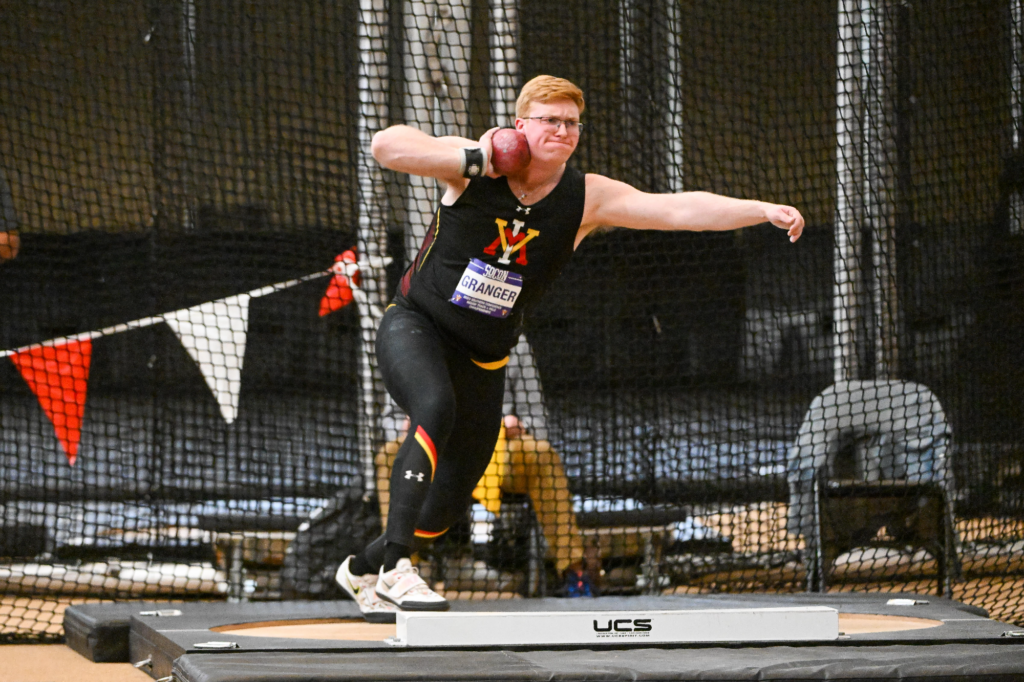
Granger is a thrower, which requires a steady technique — something he’s perfected throughout the years. He started throwing in high school. 

“When you’re throwing, if you get off balance a little bit in any direction, then you can totally mess up the throw. It doesn’t matter where you are in the stages of the throw,” he said. 

Every move is calculated: the trajectory you must throw it, or the certain angle for the best distance, down to the speed at which you’re rotating. Granger is thinking about all of this just seconds before he throws.  

“You have good body awareness, and you define ‘what did I do wrong?’ That usually tells you what you need to improve and if you can do it. It directly translates to throwing farther and getting better.” 

The English major, who will be attending Naval Officer Candidate School after graduation, decided on Virginia Military Institute after a visit with Coach Zach Scott.  

“I got to see what life was like at VMI. I was really interested in the military aspect,” he said. Granger also figured attending VMI would give him the chance to see if serving in the military was the right choice for him — something he was on the fence about.  

“I didn’t know whether or not I wanted to do it yet. So, I figured it would be a good chance for me to kind of push myself into that sort of life and see,” he said. “Also, I wanted to improve myself and have a good foundation for the rest of my life.” 

He participates in the discus, shot put, and hammer throw events for both indoor and outdoor track. His season, which starts in October, goes on until May, making it one of the longest seasons for athletics at VMI.  

Staying up to date in his 18 credits, while still participating in a Division I sport, can be difficult.  

Andrew Granger preparing to throw the shot put during a track and field event for Virginia Military Institute.

Communication is key 

Cadet-athletes at VMI not only have their responsibilities with their selected sport but cadet duties on top of that. Cadets are also required to take physical fitness classes twice a week, participate in ROTC all four years, prepare for room and uniform inspections, practice for parade, guard duty, and more.

With days starting at 6:45 a.m., classes until 4 p.m., and practice until after 7 p.m., then studying and homework until nearly midnight, Granger said it’s a full day. 

“I think the phrase I hear a lot is VMI teaches you to fit a 30-hour workload into like a 24-hour day or something. I guess that it definitely teaches you to manage your time and it taught me to be respectful to everyone.” he said. 

“It’s a lot of work. It’s a balance between the academic and the athletic workload. I kind of have to stay on top of my homework and studying, while also just being ready for practice and working as hard as I can when I’m practicing,” he said. “It’s just about managing the time outside of practice to get your work done.” 

The biggest thing is communication, which is something VMI has instilled in him.  

“I’ve learned to definitely stay in contact with my teachers, especially if I’m missing classes,” he said.  

Emailing or talking in person with his professors is how he makes sure he’s making up what he’s missing out on in classes if he’s traveling for meets.  

“Whenever I have time, which is usually during the travel time when we’re on the bus, I’m getting the work done,” he said.  

Even though his sport is more individual, he said the whole team likes to back each other up. He said they all like to watch each other compete, cheer each other on, and be overall supportive of each other. Granger said they also guide each other and act as a second set of eyes looking at each athlete’s technique.