Post View Unavailable:
Post View is currently unavailable due to technical difficulties. More information.Last Updated: 01-08-2026 09:42 AM»
Notice:
VMI.edu has recently been updated and upgraded. Please note that some URLs may have changed. Visitors are encouraged to use the new, expanded site menu and site search to navigate through these changes.
New Website Launched»
The National Academy of Education (NAEd), an honorary educational society, has selected Maj. Zachary Deibel, assistant professor in the Department of History at Virginia Military Institute, as a 2026 NAEd/Spencer Postdoctoral Fellow.
Deibel was one of 25 selected from a competitive pool of nearly 500 scholars, and will receive a fellowship award of $70,000 intended to assist with his salary replacement and research expenses for the fellowship period.
Founded in 1965, the NAEd advances high-quality research to improve education policy and practice, and consists of U.S. members and international associates who are selected on the basis of scholarship related to education. According to Okhee Lee, Ph.D., chair of the NAEd Professional Development Committee, the fellowship encourages and supports the next generation of scholars from a variety of fields and disciplines as they work to improve education.
“These fellowships are more crucial than ever given the recent dramatic declines in education research funding. It is a privilege to work with our new fellows who will contribute to education research and scholarship,” said Lee.
Deibel, who specializes in early American history, will be investigating the revolutionary origins of civic education in America for his project titled, “Liberty’s Lessons: The Educational Politics of the American Revolution,” and is excited to be participating in the fellowship. “It is an amazing opportunity to learn from and alongside some incredible scholars. I am also thrilled to be able to bring all that I learn back to VMI. The workshops, mentorship program, and collaborative learning offered by the fellowship will help me bring new approaches and research to my classes at the Institute. I am looking forward to using my research to foster new and exciting explorations with cadets and colleagues into how we can learn from the past to be informed, empathetic, and engaged citizens.”
The Vanguard series highlights cadets of Virginia Military Institute who exemplify promise, perseverance, and the true spirit of leadership. While they may not be the top-ranking students or those in prestigious positions, these individuals’ dedication, resilience, and growth embody the essence of being a VMI cadet. By sharing their stories, including the challenges they’ve faced and overcome, we shine a spotlight on the diverse paths to success at the Institute, proving that leadership and excellence come in many forms.
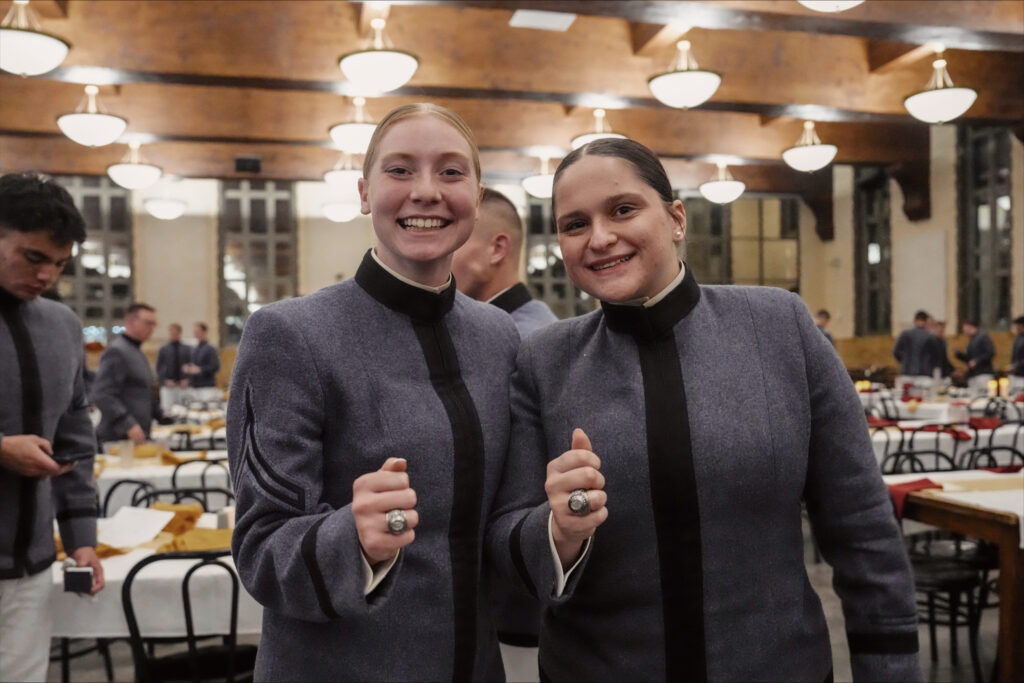
When Gracie Harlow ’27 started her collegiate career, she felt like she was going through the motions and not obtaining any growth. She started at Hollins University, an all-female college near Roanoke, but ended up transferring to Virginia Military Institute after two years.
“There was no challenge. I was just living,” she admitted. “I wanted a challenge. My brother went to The Citadel and I come from a military family. I wanted something different. I knew I could get somewhere from here.”
The transfer as a junior didn’t mean she’d end up a 2nd Class cadet. She went directly to the Rat Line and started over.
“You can’t skip it,” she said of the Rat Line. She turned 21 right after Breakout.
“It was kind of rough in the beginning. I struggled a lot. My dyke helped me a lot,” she stated. “It took a lot of getting used to, but I feel like everything I went through and I have been through so far has helped me grow in these couple years.”
Harlow also knew she needed financial assistance for school. She received a scholarship for track and field, which she participated in her first two years as a cadet. All of her aid is covered by VMI scholarships, either from the school or alumni.
“These have been crucial to me getting through school due to my financial situation at home,” she explained. “Having those opportunities that are free or I have an avenue to make it free means a lot.”
She has her plate full. A history and English double major, she also has several writing and photography extracurricular activities. Originally, she started out as an international studies major, but felt uninspired and was looking for something she enjoyed more. She switched to history, but found she needed to fill more classes.
“I had a lot of schedule to fill, so I picked up the double major in English. That has helped me branch out and meet people,” she commented.
Maj. Madeleine Ramsey, assistant professor of history and Harlow’s academic advisor, has worked closely with Harlow for the past two years. Although she hasn’t taught her, she’s heard her colleagues speak about Harlow’s influence in the classroom. Ramsey noted Harlow’s academic diligence as even more impressive because she’s been able to achieve it while participating in a DI sport of track and field and the demanding regimental system.
“She is always prepared, ready to engage with the material at hand, and willing to participate actively in classroom discussions. She is a committed student, as I have seen firsthand through the numerous visits to both my colleagues’ offices and mine, to ask questions and seek assistance with her papers,” Ramsey commented. “As she has done throughout her academic career, Ms. Harlow applies the same discipline and dedication to VMI’s Corps of Cadets. She excels both inside and outside the classroom and now holds rank as a corporal.”
The dive into history and English allowed her the opportunity for an internship with the American Battle Monuments Commission where she was given the opportunity to research for them. She also traveled to France to present her research with the commission.
Being involved has been a huge goal for Harlow.
“I like trying new things, but I feel like VMI has given me more opportunities to do that,” she said. “Hard work is more recognized here than a lot of colleges. I know we have the uniforms that look the same, but you can always tell the difference.”
She will be studying abroad this summer in Spain, spending four weeks at the University of Alcalá. She previously went to Poland in the summer of 2024 through the MirYam Institute’s program, I-SAP (Israel Strategy & Policy) tour, which is designed for U.S. military cadets to travel, learn about a country, its place among the nations, and its relationship with the United States.
Despite any shortcomings Harlow has faced in her personal life, Ramsey said she’s been able to hold numerous part-time jobs and also received an internship from John A. Adams ’71 Center for Military History and Strategic Analysis to travel to Normandy.
“Quite simply, Ms. Harlow is one of the hardest -working cadets I have encountered at VMI, a place where hard work is a part of everyday life,” Ramsey said.
As a student, she’s improved with planning things out. She used to be more sporadic with things and the regiment of VMI has pushed her to become more solid in her foundation.
“I feel like I literally have to plan out everything. I’m a big planner,” she stated.
Ramsey said that Harlow is one of the most organized and disciplined students she’s ever met.
“She arrives promptly for every meeting and is always prepared. She has faced a variety of challenging circumstances in her life that for many would have been reason to seek an easier path,” Ramsey stated. “Ms. Harlow sought out, and has excelled in, one of the most challenging systems in higher education, which speaks to her strength of character.”
Her roommate calls her OCD because she’s very strict about her uniform and how tidy their room is. She prides herself on never having any demerits.
“I hate being in trouble. I just do my best to avoid it.”
She tends to be more quiet in the classroom but will always speak up if she needs help.
“I try to do my hardest to work with my professors and get the help I need. I lean a lot on my roommate. My dyke helped me a lot my rat year. I still talk to her a lot. I met my boyfriend here,” Harlow said. “The whole support system is how I buckle down and deal with it. VMI teaches you to move forward no matter what’s in your way right now. You have to get past it. And having that support system to get past it helps.”
The Vanguard series highlights cadets of Virginia Military Institute who exemplify promise, perseverance, and the true spirit of leadership. While they may not be the top-ranking students or those in prestigious positions, these individuals’ dedication, resilience, and growth embody the essence of being a VMI cadet. By sharing their stories, including the challenges they’ve faced and overcome, we shine a spotlight on the diverse paths to success at the Institute, proving that leadership and excellence come in many forms.
Owen Johns ’28 has always been interested in how the world works, which is what drew him to an international studies major at Virginia Military Institute.
“I like to see how things in the past affect current outcomes,” he explained.
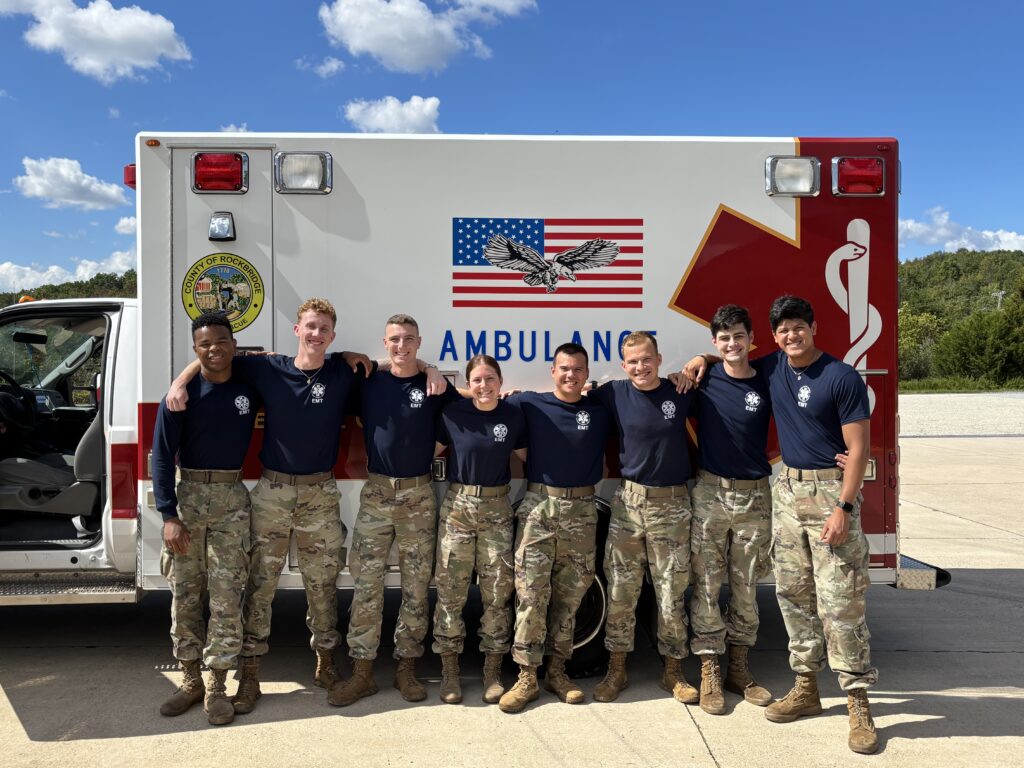
Johns knew he wanted to commission in the U.S. Army, so VMI was the best choice for him. Once he got to VMI and chose his direction, he discovered a whole new world of opportunities. He is a VMI emergency medical technician (EMT), a volunteer firefighter with the City of Lexington, and an S1 corporal.
Maj. Mattie Webb, assistant professor in the Department of History, said Johns is highly respected amongst his peers.
“I could always count on him to ask difficult but well-reasoned questions, something that showed me he was genuinely curious and eager to connect course material to larger themes and debates,” Webb explained.
From taking on leadership roles in the classroom to always engaging in discussion, Johns has impressed Webb since he was in her U.S. Constitutional History course. That course is challenging and requires cadets to learn the material and also communicate it effectively to each other.
“Johns consistently demonstrated a commitment to uplifting those around him, especially during group activities. He was eager to improve and regularly took advantage of opportunities outside the classroom, including attending guest speaker events,” she said. “This attitude reflected his enthusiasm to learn, openness to feedback, and genuine enthusiasm for U.S. constitutional history.”
Johns admits being a cadet at VMI is difficult, but he’s been able to be proactive with time management to keep things in order.
“I was not really that organized before I came here,” he said. “It was a bit of a gut check of needing to learn how to prioritize.”
One word can easily describe Johns — busy. Not only is he balancing a course load of 16 credits and his S1 duties, which includes responsibilities for personnel and administrative actions for the Corps of Cadets, plus various EMT duties throughout the week, he’s also spending his weekend running calls with Lexington Fire Department or with VMI EMS.
“I try to keep my time full between academics, extracurriculars, and EMT,” he said.
When he saw his uncle dyke (his upper-class mentor’s roommate) was an EMT, he was inspired to check it out. Johns attended an interest meeting, then ended up interviewing for the course, which only accepts around 25 cadets for a summer session. The course is completed in four weeks, teaching EMT skills in the classroom, then running calls with local stations in the area — anywhere between Rockbridge and Alleghany counties. The minimum number of runs needed to complete the course is 10. Johns completed around 18 in his time.
“It was fun, but it was stressful, too. It’s one of those things where you learn the subject quickly and you have to go out the next day and see it in person,” he admitted.
Since receiving his certification last summer, Johns has been working as an EMT at VMI. During that time, another EMT got him interested in running calls with the fire department in Lexington. Around five cadets toggle between VMI EMT work and the Lexington Fire Department on a regular basis.
“I’m running calls almost every or every other weekend — either on the ambulance or fire,” he said.
Donnie McBrayer, VMI EMS advisor, said although Johns is a newer EMT, he’s gained a lot of experience in that short time. He said he’s committed to learning.
“Johns has shown a willingness to learn and assist in teaching other new cadet EMTs as related to patient interaction,” McBrayer said. “Like with any new EMT, initially Johns was not confident in his skills. Over the past year, he has become more confident with handling medical emergencies. He has a very good future in fire and EMS.”
Johns is currently working on his Firefighter 1 certification, which requires two nights a week with the department and some skill days. That will allow him to be an entry-level firefighter where he can go into the interiors of buildings during calls.
“I found as an EMT, I still was getting the experience, still giving back, but I just want to take it one step further,” he commented. “I might be working on the ambulance, but I want to jump and help with the other aspects too.”
By taking leadership roles and working as an EMT and with the fire department, Johns said he’s gained knowledge on how to take an active approach to leadership.
“I’m able to know what needs to be done, and help coordinate other people I’m working with, like junior members, and help teach and get the job done at the same time,” he said.
He’s found the most challenging part to be the balance of it all.
“You really have to prioritize your time, always keeping a planner and notes in your phone for when I have a meeting, when I have training, when I have to go anywhere,” he stated. “Sometimes it gets a little rough and overlapping, but keeping on top of a schedule is probably the best way I found to manage that balance.”
Webb noted Johns’ involvement outside the classroom showcases his ability to balance EMT responsibilities with academic work.
“What stood out to me most was his maturity and sense of responsibility, approaching both his academic coursework and his service commitments with a high degree of professionalism,” she stated.
Virginia Military Institute welcomes Vaughn Scribner, Ph.D., associate professor of British American History at the University of Central Arkansas, for a lecture based on his award-winning book, “Under Alien Skies: Environment, Suffering, and the Defeat of the British Military in Revolutionary America,” Monday, March 2 at 8 p.m. in Gillis Theater, Marshall Hall. The event is free and open to the public.
Scribner will discuss the dynamic experiences of those who fought in the American Revolutionary War and the environmental, psychological, and social impact of combat on those who served at the front lines.
The event is sponsored by the Department of History and the Society of the Cincinnati in the State of Virginia.
Maj. Mattie Webb, assistant professor in the Department of History at Virginia Military Institute, was recently named a nonresident fellow with the Institute for Global Affairs at Eurasia Group (IGA), a nonprofitMattie Webb research and public education organization focused on geopolitics. Webb’s tenure as IGA fellow will run until December 2026. Throughout the year, she and other IGA fellows will participate in policy-focused discussions, professional development workshops, and publish public-facing research.
Additionally, Webb’s article, “Diplomacy at Work: The South African Worker, U.S. Multinationals, and Transnational Racial Solidarity,” was recently published in Enterprise & Society, a journal focused on historical relations between businesses and their larger political, cultural, institutional, social, and economic contexts, and serves as a preview of her forthcoming book. The article, which examines the history of corporate reform and anti-apartheid activism through the lens of South African labor and global worker movements, may be read here.
Webb, a Rockbridge County native, has been teaching at VMI since August. Her fields of expertise include Constitutional history, diplomatic history, labor history, and modern Africa.
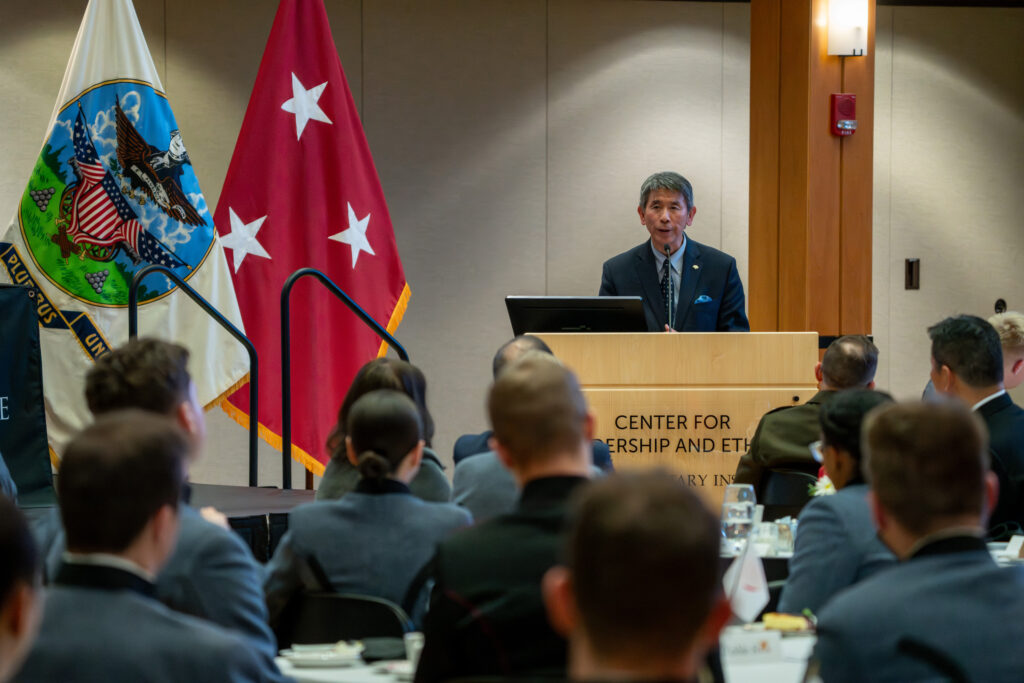
Virginia Military Institute hosted a Japan U.S. Military Program (JUMP) event which included a reception, dinner, and expert panel discussion Feb. 3 in Marshall Hall. JUMP is a partnership between Sasakawa Peace Foundation USA (Sasakawa USA) and the Embassy of Japan, which honors U.S. military personnel and veterans for their contributions to the U.S.-Japan security alliance and engages them in high-level dialogue with U.S.-Japan alliance leaders.
Col. David Gray, executive director of VMI’s Center for Leadership and Ethics, served as master of ceremonies for the evening. Welcoming guests to the event was Lt. Col. Jochen Arndt, associate professor in the Department of History and deputy director of the John A. Adams ’71 Center for Military History and Strategic Analysis (Adams Center). Arndt stated the strategic analysis portion of the Adams Center ties in with the importance of the U.S.-Japan military alliance. “This event took over four months of planning, and we are very happy, proud, and honored to welcome all our guests here tonight.”
Guest speakers included retired U.S. Marine Corps Lt. Gen. Larry Nicholson, former commanding general of III Marine Expeditionary Force in Japan who now serves as a distinguished senior fellow for Sasakawa USA and sits on boards of several veteran-related nonprofits; retired Japan Maritime Self-Defense Force (JMSDF) Adm. Ryo Sakai, a former surface warfare officer and JMSDF chief of staff; and Japan Ground Self-Defense Force Col. Satoshi Masaka, a career infantry officer who currently serves as military attaché for the Embassy of Japan in Washington, D.C. Dr. Satohiro Akimoto, director of JUMP and president and chairman of Sasakawa USA, served as moderator.
Topics of discussion included the strong alliance between Japan and the United States and the hard work involved to build trust after WWII; other partners and ally countries in the Pacific like Australia, The Philippines, and South Korea; the security and safety of Japan; emerging security threats in the Indo-Pacific; long-term sustainable deployment in the Indo-Pacific; the safety and security of Taiwan; artificial intelligence; undersea military operations; what the future holds for VMI cadets; and the importance of building strong and mutually beneficial relationships with peers from different nations.
Adm. Ryo Sakai shares his career experiences at the JUMP event in Marshall Hall.—VMI Photo by H. Lockwood McLaughlin.
Past JUMP events have been held at the U.S. Military Academy at West Point, the U.S. Air Force Academy, Camp Lejeune, Camp Pendleton, the Marine Corps University, and Naval Station Norfolk, but this is the first time the event has been held at VMI. Over 50 cadets attended the dinner and panel discussion including J. Paul Sporleder ’27, the cadet in charge of the Adams Center, a history major with a military history concentration, who plans to commission in the U.S. Army as an infantry officer. He stated the event was a wonderful experience. “I got to spend time showing the JUMP delegation around post, discussing international affairs, and learning from their experiences and different perspectives about the situation in East Asia.
For Daniel Korniluk ’27, an international studies major who plans to commission into the U.S. Marine Corps, the event provided insight on alliance strategies.
“The perspectives from Lt. Gen. Nicholson and Col. Masaka were inspiring in how to approach real-world problems and fostering productive thinking on how relationships are utilized in times of threats from other countries.”
Additional information on JUMP may be found on their website.
Col. Jeff Kendrick, director of the Office of Global Education at Virginia Military Institute, announced the U.S. Department of State’s Benjamin A. Gilman International Scholarship is currently accepting applications. The Gilman and Gilman-McCain Scholarships are merit-based awards for American undergraduate students with high financial need who want to study or intern abroad for academic credit.
Josiah Farrell ’28 and Anderson Robles Rodriguez ’28 both benefited from the scholarships when they participated in the Taiwan Huayu BEST Program to study Mandarin Chinese at the National Chengchi University in Taipei last summer.
Farrell, who is double majoring in international studies and modern languages and cultures, shared studying abroad was a lifelong dream come true. “The funding provided by Gilman kept my parents and myself from worrying about how my summer studies would be funded, and allowed me to focus on learning Mandarin. Additionally, with the funds I had left over, I was able to completely fund my follow-on service project to hold a Chinese Moon Festival last October.”
Robles Rodriguez, a mechanical engineering major, said his summer studying Mandarin in Taiwan was one of the most meaningful experiences of his life. “Through daily immersion, I gained confidence using Mandarin in night markets, on public transportation, and while traveling independently throughout the country. Without the Gilman Scholarship, studying abroad in Taiwan would not have been an option for me, and its support allowed me to fully enjoy the experience without financial stress. I was incredibly happy during my time abroad, and it reinforced how powerful and life-changing studying in a foreign country can be.”
Gracie Harlow ’27, who is double majoring in history and English with a concentration in literature, has been awarded a Gilman Scholarship to study Spanish at Universidad de Alcalá in Madrid, Spain, this summer for four weeks.
“As a Pell Grant student, I already come from a low-income background, so I never believed that studying abroad at another university would be in the cards for me. But this scholarship is covering half of the program costs, which relieved a lot of financial stress. VMI has made this amazing opportunity possible for me, and I couldn’t be more thankful.”
Kendrick reported VMI has enjoyed a 100% success rate in applications submitted and funded over the last year, and credits it to the hard work cadets put into drafting, editing, and refining their applications.
“Having served on the national review panels for both awards, I can testify that the competition is stiff. These cadets must tell a compelling story and thoughtfully connect their study abroad plans to future career goals. Over 17,000 applications were submitted nationwide last year in the March cycle, and of those, roughly only one-fourth were funded. Last year’s October cycle had 7,700 applications and only 20% were selected. This speaks to the high quality of our outstanding cadets. Furthermore, our two cadet awardees from 2026 maxed out the award at $5,000 each, and were awarded an additional $3,000 for the study of a critical language. This is a significant contribution and makes studying abroad a reality for cadets who might not otherwise have the opportunity.”
Cadets interested in studying abroad should visit the Office of Global Education on post to learn the requirements of the Gilman and Gilman-McCain Scholarships or other available awards, or email GlobalEd@vmi.edu for more information and to start on their application.
The Society for Historians of the Early American Republic (SHEAR), an association of scholars dedicated to exploring the events and the meaning of United States history between 1776 and 1861, recently named Lt. Col. Mark Boonshoft, associate professor in the Department of History and holder of the Conrad M. Hall ’65 Chair in American Constitutional History at Virginia Military Institute, co-editor of their quarterly publication, Journal of the Early Republic (JER). Lt. Col. Mark Boonshoft, associate professor in the Department of History.
His term as co-editor will be for five years beginning at the conclusion of the July SHEAR conference in Philadelphia, Pennsylvania. Additionally, VMI will be recognized as a sponsor of JER — the first liberal arts college to serve in that capacity since the journal was first published in 1981 — and many cadets will be given the opportunity to help with the editorial work.
Originally from New York, Boonshoft attended the University at Buffalo-SUNY where he majored in history. He earned his doctorate in United States history, focusing on the era of the American Revolution and Founding, at Ohio State University.
He served as a historian at the New York Public Library (NYPL) in Manhattan where he worked on a project that digitized 50,000 pages of original manuscript sources from the late 18th century and early 19th century, wrote about history for the NYPL website, advised on exhibitions, and organized various educational programs. He also taught at Norwich University and Duquesne University and worked for a time as the executive director of the American Society for Eighteenth-Century Studies, an interdisciplinary academic organization devoted to studying the history and arts of the 18th century world.
Boonshoft’s first book, “Aristocratic Education and the Making of the American Republic” was published in 2020 by the University of North Carolina Press and was a finalist for the 2021 George Washington Book Prize. He is currently working on a book tentatively titled, “The Violent Origins of Constitutional Democracy in Revolutionary America,” using New York state as a case study.
He is also the author of two JER articles, one of which received the biennial History of Education Society Prize.
Boonshoft, who has taught at VMI since 2022, said he couldn’t be more honored and excited to serve as co-editor of the journal.
“JER has been such an important part of my professional life, at least since I was a graduate student anxiously navigating the peer-review process as a prospective author. The anonymous reviewers and the editors with whom I worked on my submissions taught me much about how to critically but supportively nurture work into publishable form. I’ve been lucky to work with JER in various capacities and look forward to navigating it through a changing historical profession and public history landscape.”
Boonshoft has served JER as contributor, book reviewer, and peer-reviewer. He was a member of the editorial board from 2021 to 2024, and currently acts as associate editor for critical engagements.
What truly defines Virginia Military Institute are the people. Cadets, faculty, and staff, both past and present, are what make it “No Ordinary College.” I Am VMI will showcase the outstanding individuals who have accepted the challenges and embraced the spirit of VMI. Their perspectives provide authentic insights into life at the Institute and the value of this unique military college.
I Am VMI: Devin Auzenne ’26
Name: Devin Auzenne
VMI Class: 2026
Major(s) (and minor if applicable): History, with a concentration in military history
Hometown: Opelousas, Louisiana
NCAA and/or Club Sports: Boxing (4th and 3rd Class years), aviation club (2nd Class year), and Jiu-Jitsu club
Post-Graduation Plans: Commission, U.S. Marine Corps
Other Clubs/Societies/Activities: Member of the Virginia History Society and Omicron Delta Kappa
Devin Auzenne ’26 knew the ethics and maturity needed for the U.S. Marine Corps would best be fostered in a place like Virginia Military Institute. He also knew by attending the Institute, he would be prepared to lead in the Marine Corps.
After watching a YouTube video by VMI labeled “Don’t Do Ordinary,” he instantly knew this was the college he wanted to attend.
“I chose VMI because I wanted something different. I didn’t want to do the regular college thing,” he explained.
Going into his senior year of high school, he received a Marine Corps scholarship, which solidified his decision. He said he was looking for the right avenue to make him the best when it came time to commission after graduating.
Auzenne has always had a deep appreciation for history. Thanks to an influential high school teacher, his eyes were opened to the analytical and argumentative sides of the subject, which spurred him to study it further. VMI’s deep history and historical site, along with an incredible faculty, pushed him to be a history major.
“I really love history, and I know the program that we have here is really good, especially with getting a minor in military history,” he said. “I wanted to delve deeper into that. When I go into the Marine Corps, I’ll have this knowledge of history, and with a deeper understanding of military history and it can really help me in my career.”
He says the people he’s encountered at VMI are truly exceptional.
“I also enjoy how unique each year’s challenges are. Overall, the ability to always have someone here to have your back is very special,” he explained.
The experiences at VMI have helped him gain intangible skills he believes he couldn’t have thoroughly developed in any other environment.
“Skills such as patience, time management, grit, and flexibility have allowed me to find ways to succeed in foreign environments,” he said. “My experience at VMI is adversity that is ever changing, opportunities that are once in a lifetime, bonds that can never break, and a great place to be from but not at.”
His experience at VMI has also made him more self-aware. He’s able to understand who he is when under pressure or stress, and how to balance everything while still progressing forward.
“Skills such as patience, time management, grit, and flexibility have allowed me to find ways to succeed in foreign environments. My experience at VMI is adversity that is ever changing, opportunities that are once in a lifetime, bonds that can never break, and a great place to be from but not at.”
“It’s helped me to understand how to take these experiences, try and do the best in the moment, and then reflect upon them, so that the next time something comes around, I’ll be better for it,” he stated. “It’s building this flexibility and this resilience in me that I don’t think I could have received at any other college. Being resilient and also being able to think and make decisions on the fly is something I think is invaluable in the context of the military system.”
These qualities will transfer to anything he chooses to do later in life.
“My time at VMI will translate into me being more certain of who I am as a leader and a man,” he said. “When I graduate and commission into the Marine Corps, I am certain that because of my time at VMI, I will have an advantage compared to my peers.”
Auzenne wants those outside the VMI world to know that the Institute is not just a school, but a community and a culture.
“The end result of the VMI system is forged through the rigors of the regimental, class, and honor systems, but the extraordinary people are the defining factor that sets VMI apart,” he stated. “The illustrious history of VMI cadets and alumni, and, despite the differences in the times, the common experience we all share makes me proud to say that I am a VMI cadet.”
Five Virginia Military Institute cadets, with Dr. Sherif Abdelhamid, assistant professor in the Department of Computer and Information Sciences and outreach liaison officer for VMI’s Cyber Defense Laboratory, traveled to Spartanburg, South Carolina, to present research projects at the SoCon Undergraduate Research Forum (SURF), at Wofford College Oct. 24-25.
SURF brings together students from across the Southern Conference league’s member institutions to showcase their academic excellence.
Cadets who attended include Benjamin Davis ’26, who is double majoring in applied mathematics and computer science; Jackson Pelt ’26, a mechanical engineering major; Shahryar Shah ’26, a computer science major; Gracie Harlow ’27, who is double majoring in history and English; and Jeremiah Woods ’27, a history major.
Woods said SURF was a great opportunity to share his first research experience. His project titled, “African Americans at VMI: 1851-1865,” explores the contributions of the enslaved and free Black men and women who lived and worked in connection with the Institute during the years leading up to and throughout the Civil War.
“It highlights their lives, labor, and legacies, while reflecting on how their presence shaped the foundation of VMI and how their stories can be more fully recognized today,” he explained.
In her project titled, “Commemorating Service: Preserving Memory Through Archival Research at the American Battle Monuments Commission,” Harlow focuses on U.S. military personnel who died during the Normandy campaign in World War II, and the importance of preserving their stories. Last summer, she presented her research at the Normandy American Cemetery in France.
“I am extremely thankful to have had the opportunity to also present my research at SURF. The feedback from graders who evaluated the presentations, allowed me to move forward and broaden my views,” she said.
According to Abdelhamid, attending SURF was an invaluable experience for the cadets. “They not only showcased their research with confidence and professionalism, but also engaged deeply with peers and faculty from across the Southern Conference. SURF provided them with a meaningful platform to exchange ideas, receive constructive feedback, and see firsthand how their academic work connects to larger conversations in their disciplines.”