Post View Unavailable:
Post View is currently unavailable due to technical difficulties. More information.Last Updated: 01-08-2026 09:42 AM»
Notice:
VMI.edu has recently been updated and upgraded. Please note that some URLs may have changed. Visitors are encouraged to use the new, expanded site menu and site search to navigate through these changes.
New Website Launched»
Two professors at Virginia Military Institute are featured in “Into the Sun”, the Veterans Day episode of the public radio program, “With Good Reason,” Nov. 8 through 15.
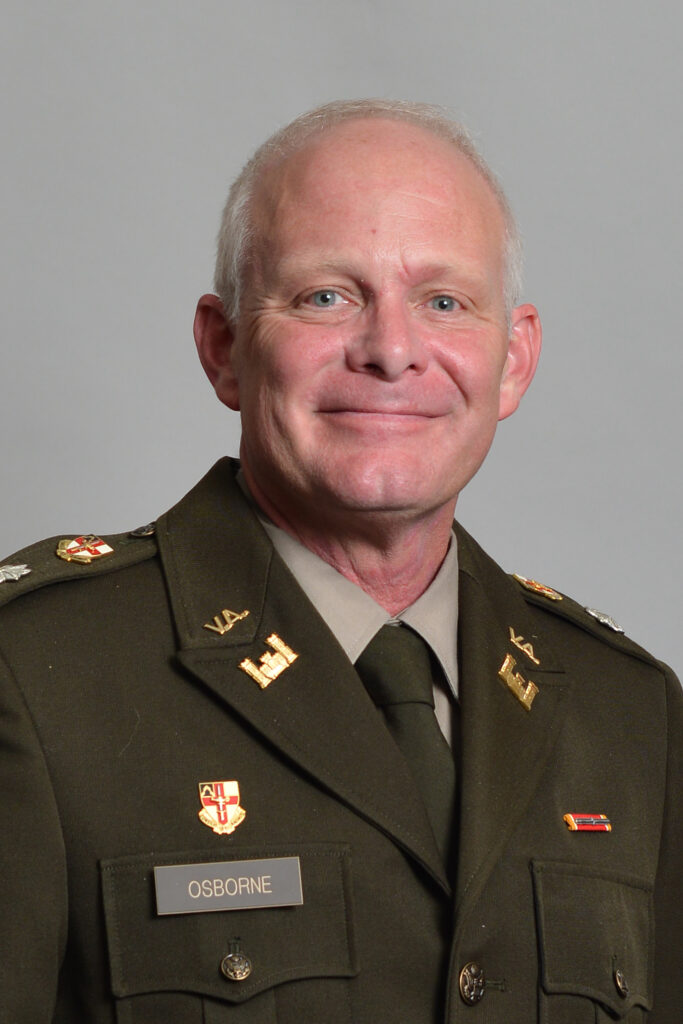
The show airs on 136 radio stations in 36 states. Lt. Col. Eric Osborne, associate professor in the Department of History, discusses the 1918 Battle of Megiddo, which was the world’s last great cavalry charge and a decisive British victory. He says the victory led to the collapse of the Ottoman Empire and paved the way for the future state of Israel in Palestinian territories. Osborne is the author of “The Battle of Megiddo: Palestine 1918.”
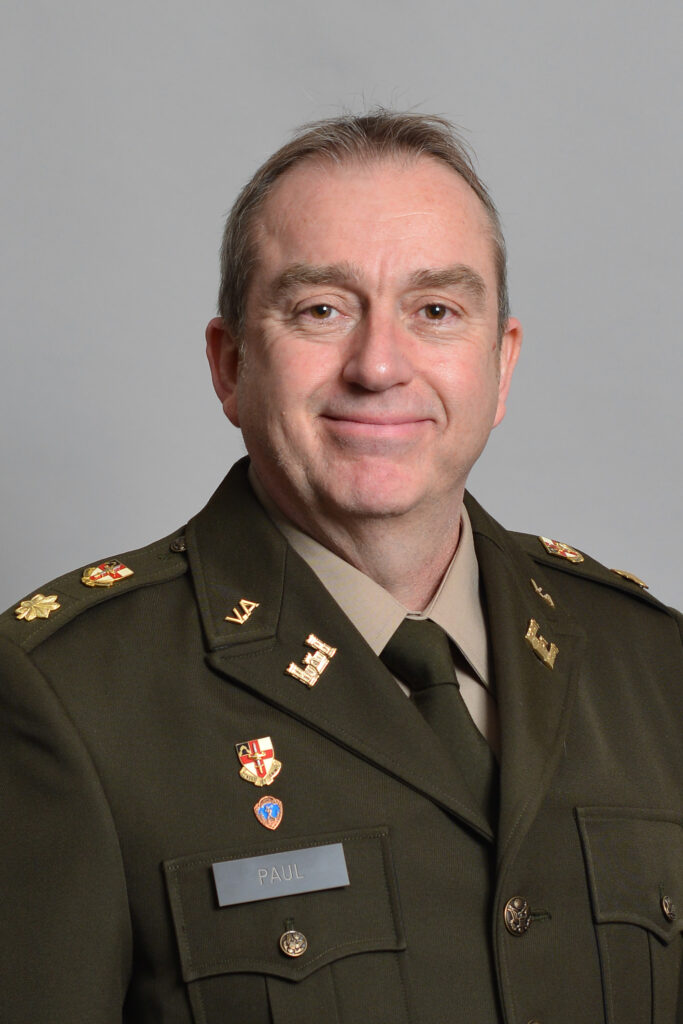
Maj. Alex Paul, assistant professor in the Department of History, shares how his forthcoming book, “Unwilling Doughboys: The U.S. Army’s Foreign-Born Conscripts in World War I,” shatters the myth that during WWI, most immigrants in the United States submissively complied with the conscription practices of many local draft boards. “With Good Reason” is sponsored by the Virginia Foundation for the Humanities. Local broadcast times, as well as audio files of full programs and companion news features, are on the “With Good Reason” website.
Patrick Kiernan ’25 started exploring different civil rights cases at the Supreme Court level during a class in high school. He found it interesting to see how different cases were and how civil rights progressed.
Jumping forward to his time at Virginia Military Institute, he started exploring more education-based civil rights cases. His interest then formed into a plan for this honors thesis, “The Courts and Educational Equality: The History of the Court’s Role in Desegregation, Integration, and Equality in American Public Schools,” which he presented during VMI Honors Week.
His thesis was centered on the enforcement of desegregation post-Brown v. Board of Education, focusing on the 1960s and 1970s. Divided into five key Supreme Court cases, Kiernan explored the complexities of desegregation, focusing on: Griffin v. Prince Edward County, Swann v. Charlotte-Mecklenburg, Milliken v. Bradley, San Antonio v. Rodriguez, and Regents of the University of California v. Bakke.
“Overall, I was trying to look at the challenges of desegregating,” he explained. “The way it’s taught in schools is that it was almost overnight. There was more going in, it was a lot more complicated. I was looking at what made it so complicated and what made it difficult to desegregate and all the other problems that kind of came with it.”
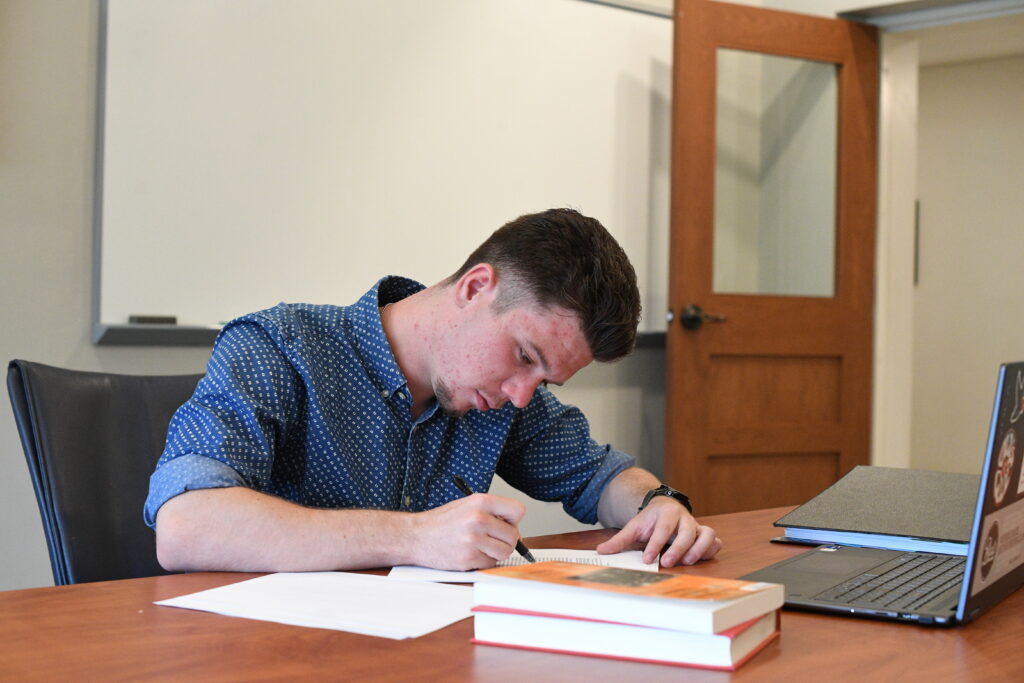
Kiernan dedicated between three to seven hours a week to reading, research, and writing in order to tackle a 70-page paper.
“I think it’s helped me develop my writing skills a bit more, because I’ve been able to write that long and able to make it more of a coherent thing,” he said. “Because, even with some of my other classes where it’s like a five- paragraph essay, it’s easy to keep it coherent when it’s that short. But when you’re trying to navigate something that’s almost the size of a small book, it takes a lot more thought and care to be able to put that all together.”
Lt. Col. Mark Boonshoft, associate professor in the Department of History, was Kiernan’s academic advisor for his thesis. The history department requires a longer thesis and additional preparatory semester of work during a cadet’s 2nd Class year, Boonshoft explained.
Boonshoft started working with Kiernan last spring with an independent study, where Kiernan studied school desegregation as it relates to courts specifically. Through that, the two refined Kiernan’s topic to identify primary sources, settle on research methods, and discuss writing.
“Compared with other disciplines, history requires a lot of independence in research for undergraduates,” Boonshoft said. “Cadet Kiernan’s project is on a subject I know a lot about from teaching it for years, but it is not something on which I have done independent research. I am not reading the hundreds of pages of primary sources from Supreme Court justices’ private papers that Cadet Kiernan is. I can keep tabs on his work, look at his notes, review drafts frequently, discuss the research weekly, but this is not collaborative research. Cadet Kiernan deserves the credit for having produced 70 -pages of carefully researched, well-sourced, original work.”
Kiernan said that the process of research and writing his thesis sparked new ambitions for him. He previously had an interest in law school, but this experience has prompted him to shift to potentially graduate school. Although Kiernan will be commissioning into the U.S. Army after graduating in May, he said the future prospect of grad school has become more alluring.
As part of the Institute Honors program, the history major said it’s allowed him to explore other concentrations and widen his academic discoveries. He said it’s made him more intellectually curious.
“If you really want to learn more about the world in general, I think Institute Honors has helped,” Kiernan admitted. “I’ve been able to learn a lot, even if it wasn’t necessarily something in my discipline.”
Boonshoft said that Kiernan’s research will help him when he commissions into the Army. He said that constitutional history has become an area of focus at VMI to help train its citizen-soldiers.
“Research like this brings important constitutional issues to cadets’ attention. It’s research that also bears on VMI’s own story of racial integration in the 1960s, of affirmative action, and so forth,” Boonshoft said. “I think this research shows his commitment to the citizenship side of the citizen-soldier ideal. More concretely, it has given him a chance to hone important skills of analysis, of writing, and most importantly of formulating clear questions and strategizing ways to answer them. He has also had to synthesize huge amounts of information into a coherent narrative. That skill of separating what is important and what’s just noise will serve him well in the military and beyond.”
The Vanguard series highlights cadets of Virginia Military Institute who exemplify promise, perseverance, and the true spirit of leadership. While they may not be the top-ranking students or those in prestigious positions, these individuals’ dedication, resilience, and growth embody the essence of being a VMI cadet. By sharing their stories, including the challenges they’ve faced and overcome, we shine a spotlight on the diverse paths to success at the Institute, proving that leadership and excellence come in many forms.
Helping others is Alexis Gonzalez’ ’25 backbone. Anything she can do to help others,; she’s immediately on board. She plans on pursuing emergency management after graduating and going to paramedic school.
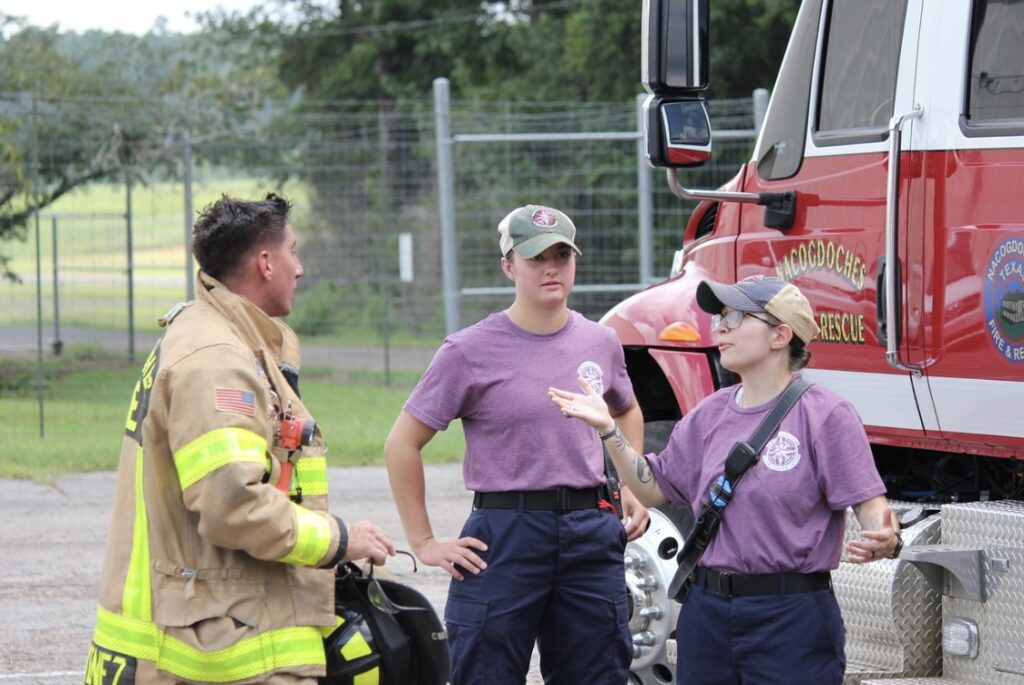
“I do it for the people,” she said about being an emergency medical technician (EMT). “I have to be the calm in the storm. I have to do my job, but it’s a Catch-22 because every time you do your job, somebody is having the worst day of their life. Being that calm in the storm for that person is a feeling that I can’t even describe. I’ve seen some incredible things and some horrific things. I’m happy to say, I don’t regret it one bit. It just gives me the opportunity to guide others getting into the field.”
The history major accidentally stumbled upon Virginia Military Institute. She admitted while searching for the University of Valley Forge, she ended up misspelling it and VMI popped up instead. It turned out to be the best mistake she’s made.
“VMI was the only school I got in early decision, and I haven’t looked back since,” Gonzalezs said. “My desire was to get out of Texas, so I was trying to go as far away as I could, and VMI was willing to give me an academic scholarship.”
She found the right fit in history. She loves learning about strategy, business history, military history, and constitutional history — which VMI has in spades. Her academics didn’t come without struggle, though.
“I’m not an academic weapon,” she admitted. “I’m a very physical, practice, tactile person, like if I can touch it, good to go. Books … can’t read. I’m highly dyslexic, the words jumble. Learning how to in college was fun.”
Her trick? Reading key parts of materials and gathering the overall sense of what is being studied.
“I worked really, really hard. My academic advisor, I give him a lot of credit, because he taught me how to read a book, because you don’t necessarily need to read all of it. You just need to read the key parts of it — the intro, the conclusion. That’s what I kind of focus on. If I need to read a chapter, I’ll skim it, and my brain will go from there.”
Screenshot
She credits a class she took early on at VMI called Intro to Methods in helping her create her own system of learning.
“It teaches you how to be a historian and read all those things you need to read and pick out the pieces that you actually need to focus on,” she explained. “That class kind of helped me solidify the rest of my academic career, because I literally transferred what I learned there and just put it to every other class and it worked. I worked really hard at it, and it didn’t click until my 2nd Class year. My GPA started going up. Last semester, I had 3.4. I’ve never had a 3.4.”
Maj. Christopher Blunda, assistant professor in the Department of History and Gonzalez’ academic advisor, described her as a hardworking student and someone he could always count on coming prepared to class and willing to share her perspectives.
“Her participation promoted an environment that was conducive to learning and was therefore quite beneficial to her fellow students,” he explained. “Her accomplishments in the classroom are, in my view, quite impressive given the extent of her numerous obligations and responsibilities.”
She says she’s decent cadet who is active as a lieutenant for VMI’s cadet EMT and the president of the Cadet Equity Association (CEA). She said she likes being part of the community and participating.
Apart from figuring out her learning style, Gonzalez said her writing has improved during her time at VMI. She credits the Writing Center for it. The biggest growth has been her confidence.
“I want to say I’ve grown quite a bit just in my confidence level,” she said. “I’ve grown together with my brother rats. Just learning your place in the system, growing, and becoming a part of the team.”
Blunda said he and his colleagues view her with great respect.
“In my view, she is among the most promising 1st Class cadets because of her attention to detail, ability to present well, and commitment to teamwork and service,” he said. “The qualities mentioned above make her stand out. There are a great number of good cadets at VMI, I consider Cadet Gonzalez among the best. She learns from her experiences and is able to apply that knowledge effectively. She is not the sort of person who ever needs to be told anything twice. Hers is a consistent pattern of improvement. My colleagues in history will certainly miss her after she graduates.”
The house of a Tibetan Catholic family was built near Cizhong, China in 1989. With a blend of Tibetan, Naxi, Bai, and Han Chinese ethnic styles, the home follows traditional layout, materials, methods, and ornamentation of houses in the region going back centuries.
In 2017, the house had to be relocated due to the construction of the Wunonglong dam. Now calling Harpers Ferry, West Virginia, home, the China Folk House is along the Appalachian Trail connecting to the Shenandoah River, echoing its previous landscape of the Himalayas and Mekong River in China. What started out as a simple teatime at the home in China, turned into having the house disassembled and shipped over to the United States.
Sitting on a 1,600-acre nature conservatory as part of the Friends Wilderness Center, the home is a cultural and educational center dedicated to environmental stewardship, cultural exchange, community engagement, and experiential education, according to its website.
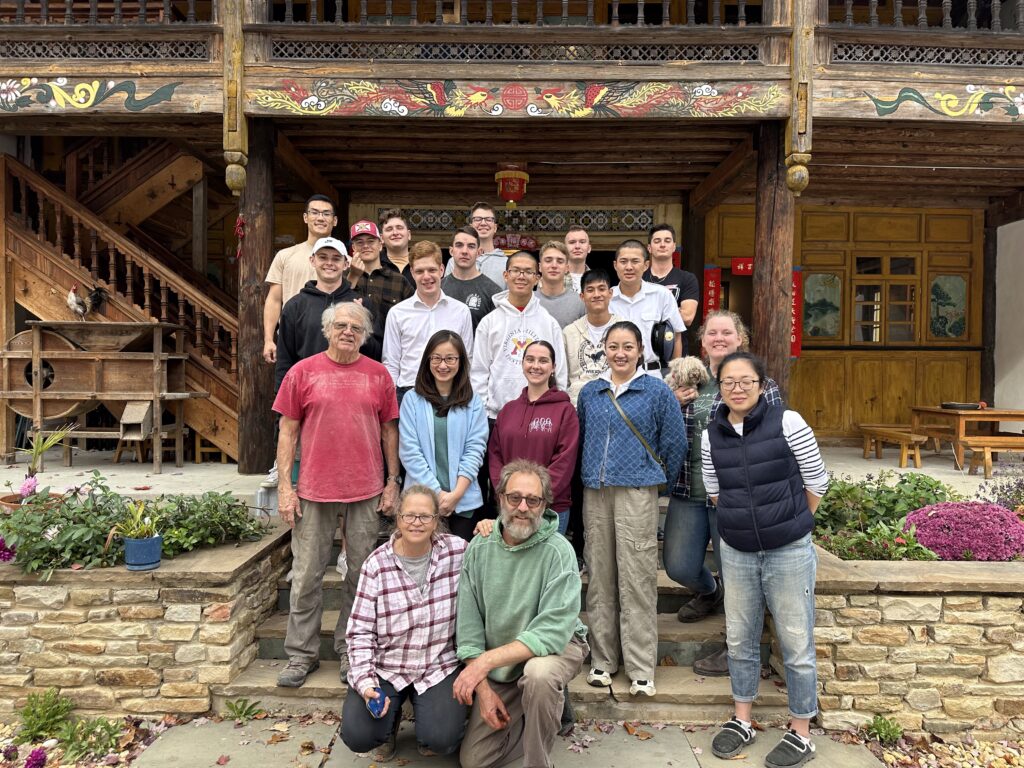
The China Folk House was the perfect place for 15 Virginia Military Institute cadets from Chinese Civilization, Introduction to Advanced Chinese, and Cultural History of Chinese Martial Arts classes to visit.
The trip was planned and organized by the Phi Sigma Iota Honor Society, the National Collegiate Chinese Honor Society, VMI’s Department of Modern Languages and Cultures, and Department of History.
Three faculty members oversaw the visit: Dr. Laura Xie, associate professor of Chinese and faculty advisor for Phi Sigma Iota Honor Society; Dr. Lu Lu, assistant professor of Chinese and faculty advisor for the National Collegiate Chinese Honor Society, and Dr. Qiong Liu, assistant professor in the history department.
The group of professors had learned about the home from colleagues at other universities who had visited it, and the founder of the China Folk House presented it at a Chinese pedagogy workshop they had attended.
Xie said it was an enriching and one-of-a-kind experience for the cadets, allowing them to engage directly with artifacts, architecture, and lifestyles that embody the history and culture of traditional Chinese society. She said during the visit, one of the founders explained the China Folk House was reconstructed to reflect the spirit of old rural China.
“She explained that the Folk House was built in the style of traditional farming villages, where neighbors worked together, supported one another, and tackled projects as a community,” Xie explained. “This gives our students a sense of how community bonds and shared responsibilities shaped traditional Chinese lifestyles.”
Xie and others said the excursion allowed cadets to explore the Chinese culture that can’t be covered in a typical classroom setting.
“To be honest, cadets don’t often have opportunities to experience Asian cultures locally in Lexington,” Lu said. “Excursions like these allow them to immerse themselves in foreign cultures and languages, even if only briefly.”
The visit provided hands-on examples of certain themes covered in class, from traditional construction techniques to symbolism.
“The highlight of the trip was the cadets’ active involvement in the house construction process itself, and I was especially impressed by their teamwork and camaraderie, a true reflection of VMI’s spirit,” Lu said. “I believe this trip bridged the gap between classroom knowledge and real-world application and offered our cadets invaluable memories.”
Liu’s class, The Cultural History of Chinese Martial Arts, covers not only the techniques of Chinese martial arts, but also the cultural meanings within the practice.
“For example, Daoism — a philosophy deeply intertwined with Chinese martial arts — emphasizes harmony between humans and nature,” she stated. “The China Folk House beautifully embodies this principle in its design and integration with the natural surroundings. Traditional Chinese architecture, often influenced by feng shui, reflects Daoist cosmology, aligning spaces for balance and positive energy.”
By exploring the layout and architecture of the Folk House, it allowed cadets to experience the principles like harmony, balance, and simplicity, Liu explained.
“This experiential learning deepened their understanding of concepts they may have only encountered in texts, revealing how abstract ideas like yin-yang and feng shui come to life in physical spaces,” Liu commented. “The visit offered a tangible link between philosophical concepts, such as naturalness, and everyday practices, illustrating that philosophy isn’t just theoretical; it shapes practical aspects of life, from martial arts to architecture. Observing these principles in action helped the cadets appreciate how cultural philosophies influence daily experiences and lifestyle choices.”
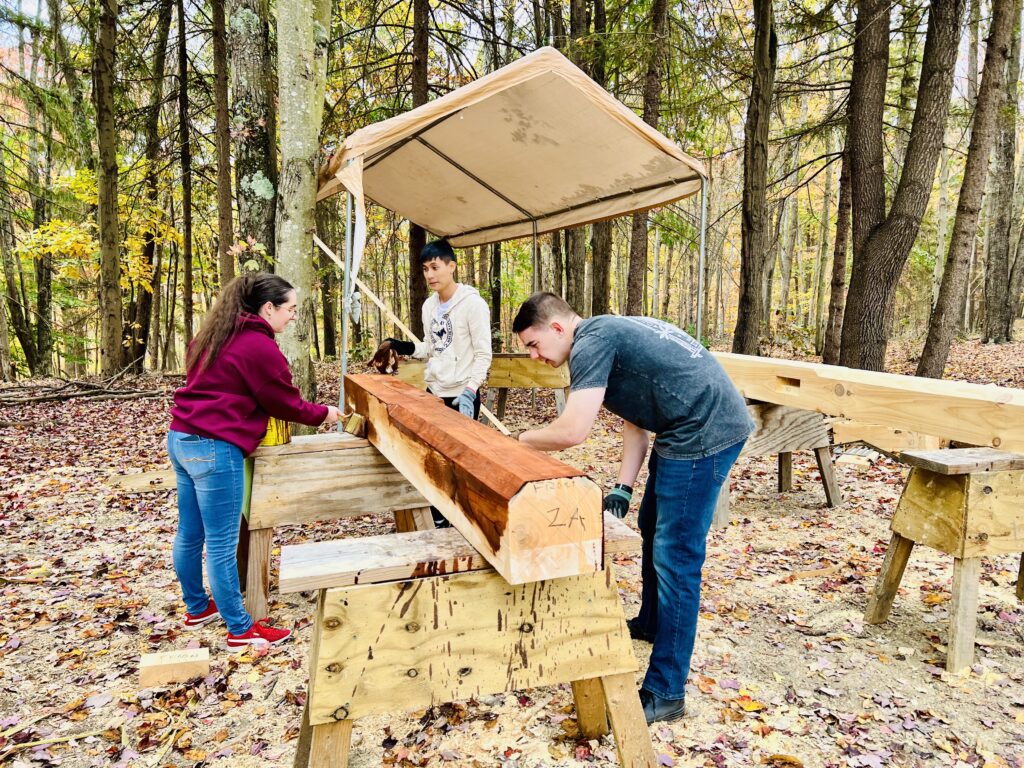
Anna Yemelianova ’25, the president of Phi Sigma Iota, found the experience meaningful because she and others were able to contribute to work at the home like staining wood, mixing concrete, and tending to gardens. It also provided a window into rural life and the transformation throughout China’s reform periods.
“Each space within the home told its own story — from the traditional kitchen that witnessed countless family gatherings to storage areas that reflected changing agricultural practices across generations,” she said. “As urbanization and modernization spread globally, preserving spaces like this becomes increasingly vital for maintaining connections to local knowledge and cultural traditions.”
The Folk House serves as a museum piece and a living bridge between past and present allowing visitors to see how rural families adapted to social and political changes, according to Yemelianova.
“Through both learning and volunteering, our group of VMI cadets became part of this ongoing story of cultural preservation, helping ensure these invaluable traditions and knowledge continue to be shared with future generations.”
Virginia Military Institute’s cadet-athletes have to juggle cadet life, heavy academic course loads, and their NCAA Division I sport. Committed to both academic and athletic pursuits, balancing their rigorous schedule in both sports and school requires a certain level of commitment and discipline. Behind the Balance is a series that focuses on those cadet-athletes and how they handle the hurdles of the day-to-day.
Community is something Patrick Kiernan ’25 values in his life. It’s one of the reasons he chose to go to Virginia Military Institute and also a big part as to why he’s on the cross country team.
He started running at a young age, thanks to a cross country camp he attended with his cousin.
“I enjoyed it, not just the sport, but the community that camp built,” he said. “I decided to do it in high school, and I really enjoyed just that sense of community I had with my teammates. I think I was a lot closer than other sports teams I had been on in middle school and elementary school.”
He continued running through high school and by his junior year, he was contacting the coach at VMI to inquire about running there. He had to track his times and give the coach updates, to show the progress he was making. Then a couple days after Matriculation Week, he was able to join the team practices.
When he first started on the team, he was averaging about 45 to 60 miles a week. Now, it’s between 60 and 80 miles.
“The longest I’ll go is 16 miles, but it depends on the day. So, some — we call them a maintenance or a recovery run — will be, for me, around eight to 10 miles,” he said. “Our harder days will usually be around 10 to 13 miles. Then usually we’ll have one really long run of about 12 to 16 consecutive miles.”
To keep occupied during the longer runs, Kiernan says he’s usually running in a group, so they’ll all talk to each other.
“When I’m on my own, my mind just kind of wanders. On a busier day, I might just be thinking about planning out my week or my day, like how I’m going to get things done,” he said. “Every once in a while, I’ll have earbuds in and listen to music. ”
Kiernan keeps a tight schedule, as do most cadets. He’s asleep by 10:30 p.m. after a full day of activities. The history major has found the busier he is, the more time he has to finish tasks. The constant movement and busyness allow him to stay focused. He participates in several clubs and serves as a S7 lieutenant, which deals with cadet life and is responsible for the general well-being and morale of the Corps of Cadets. He’s also a cadet chaplain.
“Last year was probably one of my busiest years as a cadet, where I had a bunch of different obligations. I had my rank, being on the team, I was also president of the Newman Society, vice president for Pre-Law Society. I constantly had stuff I was doing,” he said. “I think a lot of it was trying to prioritize, my sleep and not staying up super late. I found those little bits in the day and figured out how long it took me to get an assignment for class done or get something done. It was more just figuring out the little moments in the day I can use to get a little bit of work done, and then that just built up.”
Cadet-athletes at VMI not only have their responsibilities with their selected sport but cadet duties on top of that. Cadets are also required to take physical fitness classes twice a week, participate in ROTC all four years, prepare for room and uniform inspections, practice for parade, guard duty, and more.
“I think it was a lot about just me prioritizing getting work done in the day, so you have less to do at night,” he said.
He said being part of cadre has helped him establish a way to manage his time. During Cadre Week, he had to figure out what to make a priority due to multiple meetings and rank responsibilities.
“It was deciding which ones were a higher priority that I needed to be at and then which ones I could just have someone fill me in on what it was about,” he said. “I think even throughout the school year, it’s a similar thing of figuring out what needs to be done immediately and what can wait, or what I should start on early, so it doesn’t become a problem later.”
He believes VMI has built up a certain discipline in his work ethic and how he approaches problems.
“I’ve noticed that being at VMI, when they talk about discipline, it’s not doing the insane hard, workouts and stuff every day. A lot of it’s just doing those small things you don’t really want to do, like getting up early,” he said. “I think that adaptability is a big thing. There’s a lot of sudden changes, military or non-military life, where things just come up. I think it’s helped me be fairly adaptable, where I can just on the fly make an adjustment in my schedule or in my day to figure out how to get a lot of things done.”
With movements like Black Lives Matter and events of January 6, 2021, Michael “Bane” London ’25 had one question — what makes American’s gather like this to get their message across and how far back does it go?
As part of the Summer Undergraduate Research Institute (SURI) program at Virginia Military Institute, London is focusing on the ways in which a citizen or a group of citizens are trying to push a political goal, aspiration, or way of thinking on to another group. His topic, “Mob Violence in America” is being advised by Lt. Col. Mark Boonshoft, associate professor in the Department of History.
“While this may seem to be a contemporary issue, in reality “mob” violence has been used throughout American history,” London said in his preliminary SURI research. “I will trace this history through six case studies: the Stamp Act Riots in 1765, The Whiskey Rebellion which lasted from 1791 to 1794, the Philadelphia Riots of 1844, the 1863 New York City Draft Riots, the Great Railroad Strike that occurred in 1877, and the resurgence of the Klu Klux Klan in the 1920s.”
His research will analyze when and why “mob” violence is used as a political strategy in the United States.
“Two perspectives will form the basis of my analysis, social and economic,” London said of his research. “The social perspective will investigate issues such as race, culture, and religion. An economic perspective instead analyzes issues like taxation and trade regulation. Overall, I am looking to answer why and how ‘mob’ violence is used as a political strategy in the United States, and what issues have acted as a catalyst for this type of violence.”
SURI is offered by the VMI Center for Undergraduate Research (VCUR) and provides cadets with a unique opportunity to delve into high-level research that relates to their degree path. It consists of cadet-led research under the direction of a faculty advisor.
London, a history major, is spending about 30 hours a week on research for his project this summer. His hope is to apply this research to a capstone come fall.
Growing up in rural South Carolina, London wasn’t a stranger to political change. He remembers as Confederate statues were torn down and how significant that was for his community and the country.
Participating in the SURI program enables him to work on his critical thinking skills, plus tackle a larger scale research paper with no other distractions as it would be during the normal school year.
“It’s really important and it gives cadets who pursue a serious project a marketed advantage over other students,” he said.
He even surprised himself that he could take an abstract topic and dive into a well-developed thesis.
“That sounds really kind of basic, but doing this really core academic research is something I hadn’t been exposed to,” he said. “Getting that under my belt, before graduate school, before the Army I think it’s a good thing.”
As for Boonshoft, London approached him to be his advisor on the project. He wasn’t even a previous professor of his. Boonshoft taught a class in the fall of 2022 on American political violence, which covered some of what London was researching, which led London to choose him as an advisor.
“I was pretty hands-on with the proposal stage because he had this interesting idea,” Boonshoft said. “We did a lot of work to build a bibliography so that way he could hit the ground running.”
Boonshoft said the SURI program is something that is truly unique to VMI because of the way it’s structured, along with the financial support it receives.
“It effectively becomes a full-time job, which is not normal, it’s not common, and it does give you a leg up in whatever you want to do,” he said.
Overall, the program gives you some important life skills, Boonshoft said, like having a concept and actualizing it.
“Knowing how to start with a humongous idea and then figure out how to put guardrails around it so you can wrap your hands around it, that’s a transferable skill,” he said. “Cadets’ time is precious during the semesters and there are ways you can do this. This is a way to make sure that people want to do research but for various reasons it’s complicated to do during semester, can do it.”
Cadet Chris Cocoris ’23 remembers growing up listening to stories about his great-uncle George Cocoris. They were passed down to his father since his great-uncle had passed before Cocoris was born. George joined the Greek resistance to oppose the Axis occupation in 1941 Greece, Cocoris said.
For Cocoris’ senior thesis “Suppressing the Red Tide: Greek-American-British Counterinsurgency Efforts Against Greek Communist Insurgents During the Third Phase of the Greek Civil War, 1945-1949, he decided to dive into his Greek heritage.
“I selected the topic to demonstrate how the Greek government, with American and British assistance, managed to defeat one of the earliest communist insurgencies,” the 1st Class Virginia Military Institute cadet said. “In addition, I wanted to work on a topic for which I could use my fluency of the Greek language, which in this instance proved to be instrumental for the completion of my project.”
The project took nearly two years, and according to his advisor Col. David Gray, it’s more of a graduate-level thesis than an undergraduate. Gray described Cocoris as a go-getter who’s self-motivated. He was impressed with his curiosity, which led Cocoris to visit multiple archives — including some in Greece, the National Archives, the Truman Library, and the George C. Marshall Library on post — to attain research for his thesis.
“He’s got some good insights and as his young mind is developing both as a historian but perhaps more important in the near term as a future army officer, soon to be this spring, and an infantry man, he will for sure engage in some of these types of operations if he stays in long enough,” Gray said. “So this gives him a great intellectual foundation and hones his own judgment in thinking about these important issues.”
Cocoris, a history major, will commission into the United States Army as an active-duty Infantry 2nd Lieutenant upon graduation.
The biggest piece of research he collected was his great-uncle’s journal, something he wasn’t aware his family even possessed.
“The resistance group he joined was ELAS, which during WWII, had kept its communist character hidden,” Cocoris said. “I was lucky to be given his journal ‘Why we Became Guerrillas of ELAS’ by my father,which unveiled the fact that upon the liberation of Greece, George Cocoris’ partisan group opposed the rule of the Greek government, which is the focus of my study.”
His thesis was presented March 22 for VMI’s Honor Week. The Greek Civil War is one of the few successful counterinsurgencies in an era of defeats, he said. His great-uncle’s journal proved to give great insight into a firsthand account. Captured and imprisoned by the Greek National Army in 1946, George Cocoris was eventually released in 1947.
“Military historians tend to focus on leading personalities in warfare, such as general officers and political leaders. While primarily focusing on WWII rather than the Greek Civil War, George Cocoris’ journal allowed me to observe the average insurgent’s opinions and way of life during the civil strife in Greece,” Cocoris said. “His journal reflects his reactions to the Greek government’s counterinsurgency efforts and the insurgent rhetoric’s shift from national liberation towards communism.”
His thesis required lots of work and dedication — it was a three semester process to complete a 50-page report that went through a myriad of edits and refinements.
“I truly immersed myself in the study of the Greek Civil War, researching archival sources from several countries, and exploring my family’s past during the civil strife in Greece,” he said.
Gray gave Cocoris a series of 10 books to start out with the second semester of his 2nd Class year, in order to provide him with some background reading and perspective and context on the period of study.
“That gave him some clues as to where to start,” Gray said.
Research carried on over through the summer into the 1st Class year, where Cocoris began producing a thesis. After their first semester they must produce a draft of their thesis and give an oral defense, Gray said. His final semester was spent refining his research and reviewing edits from Gray after each draft of his thesis.