Post View Unavailable:
Post View is currently unavailable due to technical difficulties. More information.Last Updated: 01-08-2026 09:42 AM»
Notice:
VMI.edu has recently been updated and upgraded. Please note that some URLs may have changed. Visitors are encouraged to use the new, expanded site menu and site search to navigate through these changes.
New Website Launched»
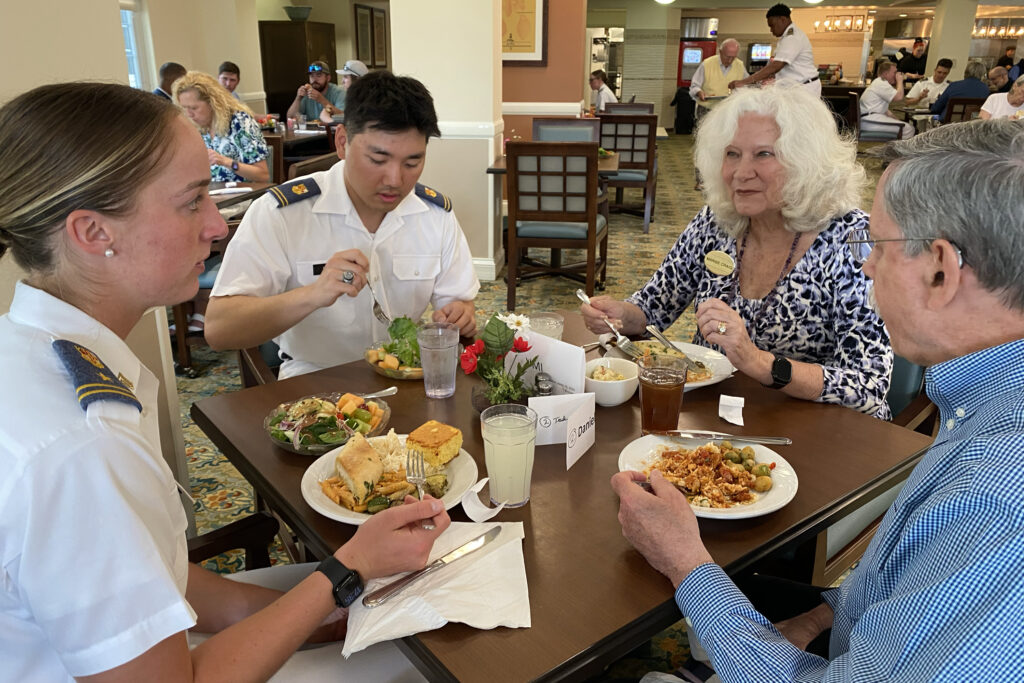
Col. Sara Whipple, professor in the Department of Psychology at Virginia Military Institute, recently accompanied cadets in her Developmental Psychology course to Kendal at Lexington, a retirement community, to interview older adults and complete a paper about the experience. This is the second year Whipple has collaborated with Kendal on the project.
Whipple explained, “The primary purpose of this project was to provide opportunities for these 12 cadets, all majoring in psychology, to put into practice what they have learned in class regarding qualitative research techniques, specifically interviews, while simultaneously applying theories of older adulthood.” Over the course of two lab periods, pairs of cadets interviewed Kendal residents using a set of questions addressing significant personal events and accomplishments, cultural changes, historical events, and problems around the world.
“The questions I prepared were intended to provide structure and standardization to the interviews. However, with the goal of having meaningful conversation and to get to know each other, both cadets and Kendal residents were free to ‘go off script’ and ask follow-up questions or curiosities of their own,” said Whipple.
Cameron Jones ’27 and Daniel Moon ’27 enjoy chatting over lunch with Kendal residents, Marise Craig and Paul Cormier. –Photo courtesy of Dianne Herrick.
Dianne Herrick, a Kendal board member and resident of 13 years, helped recruit the adult volunteers for the project. Herrick, like Whipple, strongly believes in the value of intergenerational communication and face-to-face dialogue. “Sitting down for a few hours chatting with cadets has been very popular among Kendal residents. It was a good contemplative exercise for both seniors reflecting on their lives, and cadets looking forward to the start of their careers.”
Cameron Jones ’27 said it was an honor and privilege to speak to the Kendal residents.
“I found each conversation incredibly meaningful. I think this is something that all VMI cadets would enjoy and benefit from. I would like to go back to Kendal, even on my own, prior to graduation next spring. I felt the residents enjoyed our visits as much as we did.”
Olivia Hurd ’27 is thankful she was involved with the project.
“Getting the opportunity to dive deep into what has shaped a person’s life is something I will never forget. The residents were kind and caring, and were happy to talk with us about their lives. In addition to conversation, they also gave advice and perspectives on things I never thought about before.”
With all the positive feedback Whipple received from cadets and residents, she plans to continue the project during the next academic year.
Jack Rogers ’26, a psychology major at Virginia Military Institute, will be taking his interests developed through his major with him as he heads to Mercer University School of Law after graduation. There are a number of elements related to mind and behavior that can come into play in the legal realm, including the practice and effects of solitary confinement, leading to Rogers’ senior thesis, “Is Solitary Confinement Cruel and Unusual Punishment?” which he presented April 3 as part of VMI Honors Week.
He worked closely with his advisor, Col. Glenn Sullivan, professor in the Department of Psychology, on his research. Analyzing articles and legal cases, he learned a lot about what solitary confinement looks like and how it can greatly impact one’s well-being, especially those already facing serious mental illness.
In defining solitary confinement, he reminded his audience not only of the small space, often the size of a parking space with no social interaction, but also of the unnatural light that could remain on for up to 24 hours a day, which can greatly impact sleep and sanity. Originally designed in the late 18th century to be humane and provoke reflection and repentance, Rogers’ research shows the practice of solitary confinement today often lacks oversight and pushes the legal boundaries of medical neglect. One key detail Rogers noted was that prisoners are not normally told the length of time they’d be placed in solitary confinement, basically another “version of torture,” he explained.
Many countries and groups have focused on solitary confinement reform, aiming to lessen the cruelty inflicted on inmates. While countries like Norway, Germany, and Turkey have taken strides in this, the United States is behind. Countless bills have been proposed, but rarely move forward. One such bill stated that the prison system has lost its vision to reform an individual. While Rogers acknowledges that some in decision-making positions identify solitary confinement as something that needs to be reviewed, he believes many of those decision makers only focus on issues that impact them.
While Rogers determines he’s not against solitary confinement as a practice, he does conclude in this thesis that prolonged solitary confinement of those with serious mental illness is cruel and unusual punishment.
“Jack Rogers’ thesis sits right at the fault line between psychology and the Constitution. He shows that what prisons call ‘management’ often exacerbates the symptoms of serious mental illness,” shared Sullivan. “What’s especially impressive is that he doesn’t just summarize the law—he anticipates it. His analysis of past Supreme Court cases suggests that the Court is slowly moving toward recognizing prolonged and indefinite solitary confinement of the seriously mentally ill as incompatible with the Eighth Amendment. He makes a compelling case that solitary confinement has become a kind of shadow on the mental health system—one that isolates rather than treats—and that the legal framework is struggling to catch up with what psychologists have known for decades.”
Rogers, an NCAA lacrosse player, came to VMI from Suwanee, Georgia, after graduating from North Gwinnett High School. His parents, John and Rebecca, attended his presentation and note that he has thrived in the VMI environment. Once Rogers completes law school, he hopes to go into the U.S. Army JAG Corps.
The Vanguard series highlights cadets of Virginia Military Institute who exemplify promise, perseverance, and the true spirit of leadership. While they may not be the top-ranking students or those in prestigious positions, these individuals’ dedication, resilience, and growth embody the essence of being a VMI cadet. By sharing their stories, including the challenges they’ve faced and overcome, we shine a spotlight on the diverse paths to success at the Institute, proving that leadership and excellence come in many forms.
From staying on friends’ couches to graduating early from Virginia Military Institute, Bianca Marlang’s ’27 path has never been a straight line. She faced adversity within her family, but persevered.
“Coming from a Filipino background, as a firstborn daughter, too, I felt trapped and not listened to. I had to make a way for myself,” she explained. “It’s a lot of pressure but in that, I pulled myself up.”
Graduating high school during COVID-19, she wasn’t on good terms with her parents. She spent much of that time bouncing back and forth to friends’ houses and exploring college options.
“I was practically homeless … I was living with whoever would take me in, friends at the time,” she admitted. “I didn’t have contact with my family for about two or three years.”
She got to VMI thanks to her uncle’s help. But she hit a wall with financial aid. Sitting outside the alumni building on the benches with her uncle, she thought there would be no way she could attend the Institute. She said with a lot of annoyance from her side, she attained enough information and assistance to figure it out.
“I wanted to come here because of the honor system and the most important point: I like the fact that the Rat Line evens everybody out. I can come from the background that I came from, and I meet people with completely opposite backgrounds,” she stated. “It’s really interesting that we’re all going through the same thing, and we’re all leveled out by this one adversity.”
Col. Sara Whipple, professor in the Department of Psychology, said she met Marlang as a prospective cadet and remembers being impressed by her even then.
“I have now had the opportunity to get to know her across multiple contexts — in class, as an advisee, and as an ambassador to the VMI Civil Discourse Initiative. Bianca takes her academic work seriously and devotes herself to a number of extracurriculars. At the same time though, she is humble and has a great sense of humor,” Whipple explained.
Coming to VMI as a 21-year-old was intimidating. She didn’t want to be known as the old cadet. Her other college experiences prior to attending the Institute included going to Old Dominion University and community college. That ended up in her favor, having several prerequisites already completed.
“It’s been ingrained in me that education is the one thing that people can’t take away from you, even at the grave. That comes with you,” she stated.
Those extra credits also have allowed her to graduate in the spring, a year ahead of schedule. From there she plans on attending Austin Peay University in Tennessee to complete her prerequisites for a Doctor of Physical Therapy (DTP) program. She hopes she can commission into the armed forces through that program.
“Bianca is the kind of student every professor hopes to see on the roster the first day of class — cheerful, curious, and unafraid to ask tough questions,” Col. Glenn Sullivan, professor in the Department of Psychology, said.
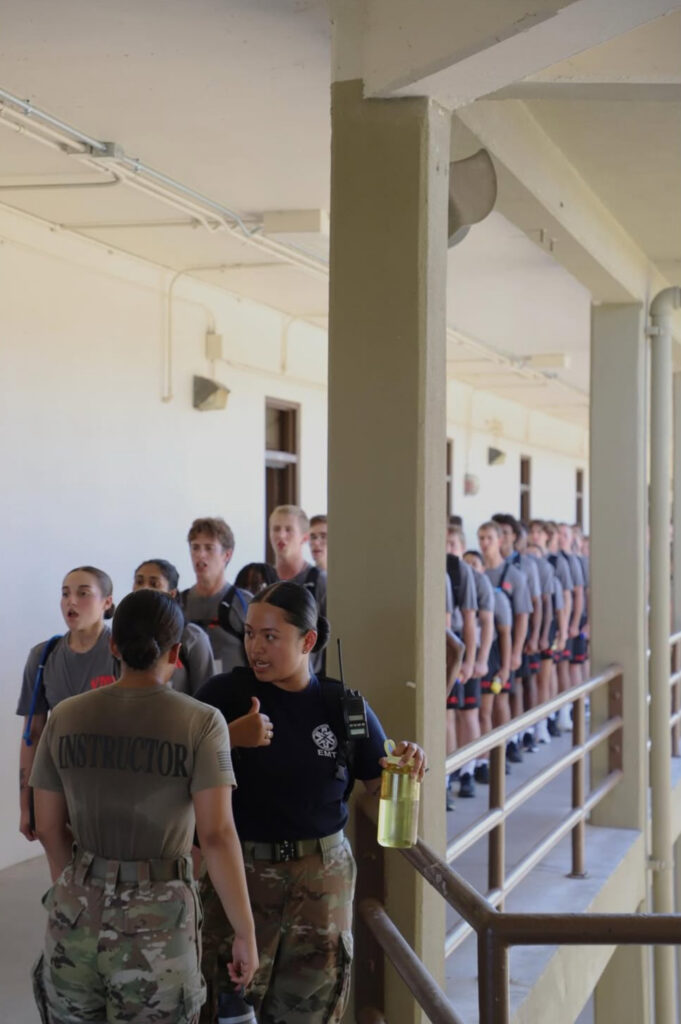
The psychology major has already taken steps towards her medical career by being a cadet emergency medical technician (EMT). She was inspired by her mother, who is a nurse, and her uncle, who is a doctor.
“I think seeing the Rat Line from behind the scenes and seeing everything from a third point of view is interesting,” she said. “As cadre, you’re too in it, because people are yelling at you; you’re yelling at people. And as a rat, it’s the same thing. But as an EMT, I kind of took a step back.”
Marlang also serves as an ambassador for Braver Angels and the VMI Civil Discourse Initiative (CDI), which holds debates teaching civil discourse.
“We try to get people to engage in these debates. I feel like people don’t want to talk or even listen, which is what we need right now,” she explained.
As a rat, Marlang said that she began as more closed off, but her time at VMI has broadened that.
“I think I’ve become more open minded because I’ve heard other people’s points of view. It’s made me stronger in my beliefs, but at the same time, it’s made me more tolerable and respectful of other people’s point of view,” she said.
Whipple could see that right away. She was particularly impressed with Marlang as a rat when she spoke at one of the CDI debates.
“Her speech was not prepared in advance but rather came out of her own interest in, and reaction to, others’ thoughts,” Whipple said. “Bianca is willing to speak her mind, but she also makes a concerted effort to listen and understand others. As such, she has been an incredible leader within the VMI CDI.”
Marlang feels the VMI system has prepared her for the future. She has noticed the changes that the Institute has instilled in her.
“It makes you fail on purpose,” she commented. “I realized that a lot of me has changed when I went home. Normally, whenever I would get criticized or yelled at, I’d have a visceral reaction. But I kind of got used to it. I think the recovery part from failures is what VMI has helped me with a lot.”
Describing her as highly inquisitive, not only academically, but on a personal level, Whipple said that Marlang is genuinely interested in others and knowing their stories.
“Whenever she drops by my office, it’s a welcome visit because I know that in one sitting, we can go from academic discussions to the completely inane,” Whipple continued. “She has had personal challenges during her time at VMI, but manages to keep her goals central during these times. I think that type of focus and commitment are major contributors to her perseverance. Last year she made up her mind that she wanted to graduate a year early, and she is doing it.”
Virginia Military Institute’s cadet-athletes have to juggle cadet life, heavy academic course loads, and their NCAA Division I sport. Committed to both academic and athletic pursuits, balancing their rigorous schedule in both sports and school requires a certain level of commitment and discipline. Behind the Balance is a series that focuses on those cadet-athletes and how they handle the hurdles of the day-to-day.
Virginia Military Institute offered a path to success, Destin Moore ’27 explained. The psychology major from Georgia wasn’t familiar with VMI at first, but after talking to several football coaches, he was inspired.
“I really fell in love with the culture they were trying to build and what the school offered,” he said. “I don’t like to fail. So, I know the challenge wasn’t something people look for … normally people take the easy route. To know that I could be amongst the few that got through this — it was desirable to me.”
Moore isn’t a stranger to a packed schedule. As a dual sport athlete, his entire year is figuring out how to balance his schedule with both football and track and field.
“I try to configure my schedule, I try to have a middle block where I can have two classes and then I’ll have a dead period after lunch so I could do any homework that I need to do, or do any homework that I’ve just received to get ahead,” he said.
This became a challenge last spring when Moore was participating in the SoCon Track and Field Championships. He went directly from football practice to track practice. For the championship, he placed second, pushing him into the finals the following day.
“I came right off the track, with my track jersey and my compression shorts, and I ran from the Corps Physical Training Facility to the football field,” he recounted. “I got done with that the football practice, went to sleep and had to wake up at 8 a.m. to run in the championship.”
Cadet-athletes at VMI not only have their responsibilities with their selected sport but cadet duties on top of that. Cadets are also required to take physical fitness classes twice a week, participate in ROTC all four years, prepare for room and uniform inspections, practice for parade, guard duty, and more.
He explained that coming to VMI and being a cadet-athlete, he had to change his mindset. He couldn’t look at the tasks he had to accomplish as something he had to do, but instead something he got to do.
“If I didn’t, I probably wouldn’t have competed like I did or did it at all. Since I wanted to do it, I had to find a way,” he said.
It’s all about prioritizing. He figures out the thing he’s least enthusiastic about and finishes that first, allowing him to do the things he wants to do. He said that’s something that will transfer to what he can accomplish later in life.
“If that’s me waking up for my job at seven in the morning, like I have done for BRC [breakfast roll call], I can get my whole schedule done, have everything planned out, do what I need to do. So, in two months, I can go on vacation or something.”
Moore plays wide receiver, point return and kick return. But he wasn’t one for paying much attention to football when he was on the field in his younger days.
“I was always one of those kids who was at practice, but wasn’t in the practices,” he stated. “I’d be crisscross applesauce on the floor, playing with the dandelion grass.”
He said that he got bored with that and started to put in more effort.
“I was always pretty fast, so I would run. And the coaches saw that one day, and they were like, let’s see what this guy can do,” Moore said. “I ended up playing and being slightly good at it.”
He started to take it more seriously in his sophomore year of high school and decided he wanted to go to college for it.
As for the stressful times at VMI, Moore leans on his friends and teammates.
“Within my friend group, we try to motivate each other and hold each other accountable, whether that be in football or in school, because being at VMI we can have the hardest workers. We need to control what we can control and be the best at it,” he explained.
The way Moore accomplishes this is by not looking at the big picture. He needs to take it piece-by-piece.
“You can’t eat a sandwich all in one bite. You have to take it bite-by-bite. Break it off. Have little sections. Complete that section. Reward yourself forward so you can do the next thing.”
This article is part of The Next Step series. While the four years at VMI are designed for cadets to push themselves academically, physically, and mentally to tackle the demands of life at a premiere military college, they also prepare cadets for life after graduation. Whether that life be one in the military or one in the private sector, VMI faculty and staff provide guidance to cadets along their journeys. One department specifically dedicated to that endeavor of post-Institute success is the Office of Career Services. In The Next Step series, we highlight cadets preparing to enter the workforce after graduation, as well as those still in the midst of their cadetship preparing for internships over the summer.
Josh Kiggans ’25 has always wanted to help others. He came to Virginia Military Institute with the mindset to join the military. However, over the years, he realized another goal.
“In high school, I told people that if I didn’t join the Navy, I would like to find a way to help people in a foreign country,” he said. “I realized that this previous goal was one that I really wanted to pursue and was motivated to follow.”
Kiggans, a psychology major from Virginia Beach, Virginia, will be part of the North American Language and Culture Assistants Program (NALCAP) through the Embassy of Spain following his graduation from the Institute.
“I applied to NALCAP because I wanted the opportunity to help others and teach, as well as travel the world and learn more about other languages and cultures. I had previously studied abroad through VMI’s summer study abroad programs to Spain,” he explained. “When the program ended, I knew that I had to find a way to get back to Spain.”
With the help from Dr. Sabrina Laroussi, associate professor of Spanish in the Department of Modern Languages and Cultures, he was able to find the right program that fit his needs.
“In the NALCAP program, I will serve as a teaching assistant in a classroom helping teach English and coming up with activities about American culture,” he said. “I currently do not know which age group I will help teach, but the ages I can teach range from 1 to 18 years old.”
Thanks to the Office of Career Services, Kiggans was able to land the job with the Embassy of Spain.
“There was an Embassy of Spain table at a career fair where I was able to get in touch with someone who worked with the NALCAP program. I was able to keep in contact with their representative, and he was very helpful throughout the application process,” he stated.
He credits Laroussi with helping him get through the process by answering any questions he had, while also developing his Spanish and connecting him with people to attain the job.
“VMI prepared me for this next step in my life with the opportunities to study abroad and develop cultural experiences in areas most people don’t go to,” he commented. “I believe that having a VMI degree on my resume has given me a competitive edge in obtaining this job, because it tells an employer that you’re hardworking without directly telling them that you’re hardworking. And with all the opportunities VMI gives you to develop your professional career outside of the military, whether it be through the career services, network of alumni, opportunities to gain leadership experience, etcetera, my degree certainly sets me apart from the crowd.”
He said another important person in his life who’s inspired him is his mother.
“When she was my age, she did a similar program in Japan and has given me advice as well as been extremely supportive the entire time,” he said. “Both of my parents have given me the opportunity to further my education and have been supportive along the way. I would not have been able to get through a place like VMI without them.”
He’s hoping in the next decade he’s able to have a career based around building a better community for people to live in. After his work with the embassy, he hopes to join the U.S. Navy and give back to the country that has given him so much.
Simon Moore ’25 was drawn to Arthur Schopenhauer’s pessimistic views and honesty about pain and suffering. He said it might be considered a taboo subject, but it intrigued him.
He presented his thesis, “Why Live?: An Analysis of Arthur Schopenhauer’s Life and Philosophy,” during Virginia Military Institute’s Honors Week. The psychology major decided to commit his time outside his department to a philosophy-focused thesis.
“There’s not really a lot of opportunity to read and learn about philosophy,” Moore admitted. “That was something that I kind of wished that I had.”
He essentially willed that and was allowed to pursue the topic of Schopenhauer’s life due to his desire to explore something more reading and writing intensive — something he hadn’t really done during his cadetship.
Moore’s thesis explored why Schopenhauer, despite his pessimistic life and work, did not commit suicide, focusing on his denial of the will through art, philosophy, compassion, and detachment. He analyzed Schopenhauer’s life, including his daily routine, his relationships, and his philosophical pursuits, to determine if he lived up to his own ideals.
The research involved extensive reading and writing, with a focus on understanding Schopenhauer as a man and the alignment of his life and work.
Moore pointed out Schopenhauer’s philosophy offers four key principles for personal resilience: art and aesthetic pleasures, philosophical thinking and reading, compassion, and detachment.
In his thesis, Moore emphasizes that these principles are always available, regardless of life’s circumstances. They provide tools for maintaining perspective and finding meaning, even during personal struggles. The core idea is to consciously choose how to respond to suffering — through art, reflection, compassion, and detachment — rather than being overwhelmed by life’s challenges.
He began his research last spring, spending about four to five hours a week on reading materials. That amped up in the fall and this spring to about eight to 10 hours a week of research. By February, he was writing his thesis in full force.
Moore said that this research opportunity allowed him to diversify himself as a student at VMI.
“That’s something that I’m really proud of doing. Nearing the end of this project, I did something that maybe a lot of other cadets aren’t necessarily willing to do,” he said. “I intend to sort of continue this philosophical interest of mine into my career after VMI.”
Moore plans to continue exploring philosophy, particularly in the context of wealth management, where understanding individual suffering and resilience is crucial.
Dr. Duncan Richter, professor in the Department of English, Rhetoric, and Humanistic Studies, was Moore’s academic advisor for his thesis. Richter met with Moore once a week to make sure he was on track, while providing feedback on what he had written and suggesting other readings.
“He is pretty self-motivated and hasn’t needed much correction, so I feel as though I have been relatively hands-off,” Richter said. “It’s my job as a professor to try to get cadets to think more and better, and this project has certainly got Cadet Moore thinking very carefully about the nature of reality and the meaning of life. If he can share some of his enthusiasm for philosophy and some of the insights he has gained, then that’s good for everyone here.
“I hope he has enjoyed doing it, but, above all, I think he has really been thinking critically about important questions. That can only be good for his intellectual development,” Richter added.
Adam Hoffman ’24 was sparked by the strategic enrollment initiatives of Virginia Military Institute, and his instinct to help led him to his honors research topic.
As an honors student, he’s required to research a topic, so when he started thinking about enrollment numbers and recruitment efforts at VMI, he knew he found something he was interested in.
“I found out answers to three questions — how cadets found out about VMI, why they decided to come and how they’re doing once they got here,” he said.
He was surprised by his findings, especially regarding how prospective cadets found out about the Institute.
“The most common way people are finding out about VMI is through their parents, which is surprising. Alumni and current cadets played a smaller role than I thought they would,” he said.
As part of VMI’s Honors Week, Hoffman presented his thesis “Virginia Military Institute Recruiting: How Cadets found their Way Here.”
He started his research last spring. He averaged about three hours a week on research, which spanned from learning how VMI recruits, sending out surveys to cadets, and talking with administration. From his research he said he’s gained a better understanding of statistics and clarity on the issue at hand. His goal now is to focus on a messaging plan moving forward to present to administration.
“For big things to change, we need to fix things between the Corps, the administration, and the alumni. I think it’s a great opportunity right now, since we’re getting a new commandant next year, having a working group of cadets involved,” he said. “It would be a good thing to change the perception of what’s going on here.”
He saw that VMI had a hard recruiting season for the Class of 2026. His research was aimed to look at the effectiveness of past resources in recruiting, specifically by studying cadets of the past four years. His thesis also touched on how cadets who were recruited prior to COVID-19 compared to post-COVID Rat Mass of 2027.
“With this and many other variables, I will seek to find the highest yield strategy for prospective cadets,” his thesis stated. “I will also look to find the cadets who are high achieving and are doing well at VMI and see how they were attracted specifically.”
Col. Sara Whipple, assistant professor of psychology, was Hoffman’s advisor for the research. The two met weekly to make sure everything was on track. When they first met, it was mostly about fleshing out the specific research questions for Hoffman’s project.
“Though Adam already had his own ideas, we worked together to meld his college recruitment interests with psychological concepts,” Whipple said.
The largest step was crafting his Institutional Review Board application, which Whipple said is required any time there’s human participants in research.
Whipple said she was both hands-on and hands-off with Hoffman’s project. She also recognized his passion for understanding effective recruiting methods. She said this experience has allowed Hoffman to connect his interest in VMI recruitment efforts with the skills he’s learned as a psychology major, specifically: ethics training, reading and critiquing empirical papers, designing study methodology, analyzing data, and ultimately writing and presenting a research paper.
“Adam’s research has implications for VMI recruiting, which was his main motivation for completing this particular project,” Whipple said. “Adam’s research examines the most common ways cadets first learned about VMI, their main motivation for attending, and their levels of well-being once at the Institute. Among other things, he finds a connection between family as a motivator and well-being. That said, although his sample is a reasonable size (300 cadets), further research using a fully representative sample is needed before we can be confident in the replicability of these findings.”
Whipple said that Hoffman was highly motivated for this topic. Despite some roadblocks concerning writer’s block and statistics, Hoffman persisted.
“Adam expresses confidence when he talks about his research methodology and results. He knows he can go from conceiving of an idea/question to getting the answer,” she said.
Advertisers have long known that a celebrity’s endorsement of a product can increase sales, but does that marketing strategy hold true for a health care campaign, more specifically a mental health campaign? That is what Delilah Martindale ’25, a Virginia Military Institute cadet, researched for her honors thesis, “Preventing Suicide: The Effect of Visibility on Mental Health Infrastructure.”
Martindale chose the subject of suicide prevention in order to merge her major in international studies with her minor in psychology. Martindale’s advisor, Vera Heuer, Ph.D., professor in the Department of International Studies and Political Science, whose area of expertise is social movements, encouraged her to take a look at mental health care.
“Essentially, we embraced this political sociological approach and came up with a project where she examined the degree with which the visibility of an organization in trying to raise awareness for suicide prevention actually impacts tangible outcomes. It’s truly in the spirit of the Institute honors program by merging various disciplines, and she did quite a wonderful job with that,” Heuer said.
Martindale’s research question asks, “What effect does visibility have on mental health infrastructure?” She defined mental health infrastructure (MHI) as the physical and organizational structures, facilities, and systems that collectively support the delivery of mental health care services. She hypothesized that the more visibility a campaign can create, the higher the rate of increasing MHI, and if a campaign can obtain a celebrity endorsement, it will enhance its visibility and therefore positively impact MHI.
“There is a psychological phenomenon where repeated exposure to a stimulus leads to an increased liking or preference for that stimulus. So essentially, familiarity breeds liking. The more familiar you are with something, the more likely you are to like it or have it in the forefront of your brain when you’re making decisions,” explained Martindale.
She tested her hypothesis by examining five case studies: The Trevor Project, a leading suicide prevention/crisis intervention nonprofit for young people ages 13 to 24 of the LGBTQ+ community; The Jed Foundation, an organization established by a couple following the suicide of their son; Active Minds, a program launched by the sister of a man who committed suicide; Hope for the Day, a prominent nonprofit movement in Chicago that influences proactive suicide prevention and mental health education; and Project Semicolon, an organization founded by a woman whose father took his own life, and in which Selena Gomez, a very prominent A-list celebrity is involved as executive producer.
Martindale assigned each case study a score based on their facilities, services, resources, education, and patient interaction compared to their social media presence, celebrity endorsement, news coverage, advertising and published literature.
She concluded that the first part of her hypothesis, “The more visibility a campaign can create, the higher the rate of increasing MHI,” is correct most of the time. “Clearly it was correct, four out of five times that I did the different case studies.”
The second part of the hypothesis, “If a campaign can obtain a celebrity endorsement, it will enhance its visibility and therefore positively impact MHI,” was inconclusive. “It seems to be more about what type of celebrity involvement there is, how actively engaged they were, what kind of endorsements they were doing, rather than general celebrity involvement,” she clarified.
Martindale is from San Bruno, California, where she attended Capuchino High School. She is the daughter of Mary Lefevre and Dave Martindale. In addition to minoring in psychology, she also minors in Spanish and leadership studies. After graduation, she plans to commission into the U.S. Army.
Virginia Military Institute’s cadet-athletes have to juggle cadet life, heavy academic course loads, and their NCAA Division I sport. Committed to both academic and athletic pursuits, balancing their rigorous schedule in both sports and school requires a certain level of commitment and discipline. Behind the Balance is a series that focuses on those cadet-athletes and how they handle the hurdles of the day-to-day.
Adrenaline and nerves flow through Eleyah Armstong ’25 before she starts a race. As a captain and sprinter on Virginia Military Institute’s track and field team, the anxiety dissipates quickly as she runs. The downside to sprinting is that it’s over faster than it began. Then, she has to start all over.
“Even though I’ve been running for so long, still, to this day, I get performance anxiety,” she admitted. “I try to calm myself. And the two words that I repeat to center my mind, to calm down, is ‘inner peace,’ because I meditate before I get into competition mode.”She doesn’t put a lot of emphasis on her anxiety, instead she puts a lot of her faith in God.
“I also talk to God, and I just put it in his hands, because I know he’s got me through it before, he’ll get me through it again,” Armstrong explained. “The path that he has me walking, I know there’s success at the end, and I’m going to accomplish the goals that I have for myself.”
She’s been running track for over 14 years. She said her parents put her in track after she raced a girl during her brother’s football practice when she was 7 years old. The girl she raced, who was just a year older, was known to be one of the fastest in the area and ran with a higher age group.
“My dad decided to put me in it,” she said. “I like to compete a lot, and I like the adrenaline that comes behind it. I just stuck with it.”
The psychology major is in her last year at VMI and plans on commissioning into the U.S. Army in May.
Cadet-athletes at VMI not only have their responsibilities with their selected sport but cadet duties on top of that. Cadets are also required to take physical fitness classes twice a week, participate in ROTC all four years, prepare for room and uniform inspections, practice for parade, guard duty, and more.
2022 SoCon Track and Field Championships
In her previous three years, Armstrong would have to get up early and split her day between practice, classes, and then practice again.
“You have to shift your focus a lot. You have to start with this, and then go back into this, and then you have to get back into the rhythm,” she explained.
Now, she’s able to have devoted afternoon practices, which leaves her mornings more open for studying and other obligations. Her role as captain has also allowed her to discover her own leadership style. She spent last year with a captain role under a 1st Class cadet, which gave her the opportunity to be able to shadow and learn. Last year, she qualified for the NCAA East Regional first round of the 2024 NCAA Track and Field Championships, making her the first women’s qualifier from VMI since 2011.
“I already had a good communication system with the coaches, because I just like to make sure my team is on the same page. I like to have harmony,” Armstrong stated.
Track served as an outlet of stress relief for Armstrong. Overall, VMI has also helped build her as a person.
“I think VMI has prepared me for the future, as far as working with different people from different backgrounds and creating bonds with different people from different backgrounds,” she said. “You never know who people really are, or where they come from, until you get to know them and work with those people, whether that’s in the classroom or in the ROTC department or your teammate.”
Virginia Military Institute’s cadet-athletes have to juggle cadet life, heavy academic course loads, and their NCAA Division I sport. Committed to both academic and athletic pursuits, balancing their rigorous schedule in both sports and school requires a certain level of commitment and discipline. Behind the Balance is a series that focuses on those cadet-athletes and how they handle the hurdles of the day-to-day.
Sedona Dancu ’25 said she wasn’t even looking at military colleges until she received a call from the women’s soccer coach at Virginia Military Institute. The psychology major, with a minor in exercise science and leadership studies, said once she learned about the vast alumni network VMI offers and the connections she could gain, she was in. That coupled with a soccer scholarship, it was the best move for her.
At the age of two, she was handed a soccer ball and there was no turning back. It’s the competitiveness and team aspect she enjoys the most.
“It’s hard to explain. I feel content when I’m on the field,” she said.
But it’s the tightness of the team that’s kept her at VMI.
“At VMI, with it not being a lot of girls, we will all do anything for each other,” she said of the girls on her team. “We will stand up for each other in any situation. I could trust all of them with my life. We go through so much, especially the girls in my class, starting with the Rat Line together.”
She said from her first year, her class went from 14 women on the team down to eight.
“All eight of us are really close,” she said.
Cadet-athletes at VMI not only have their responsibilities with their selected sport but cadet duties on top of that. Cadets are also required to take physical fitness classes twice a week, participate in ROTC all four years, prepare for room and uniform inspections, practice for parade, guard duty, and more.
Dancu is up at 5 a.m. during the week for practice. Then it’s breakfast and onto classes. This semester she has her lightest load with 12 and a half credits. Previously, most of her semesters were 18 credits or more. After classes end at 3 p.m., she’s rushing off to another practice until 7 p.m. Then it’s dinner, homework, and bed. Some nights she stays up past midnight doing homework, only to turn around and get up at 5 a.m. the next morning.
“I think the quickest thing I had to learn was to manage my time and not procrastinate,” she said. “Procrastinating is huge, especially as a 4th Class cadet. You can easily procrastinate things because you get so loaded with all the Rat Line responsibilities, soccer, and getting used to being in college.”
Managing time, and having discipline and accountability are high priorities for Dancu.
“I usually write out a schedule … just managing every hour of the day. Because every minute of the day here is so precious,” she said.
She feels that VMI has helped provide the structure that’s needed to follow a strict schedule. When Dancu compares her college life to her friends or siblings at more traditional colleges, there’s such a difference.
“They have like one class every two days and then they can sleep in. It’s funny comparing schedules, because we’re literally up from 7 a.m. to midnight doing things every hour,” she said. “Even when you don’t have homework, we have military duty. In season, you’re traveling, and we get back at 4 a.m., then you have to go to class.”
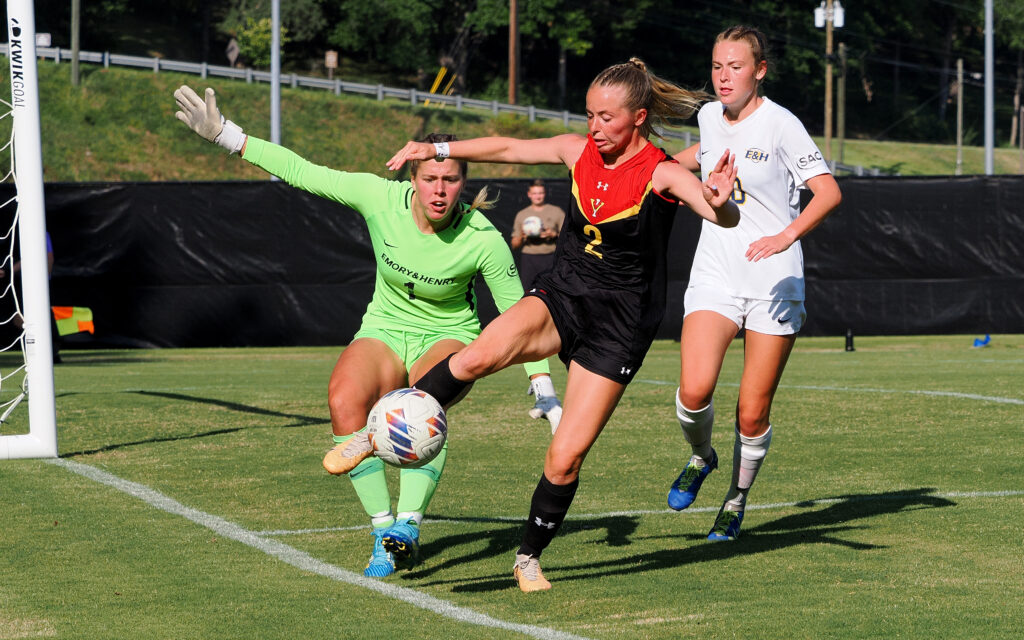
VMI’s women’s soccer team hosts Emory & Henry University at Patchin Field in Lexington, VA August 24, 2024. First half, VMI wins 2-0. (Randall K. Wolf/VMI)
Despite the rigorous schedule, Dancu pointed out that the women’s soccer team won an academic award for highest GPA among women’s sports at VMI last year.
“It’s really motivating, because when we’re on the bus or in the hotel room, everyone is doing homework, and you’re like, shoot, I should probably be doing it, too,” she said. “They’re just so smart and on top of it. In a way, soccer helps with school, because you have the time to do class and then you have practice. If I didn’t play sport here, it would be difficult for me to focus. Being on the soccer team and having such a busy schedule, it makes it easier to get your homework done.”
Dancu said she’s someone who loves staying busy. When she’s on break from school, she’s on a mission to fill her days.
“I can’t just sit around and not do anything,” she said. “It’s taught me what hard work looks like and I am very grateful for that, because I think it will really help me in the future.”
Being at VMI has offered her discipline.
“I’m more disciplined in all aspects of my life, especially my faith,” she said. “My faith has grown tremendously since I’m a cadet chaplain.”
She’s already seen the alumni network work for her. This past summer she had an internship at the University of North Florida, working in the athletic marketing department. An alumnus got her in contact with the right people and she was offered the opportunity.
Following graduation, she plans on playing soccer for one more year while attending graduate school. She wants to pursue leadership studies, ministry, or something in sports.