Post View Unavailable »
New Website Launched »

Behind the Balance: Terrell Jackson ’25 — Keydet Football

Virginia Military Institute’s cadet-athletes have to juggle cadet life, heavy academic course loads, and their NCAA Division I sport. Committed to both academic and athletic pursuits, balancing their rigorous schedule in both sports and school requires a certain level of commitment and discipline. Behind the Balance is a series that focuses on those cadet-athletes and how they handle the hurdles of the day-to-day. 

When Terrell Jackson ’25 got to Virginia Military Institute, he was assigned an academic advisor through cadet athletic development. With resources like the Miller Academic Center, Jackson said VMI provides opportunities for those who may fall behind on academic studies. 

“It really comes down to just using the resources that VMI provides,” he said. 

Academic advisors are standard in a college environment, Jackson said.  

“They help you arrange your schedule in the beginning of the semester. But also, after you arrange it, they help you stay on top of all the work that you have, keep track of your grades, let you know what you’re slipping up or getting behind on, and what you need to do to get back to it,” he said.  

They even help you find tutors, which Jackson did for history. The psychology major said the extra guidance helped him with his VMI journey. 

Cadet-athletes at VMI not only have their responsibilities with their selected sport but cadet duties on top of that. Cadets are also required to take physical fitness classes twice a week, participate in ROTC all four years, prepare for room and uniform inspections, practice for parade, guard duty, and more. 

As a captain on the defensive line, his responsibilities go beyond the field. He’s one of seven captains for the 124-player team. He says it’s an honor to see his teammates hold him in a higher regard and have respect for him.  

Being captain also means meeting with several different organizations on post. From meeting with the regimental staff, the general committee comprised of a board of cadets, to meeting with Maj. Gen. Cedric T. Wins ’85, superintendent, Jackson and the other captains are there to maintain a relationship between athletics and the Corps, while also providing support to rats on the team. 

His days start and end with football, while carrying a 15 and a half credit course load. Waking up between 6 or 6:45 a.m. each day, he goes through the motions of a cadet — rolling his hay, heading to morning practice, then onto breakfast before a full day of classes. By 3:50 p.m., it’s time for the team meeting to start where the head coach addresses the team.  

“The whole team gets together, and the head coach talks about what we’re doing for the day: what we have planned for our game, how the other team looks, the game plan, and what each position or unit needs to do for us to win the game,” he said. 

Then they all break out into specific meetings where it’s dedicated to their positions on the field. That’s where they spend time watching game film to learn either their own strengths and weaknesses or that of the other team they are set to play. By 5:30 p.m. they’re out on the practice field.  

Everything is wrapped up after 7 p.m. after the players do cool downs, treatments, and showers. Jackson oversees accounting for everyone as they line up to head to Crozet Hall for dinner. He turns in a sheet of names to the commandant’s office for accountability.  

There’s a lot of moving parts that Jackson must account for daily, so staying on top of everything takes dedication. 
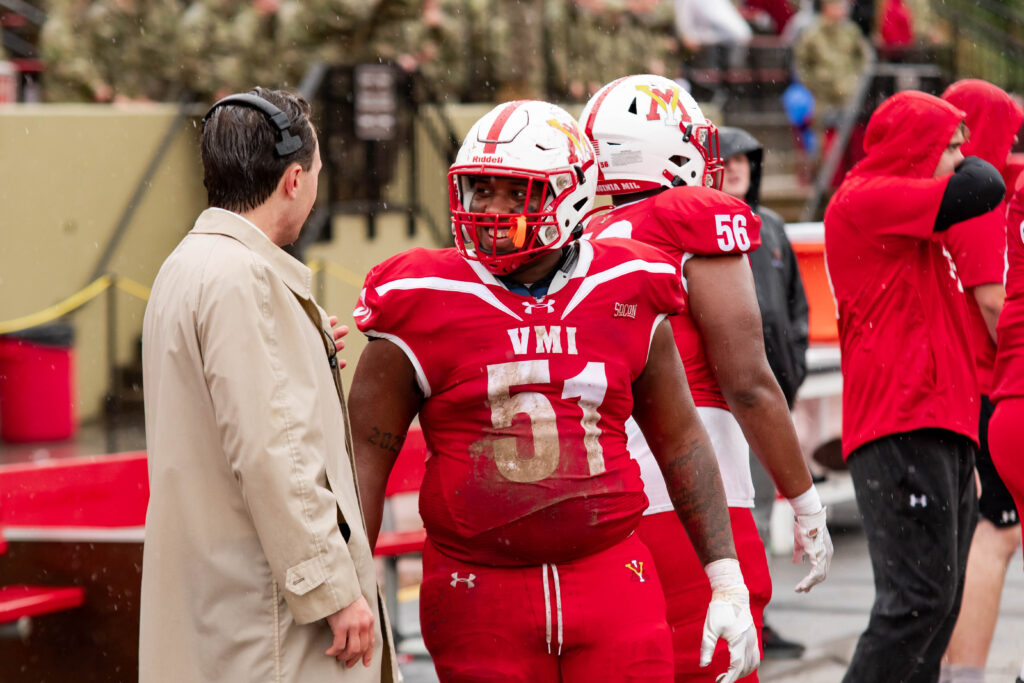
Terrell Jackson at a Virginia Military Institute football game.

“It’s just about putting in effort. There’s no special trick or secret magic to it,” he said. “You’ve got to not complain about it and just keep going. You were put here for a reason; you’ve got to embrace your role. Our biggest thing on the football team this year is just building a legacy. We might not win a playoff game or win a championship. If my class and the captains that we have now start building a legacy so we could come back in four years and we’re on top of the SoCon, or win the national championships, I’ll be happy to say, I started that. That came from our class.” 

The discipline and routine that VMI has instilled in Jackson is something he will carry throughout his life.  

“It’ll force you to get some time management skills. Either you get them or you’ll get left behind,” he said. “VMI is a tough place to be, especially to last. A lot of people could come here, but can you last?” 
The Cadet Collective: Benjamin Fong ’27

Virginia Military Institute requires structure and dedication. It also becomes a place where bonds are created that can last a lifetime. Maybe it’s a professor, a coach, or a fellow cadet. No one makes it through VMI alone. The Cadet Collective tells the stories of those relationships that help pave the way for success.  

Everything started to fall into place the week before Matriculation, Benjamin Fong ’27 said. He had traveled across the country from California and was staying with his uncle in Maryland, unsure of how he’d get down to Virginia Military Institute.  

His cross-country trip wasn’t straight from the West Coast to the East Coast. As part of his ROTC scholarship, he had to do a New Student Indoctrination (NSI) for the Naval ROTC, which was held in Chicago. He knew that he would be at VMI come August, but due to his financial restraints, he couldn’t make the move from California to Virginia.  

The Navy flew him from California to Chicago. Step one was down. He just needed to figure out how to get closer to Virginia after NSI.  

That brought him to Maryland with his uncle, who said he could drive him down to Lexington. But the VMI Parents Council had another solution.  

“The Parents Council had actually been considering finding me a way to get down here, which I didn’t know at that time,” he said. 

That’s where Robert and Dana Ruble came in. The Rubles were the 2023-24 co-presidents of the VMI Parents Council, which provides a link between parents, cadets, and staff at VMI. They offered to get him to Lexington and even went as far as to inform him their son, Sebastian Ruble ’24, was interested in being his dyke (1st Class mentor).  

“All this kindness seemed foreign to me,” he said. “The Rubles throughout the year have been very kind to me, have always been there to talk when the Rat Line got tough, connected me with alumni and school resources when needed, and regularly checked in and made sure that I was thriving. Many times, I came to them in a tricky situation, whether financially or with family issues and they gave their full support and guidance.” 

The Rubles assured Fong that there would be a family to help him walk through Matriculation Day. That’s how he met Kellett and Adrea Thomas.  

The Thomases became his host family. Before Matriculation he stayed at their home, had dinner, and prepared for what was next. During the Matriculation Fair, the Thomas’ showed Fong which church they attend and invited him to join them on Sundays. 

“On Matriculation Day, they introduced me to so many people who would later be revealed as important individuals. They answered all my questions and got me answers from those who knew them,” he said. 

A host family generally “adopts” a rat and takes care of them through the Rat Line. That includes offering care packages, putting them in touch with alumni or other resources, being a sounding board during hard times, and more.  

“I was shocked that such a family was willing to actively help out matriculants that they had never met,” he said. “As they hosted me for the night and acted as a surrogate family, I couldn’t help but feel indebted to them. Whenever I thanked them, they told me that they were glad to help and loved doing so, which I know they genuinely enjoyed.” 

The Thomases helped him acquire books. When they found out he didn’t have a pillow the first week, they got him one. They explained the process of what it was like to go through the Rat Line and what to expect, since they’d seen it firsthand with their own children who’ve attended.  

These relationships have proved to be an important factor in Fong’s time at VMI. 

“If you had no resources coming here, it’d be hard to justify staying, especially from out of state. You’re in a foreign place, a unique place. You’re facing all this adversity,” he said. “Having these recurrent relationships kind of makes it seem like it’s a reward in the sense that you go through these things, but at the same time, you’ve been taken care of. No matter how hard it is, there will always be somewhere, someone to take care of you. That kind of relationship, whether it’s a host family, your dyke’s family, or even the Parents Council is very important.” 

In addition to the Thomases, his dyke has been a major influence in his first year at VMI. 

“Sebastian Ruble is the best dyke anyone could ask for. He mentors, answers questions, and jokes around with me,” he said. “I always like to brag about him because, to me, he stands on a pedestal. I greatly appreciate him and how much he has done for me.” 

Finding VMI and all it offers was by chance. While looking at options for college, Fong sought out an ROTC scholarship. That meant selecting schools with ROTC options. He clicked Virginia Military Institute but had never heard of it.  

“I picked Virginia as a state because I knew that it had a little bit of military ties to it. Then I saw the word military and Virginia Military Institute. And I didn’t even really look into the school. I just checked it off,” he said. “So, when I applied to VMI, I found out more about it. And I decided this was a happy coincidence. I’m glad I stumbled upon the school.” 

It’s been a transformative year for Fong. Last year, he was struggling as to where he would end up after high school. He was living with friends, lacked the funds to do much, and was receiving a lot of denials. He knew he wanted to go into the military. The psychology major plans on commissioning into the U.S. Marine Corps after graduating.  

Now, he’s more regimented. He wants to be a leader, mentor others, and pay forward what he’s been given. He’s also become humbled by the generosity he’s received.  

“It’s made me appreciate reaching out. It was hard for me at first. For me, it’s very hard to receive help, because I have always been in the mindset of, I need to help myself. No one’s going to do it for me,” he said. “But here I am. People go out of their way to help me. I’ve been more comfortable with asking for help. I’ve learned to just appreciate their generosity, but also in the future when I’m able to give back or pass it forward, I will.” 

Behind the Balance: Katie Grochalski ’24 — Keydet Rifle

Virginia Military Institute’s cadet-athletes have to juggle cadet life, heavy academic course loads, and their NCAA Division I sport. Committed to both academic and athletic pursuits, balancing their rigorous schedule in both sports and school requires a certain level of commitment and discipline. Behind the Balance is a series that focuses on those cadet-athletes and how they handle the hurdles of the day-to-day.  

Katie Grochalski ’24 was taught to shoot a simple action revolver at the age of 8 by her father. She grew up on a farm in Pennsylvania and by the age of 12, she was taught to shoot a .22. By 14, she was allowed to handle any gun that was in the house, if she were to lock it back up and demonstrate proper gun safety. 

“I grew up shooting groundhogs on my property and raccoons because we had chickens,” she said.  

She always wanted to hunt with her father, but she’s not a morning person. Instead, she started diving into other activities. Her initial aspiration was to be a fashion designer — it’s something she had said since kindergarten. She loved creating, sewing, and drawing. She also loved to dance. So, when she announced she wanted to be a Navy SEAL, it was a shock to her parents.  

“My parents were completely blindsided because I never told them I wanted to be a SEAL,” she said. 

The career change was prompted by a teacher when she was in the third grade who would bring in the newspaper every Wednesday. On one Wednesday, the headline regarded SEAL Team Six taking down Osama Bin Laden.  

The self-proclaimed lazy swimmer veered off the path of wanting to be a SEAL and settled on the Marine Corps by the time she reached the seventh grade. Grochalski, a psychology major, will be commissioning into the Marines after graduation.  

“All my friends from public school were Navy, Air Force, Army, so, I just rounded it out as a Marine,” she said. “And ever since seventh grade, this is all I ever wanted to do.” 

She said her family tried to persuade her to do something else, but her mind was set.  

“My response to them was whenever I turn 18, I’m going to do it anyway, so either you love me and you’re with me or you don’t talk to me,” she said. “I’ve been on this journey ever since. I taught myself how to run and taught myself how to do pull ups. I was a dancer growing up, so learning from elegance and grace into being a warfighter was completely different.” 

Joining Junior ROTC in high school, she first started with drill, but was drawn to the sport of rifle.  

“I was a year behind most people on the team because I joined as a sophomore, instead of as a freshman. But man, I loved it,” she said. “Doing rifle gave me a sense of stability, taught me how to really be a person and look at myself. I had an inferiority complex, and rifle taught me how to calm myself down and think through things properly.” 

Junior and senior year of high school, Grochalski transferred to Massanutten Military Academy, which is modeled after Virginia Military Institute. It seemed like the proper track — after high school to attend VMI.  

She found that rifle served as her own personal time, something that she could devote only to herself. Any big decisions or thoughts occurred at the range, she said. The solid black powder, the popping of rifles, it had a calming effect on her, so much so that she could even fall asleep at the range.  

“I think the discipline is fantastic. It does a lot with your mentality and mindfulness. It teaches you how to calm yourself to the point where I can tell my heart rate. I can sit here and physically feel my body shake because my heart rate,” she said.  

Her time at a military high school also instilled discipline, along with her training on the range.  

“I had to eat the same thing every single day. I had to have three meals a day. I had to make sure I worked out the same way every single day. How to be a level head, because I was not. Every Marine is a rifleman, so why not start early?” 

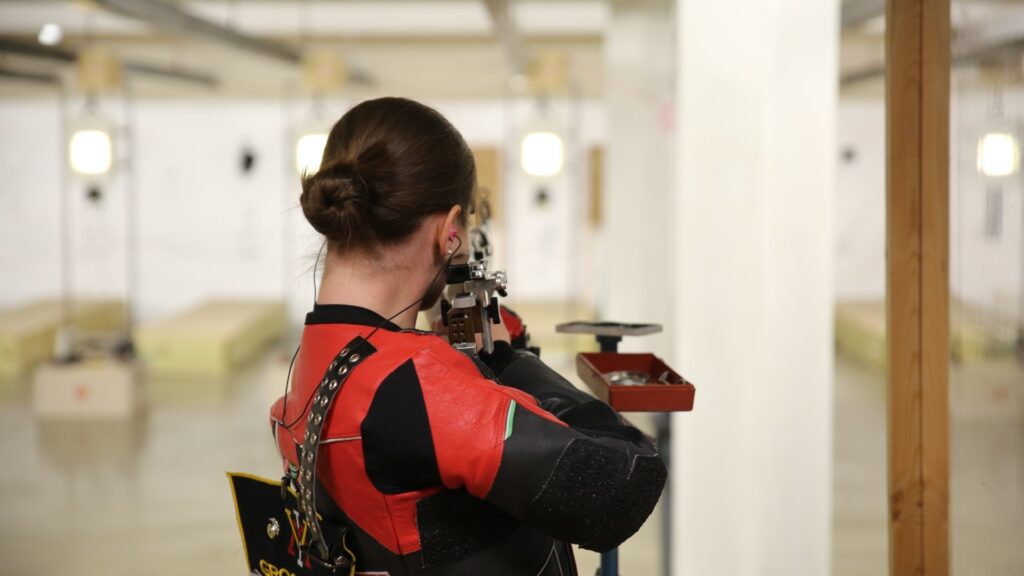
Katie Grochalski shooting a rifle as part of the Virginia Military Institute's rifle team.

On the team, in the classroom, and beyond 

She got involved with VMI’s rifle team by coming to a rifle match at VMI while she was a senior in high school. She toured the school a bit and was introduced to the rifle coach Lt. Col. Bill Bither. Her trip was cut short due to an impending snowstorm, but when she returned to VMI as a rat, she met with Bither and was on the team. 

Cadet-athletes at VMI not only have their responsibilities with their selected sport but cadet duties on top of that.  Cadets are also required to take physical fitness classes twice a week, participate in ROTC all four years, prepare for room and uniform inspections, practice for parade, guard duty, and more.

Grochalski has a stacked schedule, which includes waking up daily at 6:30 a.m. for formation at 7 a.m. On Tuesdays and Thursdays, she’s the drummer for formation, so she has to head to the band room prior to formation. After that, she heads back to her room, and if there’s time before her 10 a.m. class she’ll nap. She has three or four classes a day, depending on the day, but wraps up around 3 p.m. She has an hour after classes before practice for rifle begins at 4 p.m. 

“I’ll have an hour of me time to get things done; do any miscellaneous things,” she said.  

On Tuesdays and Thursdays, she lifts after she shoots at the range. By 9:30 p.m., she’s onto rifle formation.  

Wednesdays and Fridays, she teaches ballroom dance in the evening for the Ballroom Dance Club.  

“I love dancing,” she said. “It’s one thing that really ties me to home. It helps me handle my homesickness.” 

To balance it all, she said it’s best to come to the understanding that you can’t control everything.  

“Understand that you can’t control it all,” she said. “But with all my stuff, I’ve learned how to manage bit-by-bit over the years from first going to regular high school, then to military high school, onto here. Having that stress inoculation helps. It really helps.” 

Behind the Balance: Grant Swinehart ’24 — Keydet Football

Virginia Military Institute’s cadet-athletes have to juggle cadet life, heavy academic course loads, and their NCAA Division I sport. Committed to both academic and athletic pursuits, balancing their rigorous schedule in both sports and school requires a certain level of commitment and discipline. Behind the Balance is a series that focuses on those cadet-athletes and how they handle the hurdles of the day-to-day. 

Grant Swinehart ’24 didn’t know a lot about Virginia Military Institute until one day the former head football coach Scott Wachenheim came to him with an offer. He had no military intentions. No connection to the military. And he had no clue what a military institute could offer him.  

“It was my only offer for football. So it’s obviously something that I strongly considered,” the running back said. 

He talked to a high school friend who played basketball at VMI to explore the option of becoming a cadet-athlete.  

“He told me a lot about school and that’s when I made my decision to commit here and kind of just ended up just picking in and rolling with it,” Swinehart said. 

Swinehart started playing football at the age of six. It was something his father introduced him to since he played when he was younger and through high school. His father was even his coach for a while. Swinehart was drawn to the physical competitiveness of the sport.  

“It was just different from the other sports that I’ve played,” he said. “It’s a big team sport, but it allows you to be competitive and physical. So that’s why I fell in love with it.” 

Now, as a Keydet Football player, he loves the rush when he takes the field.  

“Waiting for the first kickoff of the game, there’s a lot of anxiety and butterflies, just excited for it to start,” he said. “Just like probably any other sport, but football it’s a big build-up to the first moment and a lot of guys on my team will probably agree that those butterflies don’t really go away until the first play or until the first set and sometimes a couple plays after that. You kind of got to get it out of your system. But it’s a feeling like no other. Just hearing the fans cheer you on and being able to be out there with the guys you’ve been working so hard with. You can’t describe it.”  

Weightlifting, class, practice, studies 

Swinehart is getting up in the early hours to do weightlifting, which starts at 6 a.m. Then it’s team meetings. It’s on to breakfast at 7 a.m. Classes are from 8 a.m. until 3 p.m. Then it’s onto pre-practice meetings and full practice from 5 to 7 p.m.  

After practice, he’s studying during a dedicated study hall period. Finally, it’s dinner time at 8 p.m. More studying. By 10 p.m., it’s free time. 

With a load of 14 and a half credits, he says he tries to get ahead on schoolwork. Cadet-athletes at VMI not only have their responsibilities with their selected sport but cadet duties on top of that. There are specific times when they can eat, go to class, study, and sleep. Cadets are also required to take physical fitness classes twice a week, participate in ROTC all four years, require room and uniform inspections, parade preparation, guard duty, and more.  

“It’s definitely a challenge, but we have great resources with the athletic department to kind of stay on top of those types of things,” he said. “You really just got to be focused and dedicated in any of the free time that you do have to be getting your homework done, reaching out to the teachers, just kind of staying on top of things.” 

He says that if you start to fall behind, it’s going to be almost impossible to catch up.   

“That’s something that VMI kind of taught me, is to not get behind and try to stay on top of things in the first place. Reach out to professors in advance about traveling and what things you might miss,” he said.   

With his travel schedule, which is normally every other weekend, he has letters to give to his professors to alert them he will be missing class and therefore gets the assignments he’ll miss. He’s not doing work on the bus rides, instead, he aims to finish everything before he leaves for away games.  

Grant Swinehart with a football in hand while running down the field.
NCAA Football Championship Subdivision: Keydets rally to defeat Wildcats, 12-7

“There are some days that kind of can hit you, especially when a lot of tests or big assignments fall on the same day. Or you got a big practice ahead of you,” he said. 

He said the small class size at VMI is helpful in these cases because it allows him to have a more personal relationship with not only his classmates but also his professors. 

“It’s really easy to have that close relationship with your professor and meet with them when need be to make up anything you might have missed,” he said.  

Swinehart knows a lot about dedication and it’s something that VMI head football coach Danny Rocco recognized. Prior to the season, Swinehart was awarded the number 0 which is a new tradition started by Rocco. Each year, number zero will be given to the captain of the special teams — someone who embodies what it means to be a cadet-athlete: hard work, dedication, sacrifice, and selflessness. 

The future 

Swinehart is set to graduate in the spring and hopes to put his name in the transfer portal to see if he can play football while getting his master’s somewhere. He has two years of eligibility due to the COVID-19 season and for tearing his ACL in his second year.  

If not, he hopes to pursue something with his psychology degree. He feels his time at VMI has prepared him for the real world.  

“What I kind of say to myself is that it’s very rewarding knowing that you’ve been through all that stuff and you were able to handle multiple different things all at once,” he said. “It’s kind of preparing you for later in life, like with a job and a family and kids and all the other things that are going to come with that. I chose to come to a school like this and to play a sport like this, which I love a lot. It’s all just part of the process, but I wouldn’t trade it for anything in the world ever. I really love it and I know that at the end of the day, it’s helping me become a better person.” 

Dyslexic Cadet Focuses Research on ADHD and Dyslexia for Honors Week Presentation

“Good afternoon. I am a 1st Class cadet here at VMI, and I have dyslexia.” That is how Claire Curtis ’23, a biology major at Virginia Military Institute, began her senior thesis titled, “Learning Differences at VMI” during Honors Week, held March 20-28.   

To a captivated audience, Curtis shared that the U.S. Department of Education defines a learning difference as being “A disorder in one or more of the basic psychological processes involved in understanding or in using language, spoken or written, which may manifest itself in an imperfect ability to listen, speak, read, write, spell, or to do mathematical calculations.”

Curtis then focused her discussion on two fairly common learning differences: ADHD, a neuropsychological disorder characterized by hyperactivity, inattention, and impulsiveness; and dyslexia, a neuropsychological disorder personal to Curtis, and characterized by issues in reading, writing, and understanding written language, and affects 20% of the population. She postulated that because the two are the most prevalent learning disorders, there may be a number of students with one or both at VMI. 

Curtis shared that her parents believed her capable of reading at the age of four, but she had only memorized the story books that her parents had read to her. They became aware of a problem when she was off by a page, but told the story verbatim. She was officially diagnosed with dyslexia when she was in 3rd grade. However, she is considered to be a twice-exceptional learner, that is a student who has both a high cognitive ability and who has a learning disorder, which is why she is an honors student at an exceptionally challenging senior military college. 

Curtis cited federal and state laws currently in place that prohibit discrimination, and allow accommodations for students with learning differences. She examined several colleges and universities in Virginia, such as George Mason University, James Madison University, Randolph-Macon College, University of Virginia, Virginia Tech, and Virginia Commonwealth University, who all offer between three to six different accommodations. But according to Curtis, using accommodations for learning differences disqualifies one from enlisting or commissioning, as well as attending a military college.

“VMI’s accommodations include assistive technology, priority registration, extra time on tests, a separate testing location, and academic assistance. I compared those accommodations to what is offered at the Citadel, a college very similar to VMI. Their accommodations include learning assistance, a test-taking center, assistive technology, peer note-takers as well as note-taking alternatives, and priority registration. Like VMI though, they cannot accommodate those who are commissioning,” she explained. 

Curtis spent much of the year researching, reviewing, and interpreting brain scans, and seeking best practices at places of higher education with regard to learning differences. She sought to educate and advocate, and identified ways to further support VMI cadets with learning differences, including additional funding for programs and support staff.  

Maj. Molly Kent, assistant professor in the Department of Biology and Curtis’ advisor stated, “Claire approaches material and data differently than many in the sciences, but her unique perspective and voice have been educational for me. I have learned so much from Claire’s project and hard work over the past several semesters. I can’t wait to see what she does next.” 

Lt. Col. Sara Whipple, assistant professor in the Department of Psychology said, “I’m impressed with the breadth of information Claire has covered, from the neuroscience of dyslexia and ADHD, to federal and state policies, down to an analysis of services and accommodations that a variety of colleges offer. Advising her on this project allowed me to recognize ways I could improve inclusivity and accessibility in my own classrooms.”  

Curtis is from Louisville, Kentucky, where she attended high school at Presentation Academy. She is the daughter of Diane and Brian Curtis. Her minors are history and chemistry. She is part of the Institute Scholar program, an S7 lieutenant, works as a cadet assistant athletic trainer, serves as an EMS member, is a member of the Cadet Superintendent’s Advisory Board, and plays volleyball. After graduation, she hopes to commission into the military and attend medical school.   

Behind the Balance: Zach Denton ’27 — Keydet Track and Field

LEXINGTON, Va. April 22, 2025 — The hurdles of college and extracurricular activities mean something a little different for Zach Denton ’27, considering he actually jumps hurdles. As part of the Virginia Military Institute track and field team, Denton is dedicated to going the distance.  

“Hurdles was always something I was very attracted to. I started in the 6th grade running hurdles, and it just always excited me so much,” he explained. “I continued it through high school. When I had the opportunity here, the coaches were receptive to me coming in to do hurdles.” 

It was a learning curve. Denton said that there’s a height increase in hurdles from high school to the college level — 39 inches to 42 inches.  

“It was a big jump freshman year to do that,” he said. “We spent a lot of my freshman year doing adjustments.” 

Not only was the height difference something to adjust to, but also the amount of coaching he was getting at VMI. Coming from a military family, he moved from school to school growing up.  

“I went to two separate high schools, and for the second half of my high school time, I didn’t have a coach. I had no hurdles coach, so I was basically self-coached,” he stated.  

Having a dedicated coach to work on his technique, plus allow for the transition in hurdle heights, Denton admitted the extra work paid off. 

“I was finally getting coached in a direction that I could go. I’m really excited for that as well.” 

He’s now living out his dream of running Division I track and field — participating in both hurdles and the long jump. The psychology major was also in one of the first classes to be able to receive the Call to Duty scholarship offered at VMI. That, in addition to a U.S. Army ROTC scholarship, the financial aid he was receiving was appealing in his decision to choose VMI.  

Zach Denton jumping hurdles during a track and field meet at Virginia Military Institute.
VMI Team Challenge track and field meet at the Corps Physical Training Facility in Lexington, VA January 11, 2025. (Randall K. Wolf)

He dedicates more than a dozen hours a week to track and field. On top of that, he’s enrolled in 17 and a half credits, and part of Color Guard staff.  

Cadet-athletes at VMI not only have their responsibilities with their selected sport but cadet duties on top of that. Cadets are also required to take physical fitness classes twice a week, participate in ROTC all four years, prepare for room and uniform inspections, practice for parade, guard duty, and more. 

He said he has to be smart about what activities he chooses.  

“For example, for Color Guard staff, a lot of the stuff I need to do I will already be at,” he explained. “We raise the flag at formations, for example, so I’m already there. I’m just tacking that stuff on and then just really knowing what you have to do … a lot of to-do lists. I make a huge list of all the assignments that I know of at the beginning of each semester, and I go through those, just being really meticulous. I always tell people VMI is great at telling you when you don’t have time. So once you know when you don’t have time, you make a list of everything you need to do. And squash it in there.”

He tries to not let the stresses of daily cadet life or the preparation before a big race get to him. He said when it comes to track and field, a lot of his thoughts are centered in the build-up to the event than the actual race.  

Zach Denton jumping at a track and field meet at Virginia Military Institute.
VMI Team Challenge track and field meet at the Corps Physical Training Facility in Lexington, VA January 11, 2025. (Randall K. Wolf)

“When you’re going through it, you really want your mind just to be conditioned to just do it in that instant, because in hurdles, that race is eight seconds long. Long jump isn’t a very long race,” he admitted. “You really want to get your body prepped and primed, and that’s where all the visualization happens when you’re going through the drills. But once you get on the run, once the gun goes off for the race, ideally, your best races, you have nothing going through your head. It’ll just be all muscle memory.” 

He said some of his best races are the ones he doesn’t really remember.   

Thanks to his time at VMI, he said he’s become more confident in himself, and it has presented him with a lot of opportunities to step up.  

“Whether it’s public speaking or handling yourself under pressure, being a neat and precise person, I would say all those are foundational things. As I go into my 2nd Class year, the main focus is exerting influence on others. As a 3rd Class cadet, I’ve watched the 2nds and the 1sts lead, and I’ve learned from them. Soon it will be my turn to start doing that. I’m really preparing for that moment when I’m primarily leading others instead of being a follower.”