Post View Unavailable »
New Website Launched »

The Extra Mile: Rock Climbing Club

All it took was the promise of extra credit for Owen Clarke ’25 to start climbing. He had to hit a certain route to gain 10 extra points on his final exam, according to Department of History assistant professor Maj. Christopher Blunda. Blunda also happens to be the assistant coach for Virginia Military Institute’s Rock Climbing Club.  

Clarke is the cadet in charge for the club. He always had some interest in climbing, but didn’t start taking it seriously until last January.  

“I had kind of dabbled in it,” he admitted. 

The club, which has about 15 cadets on the roster, practices three times a week. They also make excursions to cliffs and bouldering opportunities in the surrounding areas on the weekends. Most recently, the club took a trip to McAfee Knob outside of Roanoke to boulder.  

Zeb Barrett ’26 joined the club because he’d always enjoyed climbing things as a kid. With the giant rock wall at VMI’s Corps Physical Training Facility, he saw an opportunity to grow his skills.  

“I never really had the time to dedicate myself to rock climbing,” he explained. “Since I came to VMI, there’s a rock wall right there. I was like, I might get into this and see what’s up. And I really enjoyed it.” 

For Connor Bott ’26, he had gone to a summer camp in high school where he discovered a passion for rock climbing. 

“I didn’t really have a chance to do it since then, until I got to VMI, just because I live on the Eastern Shore. The nearest cliff is here. Once I got here, though, I started in the club, and that was a lot of fun,” he said. 

They have about seven competitive climbers on the roster, the rest are in varying skill levels — but it’s all about the confidence you have in your body and strength. 

“Rock climbing, when you begin, is not really an intuitive movement. You don’t move in a way that you’re used to moving,” Clarke stated. “You kind of have to learn over time how to move up routes and change your body in ways you’d normally not think about.” 

The club isn’t just specifically rock climbing (or top rope), they also do bouldering is done at lower heights and doesn’t require ropes or harnesses. Both Clarke and Bott prefer bouldering to rock climbing.  

“I think it’s more technique based,” Clarke said. “Bouldering is more interesting to me. It’s more of a puzzle.”

The club competes in what are called red point competitions, which consist of each climber getting a certain number of routes in varying difficulty and two hours to complete the route in one go. Scores are based on how many times you are able to complete the route in one go, which is called a flash.  
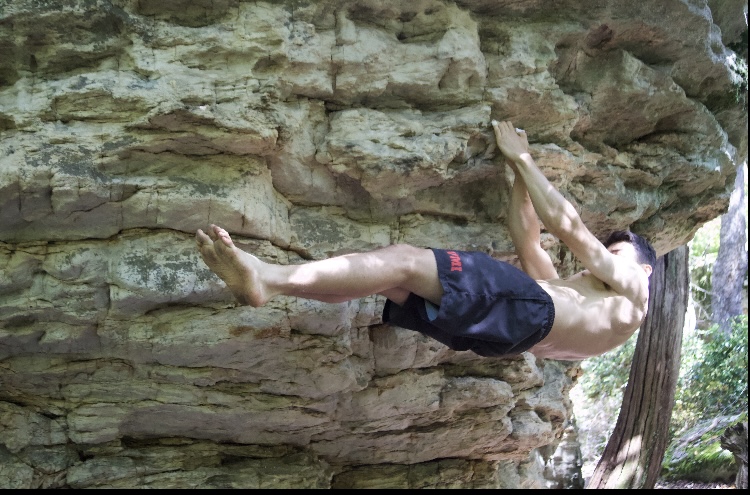
A guy grappling on rocks as a part of the rock climbing club at VMI.
Screenshot

“Top rope changes in length, so it’s a lot longer and more endurance based,” Barrett said. “Since it’s so long, you can’t have intense movements along the whole route, so it’s a lot easier on strength movements. Bouldering is a lot shorter, so it’s more intensive for a short amount of time. I prefer bouldering because I have more strength than endurance.” 

Bott is the opposite; he enjoys top rope to bouldering. He says it acts as a good way to break away from his academic schedule and have a release, which is something Clarke echoed. 

“My favorite thing about the club is it’s an escape for me. When I’m climbing, I just have to worry about the problem in front of me,” Clarke continued. “I’ve got to think about the way in which I’m going to try to go up the wall. I don’t have to worry about a million other things happening here [at VMI].” 

It also requires a lot of strength you wouldn’t even consider, according to Clarke. 

“It’s a lot of weird joint stability, putting your joints in a position that they’re not used to being in,” he said. “Rock climbing is more like calisthenics, where you’re putting the joints in your body in unstable positions and forcing them to adapt.” 

Although they do compete, it’s more of a community-based sport. Everyone wants each other to succeed, Clarke said. 

“Everyone loves watching someone get better in their climbs,” Bott said.  

“It’s not a team sport, but there is definitely a community, and people cheer each other on,” Barrett added. “If I see a person struggling, I ask if they need help, then help them as much as possible.” 

For Barrett, the club serves as a place for fun and enjoying something he’s passionate about. 

“Everybody has a passion … it’s my passion. I just love it. That’s why I think it’s important. Everybody has to love something. This is something I love,” Barrett said.  
The Extra Mile: Racquet Sports Club

Jude Roberts ’25 was inspired to start a new club sport at Virginia Military Institute after joining a badminton team while studying abroad.  

“I missed tennis and racquetball, and I remembered all the people I had talked to at VMI regarding their interest in these sports. A few of them even considered starting a tennis club before me, so I knew there was interest,” he explained. 

He and others joined together to start the Racquet Sports Club, where Roberts is the cadet in charge.  

There are currently 33 cadets on the roster for the club, but Roberts said about half of them are active, consistent tennis players. Others appear sporadically for more niche sports.

“We mostly play tennis and pickleball,” Roberts said. “We just recently acquired the equipment to play racquetball and badminton as well, so we are coordinating the schedules for those.” 

Roberts has always played a form of racquet sport since he was young, starting with racquetball. It was something his uncle taught him to do for fun, learning the basics.  

“I was just looking for something to do during my senior year of high school, so I joined the tennis team and learned a lot while having a great time with my friends and coaches,” he said. “From there, it was easy to try pickleball at my local gym and eventually badminton in England. These sports have been a tremendous source of joy and camaraderie for me, so I hope we can offer cadets some similar experiences.” 

The club has some larger events planned for the spring, but for now, they’re just playing for fun. The hope is to play with the Rockbridge Tennis Association every Saturday.  

Raj Singh ’25, a member of the club, started playing tennis when he was in elementary school, and has loved the sport ever since. He played all through high school but stopped once he came to VMI because there wasn’t a team or club dedicated to it.  

“I really enjoyed the movement, high pace, and the intensity the games can give throughout a match,” he stated. “I enjoy the club, it is a great way to relieve some stress, get a nice workout but also it allows me to keep my skills as a tennis player as it can diminish when you don’t play for a while.” 

Although the club is still in its infancy, Singh said he hopes it grows bigger and becomes an opportunity to begin outreach to other schools for more opportunities.  

“Clubs like ours are important as they give cadets an opportunity to get into sports which may not be offered in regular classes or in NCAA,” he explained. “Giving us more options can help in health, coordination, and involvement with other cadets.” 

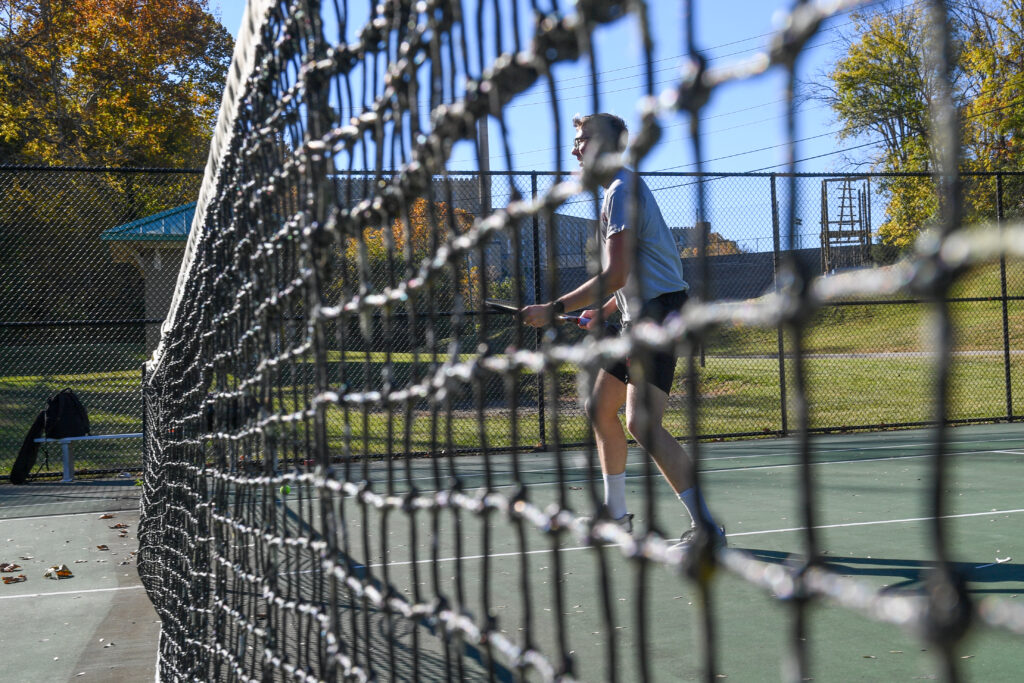
A cadet behind a net on the tennis court.

Roberts said clubs like his offer an opportunity for cadets to take a break from the stresses of VMI responsibilities. 

“I enjoy the club because it provides me with a fun way to stay fit and a break from the typical VMI monotony. It has been very fulfilling to watch it grow and see other cadets enjoying it.” 

He also said the club has offered him profound leadership experience.  

“I have learned a lot about the considerations that go into everything we do here at VMI. I have a much deeper appreciation for the level of care and effort that goes into cadet life, and I am grateful for everything that has been done for us to come out and play some racquet sports,” he said. 

The Extra Mile: Pistol Club

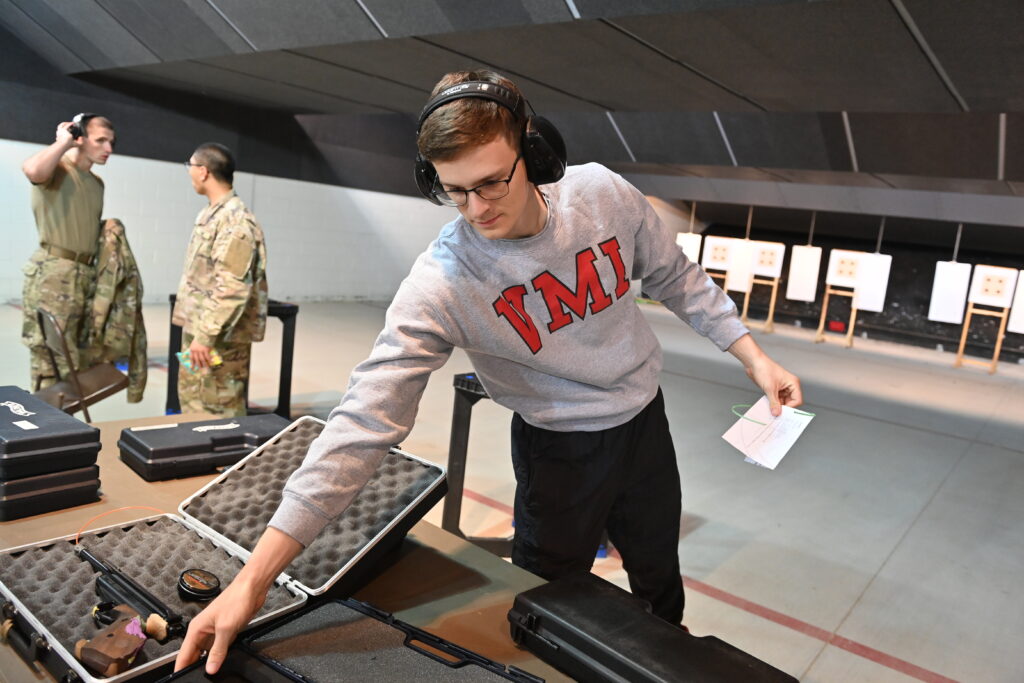
The firing range is cold and dim, except for the lit-up lanes where you fire. Half a dozen cadets are gathering their equipment and setting up their targets. During a practice, they’re shooting air pistols at the range on North Post. 

The Pistol Club at Virginia Military Institute shoots Olympic style, which can consist of three disciplines: rifle, pistol, and shotgun. The club uses air pistol and .22 pistol in a shooting range, where participants aim at targets. They utilize three different shooting methods: air pistol, sport pistol, and standard pistol. Every Tuesday and Thursday, the club, made up of about a dozen cadets both male and female, will meet up at the range either at North Post or Kilbourne Hall. 

Everyone unlocks their guns and ammunition, and targets are assembled. During practice, they use a large sheet of paper with four small targets on it. It’s stapled onto a wood panel and set up at the end of the range.   

“We’ll start with slow fire, so it’s about five minutes for 10 shots and we just try and focus on groupings and getting kind of into a rhythm at the beginning of the night,” said Chris Olsen ’25, the cadet in charge for the club.  

The club is not a sanctioned NCAA sport, but they do compete nationally. The competitions consist of 60 shots fired in three different shooting disciplines: air pistol, sport pistol, and standard pistol, for a total of 180 shots fired. 

Earlier this year, the club competed in the National Collegiate Pistol Championship held at Fort Moore (formerly Fort Benning) Army post near Columbus, Georgia, in late March. The VMI contingent consisted of a team of four shooters: Olsen, Parker Hall ’24, Jacob Cook ’26, and Kate Patrick ’27, with Jamie Palacio ’27 competing as an individual. The club held a national rank of 11th place going into the competition. With 15 schools at the championship, VMI came in 10th place for air pistol, 8th place for sport pistol, and 10th place for standard pistol. The team finished the competition in 10th place, improving their national ranking. 

This was on the heels of the club’s attendance of the Scholastic Action Shooting Program Intercollegiate Pistols Nationals — the first time in club’s history — in 2023. 

They try to do six to eight matches a year, with stops at the Naval Academy and The Citadel. 

The club is run by cadets, specifically with Olsen in charge with an assistant cadet in charge, usually a 2nd Class cadet. This year, it’s Cook. The club also has a set of coaches — head coach Reese McCormick, assistant coach Norman Claytor, Master Seargeant Robert Coleman, and Jan Downs — that help guide the cadets. 

Olsen said you can join the club without any experience. They’ll teach you how to properly shoot. He said the club atmosphere allows for a more relaxed environment. 

“It’s a competitive but relaxed environment because I’m not directly competing against anybody else in a way. I’m competing against myself every time, because I’m just trying to get that one extra point that I didn’t get last time. It creates a healthy kind of competition,” he said. 

A cadet in the shooting range placing guns back in cases.

Olsen had always been interested in precision shooting. 

“I grew up in a little bit of a rural area, and my buddy had a farm,” he said. “It was just one of those things where after school for fun, you just take a bunch of shotguns or a couple rifles out and just go shoot at random things.”

The club has been on and off since the 1970s. Olsen joined as a rat and said clubs at VMI serve as a break in cadet life. 

“I think they’re extremely important because it acts as an outlet for the regular cadet, who might not be involved in other things,” he said. “Clubs are the last area where cadets can be involved and have a leadership experience at a leadership school, but also build their own little community and find their own little group.” 

The Extra Mile: Pre-Law Society

Jon Krueger ’24 wasn’t sure what path he was going to take once arriving at Virginia Military Institute.  

“I’ve always been interested in the military and I’ve always felt like I’ve done well with the structure as far as academic skills,” he said.  

A family friend recommended VMI, so Krueger decided an overnight trip for an open house was a good plan. He enjoyed it.  

But finding the Pre-Law Society, a club option offered at VMI, was totally by chance his 3rd Class year.  

“It was an in passing conversation with my academic advisor. He asked me if I’d thought about grad school and I had no real game plan,” he said. “I kind of started getting interested in law school. There’s still a lot that I don’t know about, but being an English major working with documents and a lot of writing … law interests me in general. So that’s what piqued my interest.” 

Krueger is the project manager of the club, which means he’s in charge of organizing events while working with other leadership within the club. In the past, the club has sat in on University of Virginia’s law students’ mock trials as jurors, along with tours of UVA Law School.  

He said the Pre-Law Society is a good way to dip your toes into discovering what law and law school are about. 

“We just try to get an experience for newer members or people that aren’t quite sure how law school works,” he said. “I think it’s to get everybody introduced to it, see if it’s even for you. It’s not necessarily with joining the Pre-Law Society, anybody expects you to be a lawyer. It’s more to get people interested, see if this is something that they enjoy.” 

The club is well-received, having almost 50 members.  

Most of the events of the society does include VMI alumni visits. Former professors, judges, and lawyers have all stepped onto post to talk. 

“We’ve been able to talk to people who do a lot of different aspects of the law, like military and civilian. We’ve also had different judges and trial lawyers from the JAG Corps. There’s also a member of the Law School Admission Council that comes once a year to talk about the LSAT, the standardized test to get into law school, and a lot of people found that helpful for their own LSAT.” 

The club also takes trips, apart from UVA, to Richmond and Washington, D.C. to speak with lawyers and other law professionals.  

Once Krueger graduates in the spring, his plan is to go to Officer Candidate School for the Navy, then go to law school, so this club has been imperative for his future.  

Patrick Kiernan ’25, a history major, said he started becoming interested in law after several junior and high school classes he took.  

“I had interest from taking those classes, wanting to look more into practicing law,” he said.  

Kiernan said a great aspect of the club is the advisor Maj. Tim Passmore, assistant professor of international studies, who can recommend a certain number of cadets and alumni that want to attend certain law schools through a memorandum of understanding.   

“They basically guarantee an interview because the idea is with the time constraints you have at VMI, your GPA and LSAT scores aren’t necessarily the best reflection of what you can do,” he said. 

The two said the amount of knowledge they’ve received through participating in the club is insurmountable.  

“Being around people that can tell you more about law, life, and the resources available to you … not to mention, I don’t think it ever looks bad on a resume to say that you’re part of the Pre-Law Society,” Krueger said.

The Extra Mile: Triathlon

Discipline. It’s something that Virginia Military Institute instills in its cadets. Luke Rose ’24 said it’s integral in being part of the triathlon club.  

Rose, the cadet in charge (CIC) of the club, said the members focus on training for triathlons — which encompasses cycling, swimming and running.  

The team, which is made up of eight people, practices twice a week, either focusing on swimming or biking. Rose, an international studies major, said running is mainly done individually, on each cadet’s own time.  

“Most people are proficient in two of the subjects and then work on the third,” Peyton Reingruber ’23, a civil and environmental engineering major. said. “So, more common than not, people are usually getting into cycling. It’s not a very common sport.” 

Rose said cycling is a demanding sport and credits their coach, Brian Frazier, in training them, especially with cycling. A lot of the athletes on the team are training up to 15 hours a week.  

“He’s done a great job with helping us progress in our cycling and that’s kind of where his expertise is,” Rose said. “Most people who show up here have ran before or used to run.” 

Part of the USA Triathlon Collegiate Club, the VMI Triathlon Club participates in several competitions throughout the year. They focus on two types of triathlons — sprint and Olympic. Sprint is a half mile swim, 12.4 mile bike, and 3.1 mile run. Olympic is a .93 mile swim, 24.8 mile bike, and 6.2 mile run.  

“Being a military school, it’s pretty difficult,” Rose said about competing. “The season is more of a spring and summer season and then into early fall. So, we miss the kind of big conference events, which are in early September. Our main events that we really train up for are in the spring.” 

The main goal: go to the national championship. Last year, the event was held in Georgia, and Rose said everyone finished and it got competitive. This spring, the championship will be held in California.  

‘It’s a sweat-fest’ 

They utilize VMI’s Aquatic Center for swimming practice, while they take to the streets around Lexington atop a bicycle. Most of the team have their own bike, but there are team bikes available for use. 

But what happens when the weather turns cold? That’s when they sweat it out in Cocke Hall on stationary bikes for about an hour and a half. 

“It’s a sweat fest,” Rose said. “It’s a room with no windows or anything. Just put on some music and work really hard.” 

Andrew Wright ’25, an economics and business major, joined the club last spring. He said he grew up watching his father do long distance events in running and cycling. When he found out VMI had a triathlon club, he was on board.

“I think my favorite part is just learning just learning how to do it better,” he said. “I’m pretty new to cycling. Coach Brian has been great and helped me figure out how to become more efficient and become a better cyclist. I grew up swimming a good bit but didn’t really have the technique or anything like that or had never done a lot of endurance or long swims. So I’m learning new things, and just becoming better at this fun sport.” 

Reingruber said his mother did triathlons while he was growing up, but he never participated in them until after Breakout. He was an avid swimmer in high school. 

“I’d say my favorite part is people’s dedication to go that extra mile and do more than what they already are doing,” he said. “Most of the team or at least half is planning on commissioning on top of academics and everything. So, to spend four hours a week just on practices, roughly, that’s a big time commitment. To see some people come out and have a good attitude and work hard is really uplifting, especially if someone’s having like a hard day.”

Rose said physical activity, especially in this club, acts as a cleanser. 

“Not only is it productive to your overall health, but I think it also benefits the mind greatly,” he said. “Instead of just going and playing some video games to blow off steam, you’re going to do something physical and work on yourself. It kind of gives you that mental reset, so by the time you’re done, you go shower, you’re ready to go again to go work on academics. I think that’s very beneficial to cadets, especially.” 

His favorite part — club members showing up and working hard. 

“Practices aren’t necessarily always a fun, jolly time,” he said. “We go out there and we work really hard, and I think it builds a lot of camaraderie and builds us as a team, you kind of get to know each other a little more when you’re really suffering through some of the tougher workouts. It’s pretty awesome to see the team come together and support each other.” 

The Extra Mile: Arnold Air Society

With dreams of attending the U.S. Air Force Academy, Nathan “Skye” Van Ness ’25 had to shift gears when he wasn’t accepted. But it didn’t deter him. Rather, if he could go back in time, he wouldn’t have even applied. Instead, Virginia Military Institute has provided an overwhelmingly beneficial college and military experience for the cadet.  

Overall, he’s much happier in his decision.  

“VMI teaches a level of humility and appreciation for the enlisted side. And not only that, but also for the non-commissioning cadets as well,” the physics major said. “It affords all sorts of other unique and distinct opportunities to interact with other kids in different branches and really get a full picture of everything while building yourself in a way that I haven’t really seen anywhere else.”

Van Ness said by attending VMI, his skills in athletics, academics, and leadership have improved significantly, which in turn has prepared him to be an effective leader. By joining VMI’s Air Force ROTC Det 880 Arnold Air Society John P. Jumper Squadron, his leadership skills have increased tenfold.  

The Arnold Air Society (AAS) is a service organization through the Air Force ROTC (AFROTC) that centers on professionalism, honor, and community service. Squadrons are formed by AFROTC in collegiate settings focusing on cadets who are dedicated to their community and to becoming an Air Force officer. 

Van Ness is the commander for the squadron. The club was recently rebooted. It was reinstated in 2021 after a pause, but the club has ties at VMI stemming back to the 1970s.  

What drew Van Ness to the club was its values, but also there’s the possibility of national scholarships upwards to $10,000.  

“I saw that sort of excellence as something I want to be a part of and really live up to,” he said.  

He decided to join, which requires a list of things before being initiated, that includes: 

  • Have at least a 2.5 GPA 
  • Score at least an 80 on the United States Air Force Physical Fitness Assessment and meet physical standards 
  • Be active in the cadet corps and have necessary leadership qualities 
  • Receive an invitation from AAS and complete the post-training program 
  • Pass the AAS national test 

The two big things that VMI’s chapter does is have the candidacy class come up with a service project. This year it was collecting funds for the Rockbridge SPCA. The other initiation task is getting signatures from all the current members, which is around 10. 

Normally, that wouldn’t sound hard, but to get the signatures, the candidate would need to do a task. Last year, Van Ness required a candidate to clean his shoes in order to get his signature.  

“I took one shoe, and I shined it because I’m good at shining shoes. I love doing it. I made one shoe as shiny as I possibly could get it. I was like, if you can get this other shoe just as shiny, I’ll give you my signature,” he said. 

The more Van Ness participated, the more leadership opportunities he craved. He began working towards squadron commander. 

“I would say that the Arnold Air Society has single-handedly improved my leadership and leadership philosophy as a whole,” he said. 

By attending the National Conclave, or NATCON, last year, Van Ness said he felt like he grew up an entire year within just a few days due to the impact of the conference.  

“It felt like I matured so much just from being able to be there,” he said.  

Last semester, Donald “Alex” Dieffenbach ’26, a computer science major, was the candidate training officer for the club. His role in the squadron was member onboarding, and initiation. Each potential new member participates in a candidacy before they are initiated.  

Candidacy is a several months long process which goes over the basic knowledge about AAS, history, structure, and administration.  

“A lot of it is like the tradition, the heritage, the values, just kind of teaching the candidates what kind of person best fits into this society,” Dieffenbach said.  

The club is also not strictly for VMI cadets, as they’ve had Washington & Lee and Mary Baldwin students also participate.  

“We intend on completing a lot more service projects, a lot more morale events, and really engaging with the region and as a squadron,” Van Ness said. 

“That’s the nice part about Lexington, it’s a small community,” Dieffenbach said. “We’re really blessed to be in this place because community outreach is significantly easier than say, like Richmond or Charlottesville. You can build those connections.” 

The Extra Mile: Trap and Skeet Club

The long gravel road winds around to the back of McKethan Park. From the first turn, you may see a large flagpole with a red flag flying. It signals that there’s shooting in progress at the outdoor range. 

Lucas Wood ’24 grew up hunting and target shooting, but it wasn’t until he became friends with Virginia Military Institute’s Trap and Skeet Club cadet in charge that he shot a clay. 

“I grew up shooting but never like this,” he said. “I tried it out and I just really enjoyed it and figured it out.” 

He’s now the cadet in charge (CIC) for the club, which practices twice a week at McKethan Park in Lexington. He said the club is a good chance for cadets to step out of the confines of who they know in their class and create bonds with the rest of the Corps involved.  

“VMI is very separated by class. You’re friends with the people who are in your class. But the clubs give an opportunity for all the classes to come together and get to know each other,” he said. “When you’re spending five hours a week out on the range with somebody that’s a year younger than you or two years older than you, whatever it might be, it’s really good to know a large variety of people.” 

Most of those in the club either grew up shooting or have experience with a gun. Bryant Falk ’25 also grew up shooting.  

“You all kind of have a certain similarity,” Falk said. “Some people will go and hunt together with people in the club or we’ll go shoot together with people in the club.” 

But not everyone needs to be an experienced shooter to join the club. Wood said there are a number of members who have never shot before.  

“It’s really interesting to see them as they progress … start to figure out the basics of it,  and then really become some good shooters,” he said. 

It’s the comradery of the team that keeps them engaged in the club. During practice is the time when they can shine individually, though.  

“We get competitive because when we go out somewhere to compete, it’s as a team,” Wood said. “But then when we’re out there practicing is more individual, like what your individual scores are. So I like the competitiveness within the team. We kind of like egg each other on, so it’s always a good time just to be out there.” 

Practice is also a time to hone your skills and aim for perfection. The perfect score in skeet is 25, and Wood has shot that once while at practice.  

“A tradition within the skeet shooting community is that when you shoot your first 25, everybody that you’re shooting with shoots the hat that you’re wearing,” he said. “You take your hat and throw it over and everybody that you’re shooting with, shoots your hat in the air.” 

Wood, although ecstatic he shot that perfect score, was a little bummed to have one of his favorite hats ruined.  

“I got it at one of the competitions we did,” he said. “So you’ve got to be mindful of what hats you’re wearing.” 

The difficulty of the sport is what draws Wood in, he said.  

“We’ll shoot multiple rounds or multiple matches while we’re out there at practice. And in one round, you can shoot a 23 out of 25 and the next round you only hit 16 of the 25. It’s literally hit or miss,” he said. “It gets aggravating. That’s what keeps us coming back.” 

Falk said he enjoys the excitement of knowing twice a week he’ll be out there shooting.  

“You get excited to go out and shoot because you get away from this place for a little bit. And you’re not doing like military or anything like that,” he said. “It’s a fun thing to do. But it’s also difficult at the same time. It’s challenging, because you want to shoot as good as possible.” 

Falk said when he started, he could barely shoot an eight.  

“Over time, as we kept going, we kept shooting more and more and more. And we just keep going back because we want to shoot better and better and better.” 

How trap and skeet works 

It’s easier to see and experience than it is to explain, Wood warns.  

Trap and skeet are two different type of shooting sports. With skeet, you rotate through for a total of 25 targets from eight different stations. Skeet is shot in squads of up to five shooters, who move from station to station around the half-moon, ending up in the center, at the end of the round. 

“The target is farther away from you and it’s moving,” Wood said. “When the wind starts flying. it’ll push targets either super-fast or slow or the wind can push them way up.”

In trap shooting, you stand in stations on a crescent shape behind the trap house, which is in front of the posts. Each trap house is equipped with a mechanical trap that throws clay targets into the air.  

One of the main differences between these shooting sports is skeet is a rotation of shots that you have to get to each station, despite any timing of when the clays are thrown. In trap, the shooter yells, “pull,” for the clay to be released.  

In trap, each shooter takes turns until everyone has fired five rounds at their post, then they rotate to the next post to do the same. They do this rotation until each shooter has hit the five different stations, shooting five shots at each station.  

 The club is open to everyone but rats, who can join once they’re 4th Class cadets.

The Extra Mile: Building BRIDGES

Emma Funkhouser ’24 grew up in Rockbridge County, often attending events at Virginia Military Institute. She knew she wanted to make an impact, somehow, while attending college and into the future. 

“I got to see the character of people who came out of here and see the success that people were set up for here,” she said.  

That was one of the main reasons she chose to attend VMI.

Giving back and being part of the community is in her blood. Her father is a police officer, and she grew up participating in Girl Scouts.  

“I grew up with that aspect of giving back to the community, it is one of the best things you can do,” she said. 

She’s the cadet in charge (CIC) for VMI’s Building BRIDGES Club, which bridges the gap between VMI cadets, faculty, and staff and the community. Bijon Bose ’24, the other CIC for the club said he was drawn to serve his community, and helping out the community is just part of being a cadet.  

“This club is important to VMI because all cadets should be willing to serve in a capacity greater than themselves or serve others,” said Bose, a computer science major. “Every cadet at least should want to serve others. You don’t come to VMI with selfish intentions. We have our code of cadet; we have rules for how cadets should act. I think Building BRIDGES provides cadets a way to engage with the community where they wouldn’t have been able to do so by themselves.” 

Some goals of the club include facilitating learning outside the classroom, while providing space to have discussions concerning societal issues. The club helps develop the citizen -soldier mindset, while expanding critical thinking skills, promoting the ideas of selflessness, and creating compassionate engagement in the community.  

From guest speaker events, the Braver Angels debates, building with the area’s Habitat for Humanity, helping the Rockbridge SPCA, to making holiday postcards for local assisted living facilities, mentoring school children from kindergarten through grade 12, the club touches all aspects of the community. 

Funkhouser and Bose are both cadet EMTs, so they have a pulse on what sort of things need to be addressed in the community — both on and off post. One of the foundational aspects of VMI is creating citizen-soldiers, said Funkhouser, a chemistry major, who is pre-med. Building BRIDGES emphasizes the citizen aspect of that. She said that VMI focuses a lot on the soldier aspect, so this club helps cadets interact and connect with the community.  

Bose, Funkhouser, along with Madelyn Kennedy ’25, assistant CIC, hold a meeting at the beginning and end of the year. Throughout the two semesters, though, the club acts as a call-to-action group. There are several service projects or activities the club participates in — anytime there’s an event or activity, there’s a bulletin sent out asking for volunteers.  

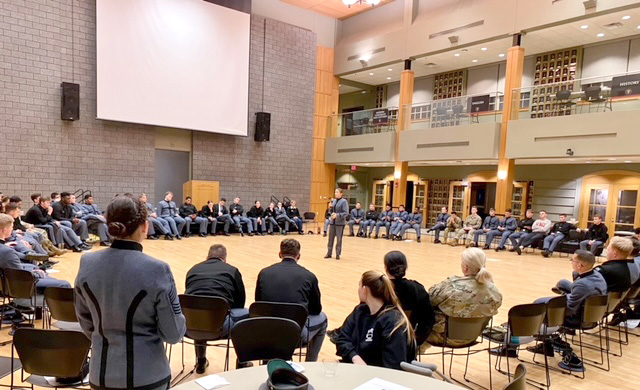
Cadets holding a discussion in Marshall Hall.

The club is made up of about 40 members and holds dozens of different activities throughout the year. Bose said there’s no set schedule on what they do. It’s even open for rats to join.  

Most of the club’s events on post are open to the full VMI community, so a lot of cadets who are not in the club participate. Hundreds of cadets have participated in the club’s fall debate, the Social Business Standards event, the fall Life, Culture and Society film event, and the Native American Heritage event. 

“The nature of the things that we do is very dynamic. We’ll have people from the community reach out to us on a few day’s’ notice,” he said. “Some weeks ago, a few of us went to the public library and we helped out with moving shelves there and that was on short notice.” 

Col. Valentina Dimitrova-Grajzl, along with Lt. Col. Sara Whipple and Dr. Sabrina Laroussi, are faculty co-advisors for the club. Dimitrova-Grajzl said the club aims to build relationships and connections between people. 

“That is very meaningful, especially when technology facilitates living in our echo chambers and augments divisions,” she said. “Our club leaders have the opportunity to be creative, to communicate with multiple stakeholders, and to learn how to organize events. All of our club members have the opportunity to develop new skills, gain a sense of efficacy, and develop an appreciation for community engagement and service. We are very proud of the work of our club leaders and members. Cadets always do exceptional work, which is why the community reaches out to us with volunteer opportunities on a regular basis.”

Bose said he can see that they are fostering good relationships between VMI and the community. 

“I think it shows the community that cadets are always there to help. People from the community reach out to our club all the time because they know that we’re kind of the liaison between cadets and the community,” he said. 

Funkhouser said the club serves as a reminder for the Corps of the type of standards they are held to. 

“I think the Corps really appreciates the fact that we do set up events for everything and have that kind of in with our community,” she said. “If you need help, absolutely let us know. Anybody would be willing to do anything for you.” 

The Extra Mile: Aviation Club

When Carter Wasser ’25 got in a plane to fly it for the first time, she was scared for her life. Climbing up in the sky, they reached the desired altitude, and her instructor took his hands off the controls. She grabbed on, let her fears settle, and ended up falling in love with flight.  

“I found my passion of aviation at that moment,” she said. “It was insane to be so high up. I was just around my hometown so I could see it from a different perspective. That’s one of the things I love about aviation is you can go up and see the world from a different perspective and kind of just breathe for a little bit.”

Wasser is part of Virginia Military Institute’s Aviation Club. It’s selective — only eight people can join at a time, because VMI foots the bill for participating cadets to get five hours of flight time towards their private pilot’s license. The contract is through Blue Ridge Aviation, based out of Shenandoah Valley Regional Airport.  

The club is open to 1st Class cadets, with the exception of some 2nd Class cadets. Wasser and Brayden Jones ’24 were some of those exceptions — both joining as 2nd Class cadets. The enrollment process for the club is first-come, first-serve, with higher classmen getting first dibs.  

Those who participate in the club have to give a good deal of their time up for it. It requires travel to the airport in Weyers Cave, then hours up in the sky. Jones said you have to have your own transportation to make the trips to clock your flight hours.  

“People who are in a lot of different clubs or NCAA stuff, we kind of stay away from because we want to make sure people are getting the most hours as they can so that we can keep the club up and running since there’s not a lot of people,” said Jones, who is the cadet in charge of the club. 

The club is also geared towards those who plan on commissioning and entering the aviation field. Wasser said the club is a good opportunity to test it out — aviation in the military is selective, so the club gives a good option to try it out.  

To get your private pilot’s license, you need a total of 140 flight hours. The club will provide five of them each year per cadet. Members have already racked up hours, though, ranging from 15 to 40 hours.  

Club activities include understanding the basic flight controls of a Cessna 172, understanding flight pictures, also studying and working toward the written test portion of the private pilot’s license, which consists of a random selection of 60 total questions from a pool of 1,000.  

“It’s all learning about the flight controls of the Cessna 172 and how that correlates to flying in the Shenandoah area because flying the mountains is not the easiest thing in the world,” Wasser said.  

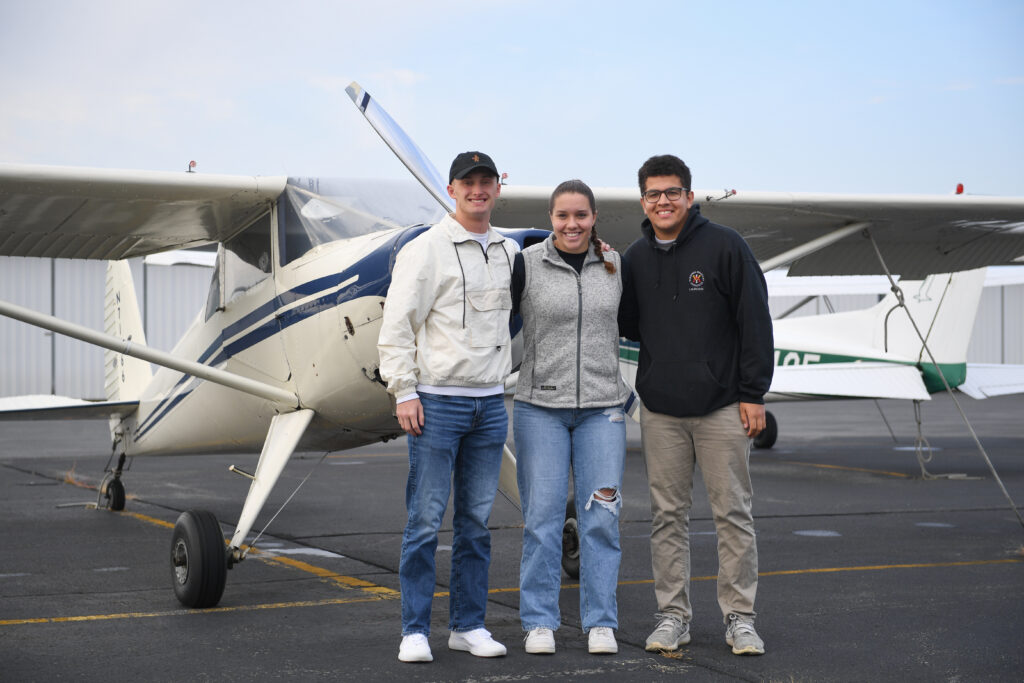
Three VMI Cadets stand in front of a plane on the tar mat, as part of the school's aviation club.

Experience in the air 

Wasser may have more flight time and plane experience than most members. She’s been flying back home in King George, Virginia. Graduating high school during COVID-19, her parents gifted her flight lessons.  

“I ended up falling in love with it. So, after my few flight lessons, I convinced my parents that I should continue, so I’ve been working on it for about two years now,” she said. “Every summer I go home I take flying lessons and work towards that.” 

But Jones went up in a plane to fly it for the first time last year. He said the instructor was surprised by how Jones kept his cool.  

“A lot of people kind of freak out when they get on the controls for the first time,” he said, but his instructor pointed out that, despite the plan doing weird things, Jones was able to remain calm and under control. “Then I got down on the ground and I was like, ‘OK, this is awesome. I’ve got to keep doing this.’ And I knocked out my hours for the first semester in like two or three weeks.”

Both are commissioning after graduation — Jones into the Navy and Wasser into the Army, both with aviation paths. For Jones, after graduation, he must teach for two years while waiting to go to flight school in the Navy.  

“I’m going to work towards getting my private pilot’s license and then fly in the Navy. Whatever they give me., I’m just happy flying,” he said.  

His plan after the military is flying privately for either the Department of Defense or other companies that have private pilots flying smaller planes. 

Wasser said she hopes after her time in the military she could come back to her hometown area near the Chesapeake Bay to work on conservation work. She wants to use her civil engineering degree and private pilot’s license to work with farmers and apply it to pesticide runoff reduction into the Chesapeake Bay. 

“Growing up on a farm I’d seen so many species die from runoff, pesticides, and herbicides,” she said. “I could take the flying aspect and the being outside aspect and kind of go out to farmers, get their soil, take it back to my lab tested and then take my own airplane and apply it and know that I was doing the right thing for the Chesapeake Bay, because that’s my home.” 

The Extra Mile: Golf Club

Zac Somers ’24 wasn’t hitting his shots the Sunday at a golf tournament. His swings weren’t looking good. The day just felt off. He needed some support to continue on the course.  

“I couldn’t hit a shot to save my life,” he said. “I called my mom like, ‘Hey, Mom, I don’t know if I want to quit, or I don’t know if I want to go.’” 

He went to his car and took a moment to set his mind straight.

“I sat there and had a long conversation with God. He told me to play. Did I do good? No. But I did better than Saturday,” Somers said.  

As the cadet in charge (CIC) for Virginia Military Institute’s Golf Club, he said often times the sport is a mental game.  

“With golf, it’s an individual sport. It’s all in their head. You basically have to be mentally strong. And that’s something that I’ve struggled with in the past, just that mentality,” he said. 

Somers got involved with the game of golf thanks to his grandfather. He credits him as his biggest inspiration when it comes to the sport. At a young age, he’d hit the links with his grandfather, then he started playing in middle and high school.  

When he got to VMI, his dyke (upperclass mentor) was part of the golf club. He decided to join his 3rd Class year, played a few tournaments and then by his 2nd Class year he was named assistant cadet in charge. Now, serving as CIC for the club, he’s been instrumental in forming a new tournament with the club, which began last year. 

Made up of 32 members, the club this year is all male cadets, but it is open to females. Part of the National Collegiate Club Golf Association, the club participates in various tournaments within that association. For each tournament only eight members can attend. Somers said it’s dependent on score and skill and varies for each event.  

“We’re starting to compete in everything, we want the best of the best in barracks, however, really, the club is just for those who like to play golf,” he said.  

Ian Struzzieri ’24, a history major, said he got involved with golf club after his roommate was the CIC two years ago. He’s been playing golf for about three years and thinks the club is important at VMI because there’s a good golfer population on post.  

“The team provides practice for the guys to go out and play or hit the range. It also brings that competitive atmosphere of a regular sport into the club realm,” he said.  

He uses his time in the club as a departure from cadet life. 

“The grind of golf lets all of life’s stressors go away,” he said. 

Allen Stewart ’24, a civil engineering major, joined during his 3rd Class year. He’s been playing golf for most of his life, starting with his father. He said that the key to golf is the willingness to play and have fun while not taking it too seriously. It’s a chance to go out and have fun with your brother rats, he said.  

Their home turf is Lexington Golf and Country Club and, even if they stay local to practice, it allows cadets to get off post and relax their minds.  

“To have the ability to just get off post in my opinion is the best thing,” Somers said. “There are  some club sports that don’t even leave post. Luckily for us, we have to leave post in order to practice.” 

But Somers has some rules — respect the course.  

“At the beginning of each semester [I explain] expectations on and off the course. Play fair, play right. Respect the course,” he said. 

Practicing in Lexington allows for participating cadets to also connect with those on the course, which tend to be a lot of alumni, Somers said. The civil engineering major said he’s able to talk to alumni and make connections that could help him upon graduation.  

“It’s a good way to network with the alumni while playing golf,” he said. “It’s the fact of networking and being able to get off post and meet new people. Get a taste of the civilian life, basically.”