Post View Unavailable »
New Website Launched »

The Extra Mile: Powerlifting Club

Calin Green ’24 was looking to escape from the rush hour of cadets at Virginia Military Institute’s regular gym. Every Tuesday, Wednesday, and Thursday around 4 p.m. he’d run into an influx of other cadets trying to get a workout in.  

With a background in wrestling, he was looking for options in strength training. Plus, he wanted to stay in shape in preparation for commissioning into the Marines, while also participating in ROTC. 

“Powerlifting was really right up my alley, and I fell in love with it really quickly,” the psychology major said.  

As the cadet in charge of the VMI Powerlifting Club, he said even though the club is a team, the sport itself is a competition with yourself.  

“You’re trying to better yourself,” he said. “This is such an individually-focused sport. You can really focus on what you did right and what you did wrong. There’s no other confounding factor, like an opponent you’re going against.” 

You can be your greatest competition, Green continued.  

“IIt’s just you and that bar and whether you get it up or not,” he said. “Usually you can see or feel what exactly went wrong. Whether there was a missed groove in your form or if you just chose too heavy of a weight for your next lift.  It’s also something that you can constantly improve at and you can track your improvement very easily.” 

Although it’s an individual sport, the club is very team-oriented. When someone is going for a personal record (PR), the rest of the club is there to back them up and cheer them on. The powerlifting gym, which is in the basement of Cocke Hall on post, is completely outfitted for heavy lifting — plus it has an amazing sound system that allows for music to be blasted while members work out.  

“I like the type of people that it attracts, and the environment of the gym, especially,” Green said. “Everyone’s very supportive of each other and their lifts and their goals. I think it’s good to have people that support you and I think it’s good to support other people and their goals. I just think it fosters growth better than anything else.” 

Powerlifting club also provides a good mental break.  

“I think being able to give your maximum effort in something and just say that I trained the hardest that I possibly could today, that it makes you feel like you’re worth something, makes you feel like you can do something and it makes you better off,” Green said. 

Owen Clifford ’24, a civil engineering major, got into the club post-Breakout after he started hitting the gym more. He was looking for a club sport to participate in and he had heard from several friends that powerlifting was a good option.  

The assistant cadet in charge for the club said his favorite part about the club is the separate space and equipment allotted for the club. But also, being surrounded by people who are working towards the same goals.  

“That creates a very encouraging environment and people to kind of compete with internally,” he said. “Having the guidance from the coaches to make sure that I’m doing the best I can so I’m reaching a much higher goal, much higher lifts than I would just on my own in the normal gym.”

Both Green and Clifford said having the powerlifting club is a good departure from the demands of being a VMI cadet.  

“Having a little outlet — the hour and a half, where you’re not really worried about anything else, you don’t even worry about how long you have to be there because that’s your time to be there,” Clifford said. “So it makes it super easy to just focus on that. Go as hard as you want to, have the music pretty much as loud as the speakers will handle, and just work on yourself before finishing up the day.” 
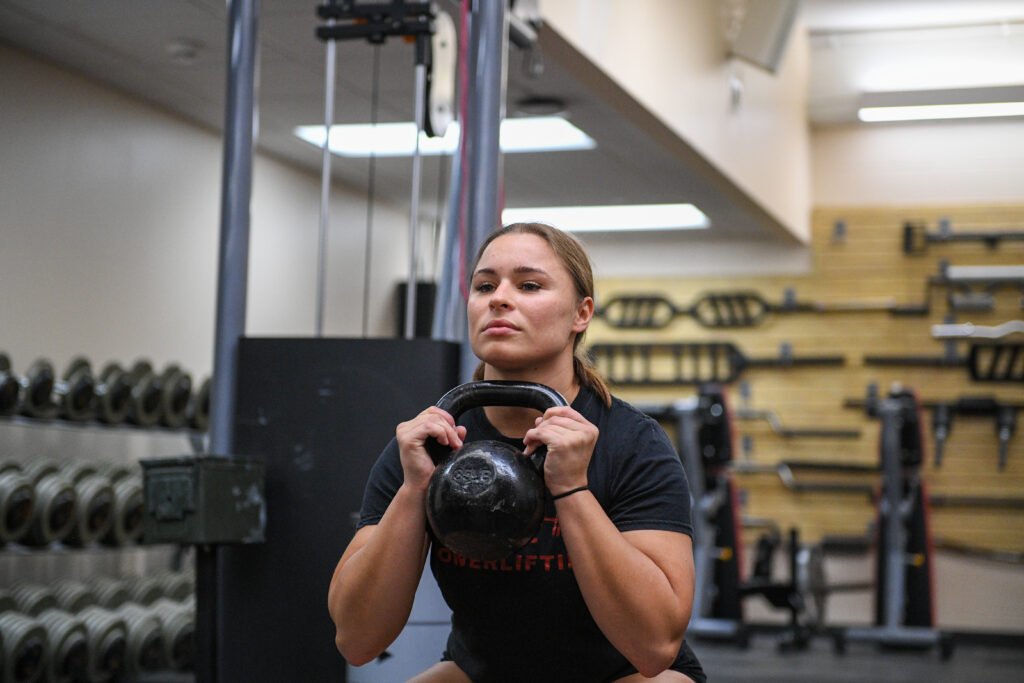
A woman does a goblet squat with a kettlebell.

The club centers on three main lifts: deadlift, back squat, and bench. The club, which has about 40 members, participates in various competitions throughout the year, where members are broken up into different weight classes. On average, about 20 cadets participate in the club practices regularly.  

Coach David Henson, police captain for VMI Police, and Coach Rebecca Owen enjoy interacting with the cadets and boosting their physical power. Henson has been coaching the team since 2013 and became head coach in 2016. The two work with cadets on their form, technique, programming, and preparation for competitions or meets.  

“Working with the cadets doing something they are very passionate about not only helps them but helps us as well,” Henson said. “Powerlifting is tough not only physically, but mentally. It’s a maximal strength sport and you have to have an appreciation for strength to enjoy lifting heavy weights a majority of the time.” 

The sport, he says, is beneficial in increasing overall strength and requires “sacrifice, discipline, discomfort, and determination.” 

“What makes it worth it is when you lift a weight that you previously thought was impossible,” he said.  

This is Owen’s ninth year coaching the team.  

“As coaches, we are trained to pick apart the power lifts (squat, bench, deadlift). We are pretty good at picking out weaknesses due to technique or muscle imbalances,” she said. “The strength aspect definitely helps with physical fitness tests, but one of the biggest benefits is being a part of the powerlifting family. We tend to develop strong relationships as we support each other in the trenches — tough training, maximal efforts in competitions, etcetera.” 

The two coaches said they most enjoy seeing the progress and transformation of the club’s members.  

“I really enjoy interacting with the cadets at practice and when we travel to meets,” Henson said. “Powerlifters go out of their way to support one another and that creates a great atmosphere to be in, especially here at VMI where nothing is really easy. Watching the cadets hit a PR at a meet and being able to celebrate with them makes it all worthwhile. It shows them that hard work pays off and that carries over to other aspects of life.”   
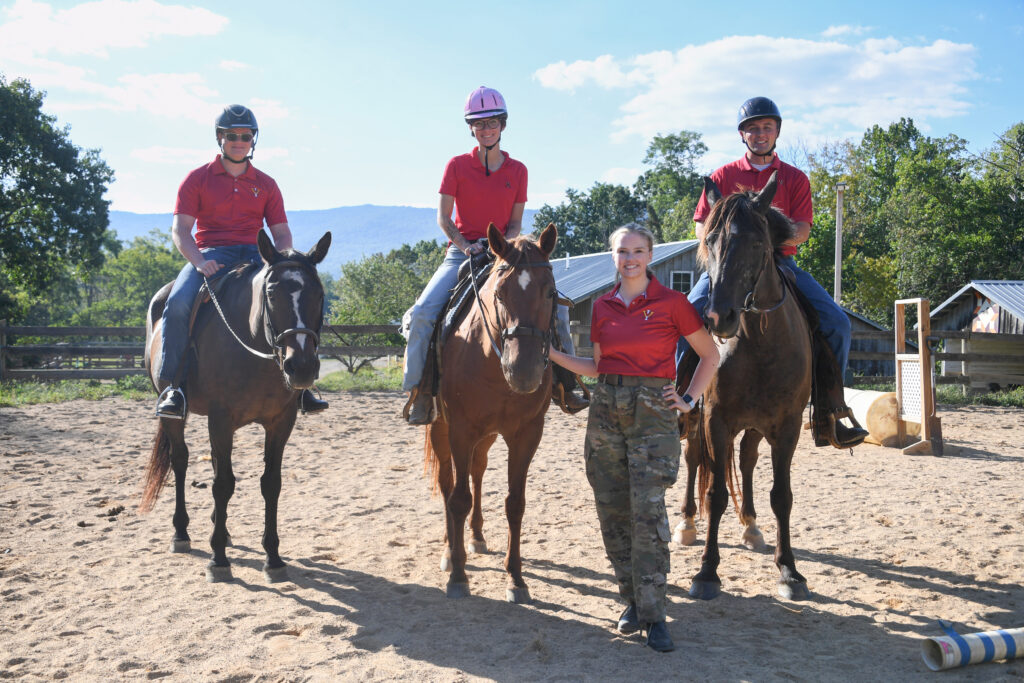
The Extra Mile: Equestrian Club

When a cadet is looking for a unique club experience at the Virginia Military Institute, the equestrian club might just be the perfect fit. David Hess ’24 explained that the club is best known for its blend of riding, training, and trail adventures.  

The VMI Equestrian Club attracts a diverse group of cadets. Some, like Hess, come from horse-related backgrounds, while others enter the equestrian world with no prior experience. At the heart of this club is Tish Vest, a dedicated horse trainer who leads the club.  

“She will work with anybody and teach you everything you need to know,” said Hess, the cadet in charge.  

Access to the equestrian club is made possible through Vest, who boards the horses, some of which belong to her, while others are owned by individuals who pay for their care at her barn.

Cadets, in return, provide a valuable service by riding and exercising these horses, ensuring their well-being.  

Saddling up to de-stress

For Hess, the equestrian club serves as a sanctuary from the rigors of academic life at VMI.  

“I love to get outside and go to the barn two to three times a week. It makes me feel like I’m at home,” he said.  

The stressors of everyday cadet life fade into the background as cadets interact with horses.  

“You truly do get to know the horses, and building a relationship with them is just like you do with a pet. It helps lighten your mood,” said Hess.  

The club’s regular weekly meetings begin at the Washington Arch on Thursdays. From there, the group travels to Windhorse Farm, where they saddle up for the evening.  

Once at the farm, club meetings are kicked off by grooming the horses. This task tidies up the animals and deepens the connection between rider and horse.  

“The first thing you do is brush them down, and that does two things: it cleans up the dirt and debris before putting the saddle on, and it also formulates your bond with the horse,” said Hess.  

Once the horses are ready, the cadets determine their riding goals for the day — whether it be in the ring or a trail ride — all under Vest’s guidance. The practice lasts for about an hour to an hour and 15 minutes, after which the cadets return to the barn to care for the horses, removing saddles and brushing them again.  

Cadets atop horses while participating in VMI's equestrian club.

No equestrian experience? No problem.  

For cadets interested in joining the equestrian club with no prior horseback riding experience, Hess emphasizes the club’s welcoming and supportive atmosphere.  

“You don’t have to have any gear,” he says, “everything you need is available at the barn.” 

Newcomers can contact Hess to arrange a visit.  

The introductory experience resembles learning to swim, where they will quickly acclimate to the horses, their size, and their temperament.  

“You just kind of throw them on the horse and it’s sink-or-swim,” he said. “You’ve just got to get on the saddle and learn the technique from there.”   
 
“A lot of people who haven’t been around a horse get intimidated,” he said. “But the more you’re around them and get to know them, it’s almost like being around an oversized dog.”  

Currently, the equestrian club is comprised of around a dozen members, with an average of four to five cadets attending each practice. The flexible schedule accommodates the demanding commitments of cadet life, with members deciding on participation shortly before each session.  

The Extra Mile: Glee Club

On Matriculation Day in 2020, Joyce Ellis ’24 wore a shirt that said, “I was in chorus in high school.” It caught the attention of Col. John Brodie, Virginia Military Institute’s music director. 

“He was like, ‘Oh my gosh, you sing!’ she said. “He just had this crazy personality and he told me that I was coming to glee club, wrote my name down, then emailed me later.” 

She’s been in the VMI Glee Club since she was a rat — it’s one of the only clubs that rats can join. Glee club is also one of the oldest clubs on post. The club was first listed in the VMI yearbook, The Bomb, back in 1885, where the club performed with vocals, guitars, mandolins, and violins. 

According to Brodie, in the early days of glee, cadets would sing on the stoops around post and perform for the other cadets.  

The more-than-a-century-old club has been in high demand since its inception, performing around the country and the globe. Members like Ellis, who is the club’s vice president, say that their spring trip is often the highlight of the year, performing in places like Florida and even Puerto Rico. 

Club president Rommel Meza ’24 has an extensive background in vocal experience. The tenor was part of a professional acapella group at his high school in Petersburg, Virginia. It was something he wanted to continue, no matter what school he ended up at for his degree.  

Ben Lovingood ’25, the glee club secretary, has been in choir since elementary school. But, prior singing experience isn’t a prerequisite for joining the glee club. 

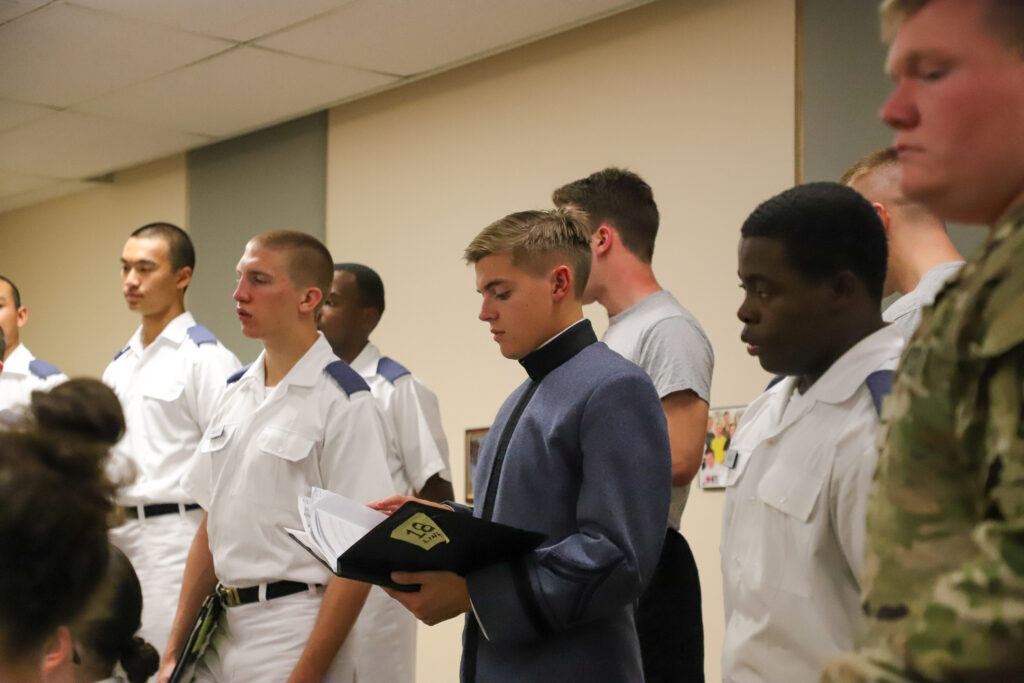
Cadets sing in the glee club.

Overall, the club has a welcoming vibe. Meza said they encourage incoming rats and cadets who are showing up for the first time to step out of their comfort zone. The range of experience varies — some people have spent much of their life singing or being involved in music while others have never touched sheet music or even sung before. 

“You have kids like us who are willing to step in, help, encourage them, and teach them the ropes,” Meza said. “We’re just trying to keep an open and welcome vibe, ensuring that they step out of their comfort zone a little bit and try something new.” 

The club rehearses twice a week and includes two smaller ensembles — the “Men In Grey,” a male acapella group, and the “Sentinels,” a mixed voice specialty septet. 

“One of our main points is that you don’t have to have any singing experience,” Lovingood, a baritone, said. “Obviously it helps. But if you’ve literally never sung a song in your entire life, and you’re like, ‘I want to try this,’ then we’re very welcome to that.” 

Ellis, an alto, said the club really drives inclusivity, especially with the acceptance of rats into the club. 

“It makes it feel like more of a family for them, like stress relief from their day-to-day. So that’s kind of a big pull,” she said.  

For Ellis, the glee club was something she could look forward to every week. 

“I would know Mondays and Thursdays, I could be with some of my closest friends. And I would be able to just sing, which is what I really enjoy doing,” she said. “I just really love the environment, like how nice everyone was and how inclusive everyone was.” 

Members of the glee club also act as ambassadors for the Institute. 

“For the glee club, it’s not just performance-based. We’re also interacting with a lot of people, civilian speaking and alumni, too,” Lovingood said.  

“Every time we go out, we are acting as representatives for the Institute at all times,” Meza added.

Two years ago, the club went to Puerto Rico and performed at the governor’s mansion and for Congress. Last year, they performed in Florida. This spring, the club is headed back to Puerto Rico.

Brodie said the glee club allows cadets to have a musical outlet. With more than 60 other clubs on post, glee has to compete with a lot of variety. Brodie said there are only a few fine arts club cadets can choose from, glee being one of them. With the busy schedules, he said it can be tough for some cadets to fit it in, especially with the later practices twice a week.

“Singing kind of lets off steam,” he said.  

Brodie gets to put his hat in the ring for the music selection, picking more patriotic tunes and old standard acapella music. But, the members also get a say. In the past, they’ve done Disney songs, Beach Boys, and even Backstreet Boys. This year, Brodie said they’re working on “Killer Queen” by Queen and potentially some songs from the musical Hamilton.  

Overall, Brodie likes the musicality of the glee club and how it not only provides the members solace, but it gives those who are listening to it an experience they won’t forget.  

“I’ve had much more meaningful musical experiences, conducting concert music with the glee club than I ever get with the band or the jazz band or stuff like that,” he said. “It’s kind of cool. I’ve had times when the glee club could bring you to tears, like emotionally and you know, playing ‘Hey, baby’ doesn’t bring you to tears.”

The Extra Mile: Ducks Unlimited

Growing up, Reese Devries ’24 spent a lot of time on the water. His family owned a marina on the James River in the 1960s. As the seasons changed, so did their hobbies.  

“Fishing and being on the boat were kind of a segue into duck hunting,” he said. “Once the summer runs out, we’re switching over and trying to find something new to do on the weekends.” 

After spending time on both federal and state land, he was inspired to preserve the land he loved. Eventually, his family boating trips turned into clean-up efforts.  

“We would go out, and pick up trash, or rebuild blinds,” he said. “We wanted to keep the habitat up for fish, waterfowl, and everything else.”  

Throughout his childhood, Devries spent weekends hunting with his uncle and grandfather, and occasionally attended Ducks Unlimited meetings. During his first year at Virginia Military Institute, he learned that his uncle–dyke (a roommate of his senior mentor) was one of the founding members of VMI’s Ducks Unlimited Club.  

“He asked if any of us wanted to go to the club, and I was like, ‘Yeah, I love Ducks Unlimited,’” he said. “And now here I am — three years later, as a chairman.”  

What is Ducks Unlimited?  

The mission of Ducks Unlimited is to conserve, restore, and manage wetlands and associated habitats for North America’s waterfowl. The VMI Ducks Unlimited Club hosts an annual banquet at the Commonwealth Club in Richmond, which is accomplished by fundraising through a live auction, raffle, donations, and selling tables.  

Last year at the annual banquet the VMI club raised $27,000 for Ducks Unlimited.  

“All of that money goes towards the conservation mission,” said Devries.

“We’re not just a VMI club — we’re also a part of a national organization,” said Devries, who is the cadet in charge of the club. “We get to work with people who have been doing this for 20 to 30 years, as opposed to us, who have only been in the club for three years.”  

With nearly 4,000 Ducks Unlimited chapters across the nation, the VMI Ducks Unlimited Club is making a huge mark.  

“We’ve been recognized as both a silver and an all-American chapter at our National Collegiate Conference,” said Devries. 

The VMI Ducks Unlimited Club works directly with the VMI Alumni Association, the regional director of Ducks Unlimited, and the chairman of the Richmond Ducks Unlimited Chapter, Elliot Warren ’17. With these resources at hand, the VMI club can send out invitations and orchestrate large-scale events.  

Devries shared that the banquet is much greater than a networking event — It’s a chance to connect with likeminded individuals and make lasting relationships.  

“Alumni will come to their reunion, and they’ll recognize me and shake my hand and say, ‘Hey, man, when’s the next Ducks Unlimited banquet?’” he said. “The banquet doesn’t just impact us as a chapter — but the people that get to come and experience it really enjoy it.”  

A club strictly for hunters and fishermen? Nope.  

When it comes to hunting, deer, duck, squirrel, and rabbit are all fair game to Lucas Wood ’24. Growing up in Eastern North Carolina, he started hunting with his dad at a young age. 

Wood, an economics and business major, interned with Ducks Unlimited last summer. After graduating from VMI, he hopes to return to their corporate office. “I’m looking at potentially going back there to work for Ducks Unlimited, or going into agricultural sales,” he said.   

There’s a common misconception about Ducks Unlimited. It’s a conservation group, not a hunting club, according to Wood, the assistant cadet in charge.  

The biggest challenge the organization faces? Convincing hunters to practice conservation.  

“When somebody gets that itch, they want to take people with them,” said Devries. “They want to get other people involved … so they have somebody to go with and Ducks Unlimited is a great place to find people to go with.”  

The group has two main recruiting pools: “people who enjoy hunting and people who are solely there for the conservation efforts,” said Devries.  

For hunters, the organizations’ goal is to educate and inform them.  

“The biggest thing that anybody that’s out hunting can do … is making sure that they’re following all of the regulations,” said Wood.  

While these rules may seem strict to the average person, they are in place for a reason.  

“If they have a limit on how many ducks you can kill, there’s actually a scientist and biologist who figured out that that is the best way that we can grow the population of the waterfowl,” said Wood.  

Ducks Unlimited is open to all cadets, including rats. The club hosts their annual event during the Spring semester and encourages members to take on leadership roles within the club. “It’s really nice having [the rats] come back… and then they can give guidance as 3rd Class cadets,” said Devries. “Then, they can take on a leadership role as a 2nd or 1st Class cadet.”  

The Extra Mile: Firefighting Club

As a junior in high school, Heaton Lawrence ’26 was inspired by his science teacher to become a volunteer firefighter. Within a year, he began volunteering his time at Goochland County Fire and Rescue.  

“I completed the academy, got all of my certifications, and started volunteering which was two nights a week of 12-hour shifts,” said Lawrence, the assistant cadet in charge of the VMI Firefighting Club.  

For John Taxiarchou ’24, the decision to become a firefighter wasn’t quite as easy. 

One of his friends volunteered at the local fire department and encouraged him to join. He was interested in becoming a firefighter but gave himself two weeks to simmer on the idea.  

“I told myself, if I don’t like it, I could always decide that it was not for me,” said Taxiarchou, the cadet in charge of the VMI Firefighting Club. After several nudges from his friend, he turned in the paperwork and began volunteering as a firefighter at Long Valley Fire Company.  

“Within the first call, I was pretty much hooked,” said Taxiarchou.  

From jumping on the engine to rushing through town, he experienced a thrill that encouraged him to keep serving.  

“For me it’s a humbling experience to see people at their lowest point and have them look to you for help,” he said. “The lights and sirens and going fast to call gives me an adrenaline rush.” 

Becoming a volunteer firefighter 

To become a firefighter, you must be state certified. It’s a lengthy and grueling process, Lawrence said.  

Before receiving your certification, you complete an academy which requires six months of training.  

“I was in the academy on Mondays and Wednesdays from 6 p.m. until 10 p.m., and again on Saturdays from 8 a.m. until 4 p.m.,” Lawrence said. “Then, you’re ready to take your state exam.”  

Cadets in the VMI Firefighting Club have the option of serving at three different departments — Lexington Fire Department, South River Fire Department, or Kerrs Creek Fire Department. Members of the firefighting club are permitted to volunteer for two days each week — once during the academic week, and once on the weekends.  

As a volunteer, Taxiarchou works 12-hour shifts on weekdays. His shift begins shortly after supper roll call (SRC) and ends the next morning at breakfast roll call (BRC). On the weekends — his shifts range from 24 to 48 hours.  

Volunteer firefighters work alongside full-time firefighters at the Lexington Fire Department. Taxiarchou shared that this has been a highlight of his volunteer experience.  

“You volunteer and you’re embedded with the career staff,” said Taxiarchou. “They uphold all the same standards, and they expect of you the same as they would any other firefighter, whether you’re a career or volunteer.”  

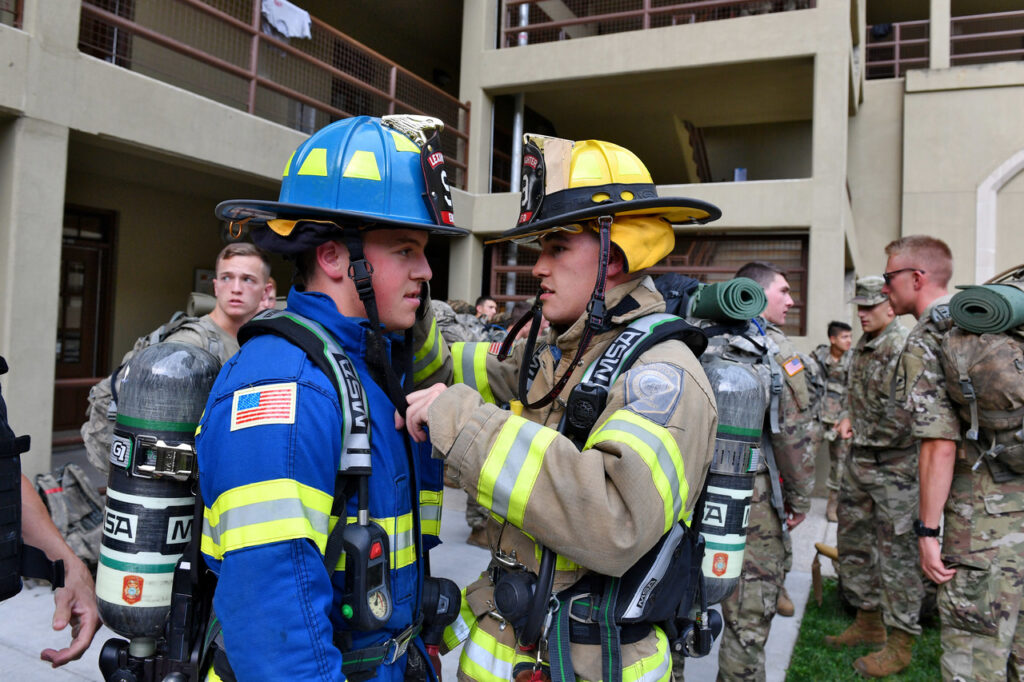
Two cadets gear up in firefighting equipment in barracks.

The reward outweighs the risk 

Firefighting is a large time commitment, but one that Taxiarchou enjoys. He shared that many people ask him why he volunteers his time. His response – “If I can help even one person, that’s enough for me.”  

For Lawrence, the brotherhood among firefighters is what keeps him going. He is especially close with his home department, the Goochland County Fire and Rescue.  

“I feel honored to have run calls with them,” he said. “I couldn’t say enough good things about the people in that department.”  

Firefighting on post 

In addition to serving the community, the VMI Firefighting Club also serves the Corps. “We focus on educating people in the Corps about firefighting and fire safety,” said Lawrence.  

During room inspections, members of the club go from room to room and ensure the fire escape plans are up to date. The club also hosts the 9/11 Memorial Stair Climb each year.  

“I helped run the 9/11 stair climb this year, which was an incredible experience,” said Lawrence.   

This year, the club hopes to improve room inspections, drill with the local firehouses, and continue to educate the Corps and the community. To accomplish this — they have set a goal of producing a public service awareness campaign.  

Before cadets leave for Thanksgiving furlough, the club is planning to hold a public safety announcement on post.  

“We are working to organize some kind of event to bring awareness of the dangers of drinking and driving, one potential option being explored is the possibility of a real-life vehicle extrication drill that would simulate a drunk driving accident,” he said. 

The Extra Mile: Promaji

In 1975, several Black cadets at Virginia Military Institute joined together to create a community for minorities on post. To better understand VMI, and navigate the Institute as a Black cadet, these students assembled to build what is now known as “Promaji.”  

When the club was created, the members made it their goal to leave a legacy for Black cadets at VMI.  

“One of the first classes of Black cadets thought that they needed to have a community of people where they felt like they belonged,” said Fatoumata Diallo ’23, last year’s president of Promaji. “It was this idea of togetherness … looking out for each other and looking out for the people that came after them.” 

Promaji comes from the Swahili word “Pamoja,” which translates to “togetherness.” Today, the group still embraces this pillar and has extended its mission to serve all cadets and all minorities.  

Representing the underrepresented  

“The club members have become more diverse over the years to include people from different cultural backgrounds and different genders,” said Diallo.  

Mark Shelton II ’23, council member of Promaji and 2023-24 regimental commander, explained the group’s significance – “We have a lot of underrepresented groups at VMI,” he said. “Promaji gives those individuals a safe space, a place to interact with their peers and people that look like them or may have a similar background.”  

The club meets once a week and holds various events throughout the year.  

“We host movie nights, trivia nights, and open mic nights,” said Shelton. “We also sponsor sporting events, like basketball tournaments and other tournaments.”  

To celebrate different heritages, the club hosts events for most heritage months.  

“We’ve held events for Black History Month, Women’s History Month, Hispanic Heritage Month,” said Shelton.  

The bond among cadets and alumni at VMI is best defined by the term – “One Corps, One VMI.” Shelton shared that this bond is parallel to the mission of Promaji.  

“Togetherness … ‘One Corps, One VMI,’ they’re interchangeable,” he said. “We encourage everyone from different backgrounds to come and share their ideas, beliefs, and to be supportive of everybody because no one person is the same.”  

Building leaders and breaking up the Rat Line 

Shelton and Diallo were both influenced by their dykes to join the club, and they became members during their first year at VMI. When it was time for club meetings, Diallo and several of her brother rats gathered in their dyke’s room to head down for the meeting. “Initially, we didn’t think much of it,” she said.  

Diallo joined the club to accompany her friends and her dyke, but it later grew into a meaningful experience. At one of her first meetings, Diallo noticed that the atmosphere of the club was different.  

“Seeing how welcoming the upperclassmen were to us, even though we were rats…” she said. “Telling us about opportunities we could apply for, telling us how to stand out, and strive at VMI… is what made me interested in staying in Promaji.”  

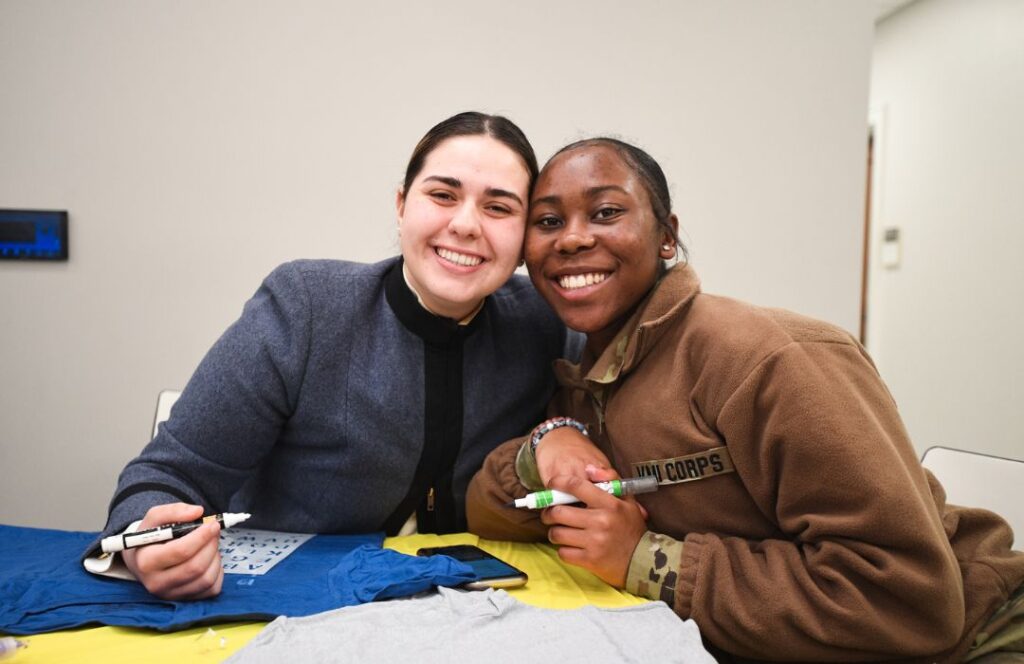
Two cadets pose for a picture.

Diallo shared that the club was instrumental in her leadership journey, helping her take steps towards being someone who stands up for people like herself.  

“I wanted to be a role model for other cadets who came in and looked like me, or who felt like they didn’t see representation in leadership positions,” she said.  

As a rat, Diallo recognized the importance of the club and wanted to follow in her dykes’ footsteps. Holly Jabo ’20 was the president of Promaji in 2019 and spurred a long journey of leadership in her rat. As a 3rd Class cadet, Diallo became the secretary and the following year, she served as the vice president of Promaji.  

The Promaji legacy  

Each year, Promaji alumni ask a single question to the 1st Class club members: “What legacy do you want to leave once you leave Promaji?” For Diallo, the answer is inherently clear.  

“I hope that Promaji remains a club for minorities and that they feel safe to discuss any issues,” she said. “I hope Promaji keeps representing and being a voice for minorities … and that they will not be shackled or submit to any pressure from people or organizations … that’s what makes Promaji unique.”  

Diallo hopes that the club can increase its membership and continue to expand its diverse composition.  

“I hope that Promaji will continue to welcome anyone that is willing to listen or learn,” she said. 

The Extra Mile: Ranger Challenge

Have you ever wondered what a mix of Army ROTC and a varsity sport would be? You’d get the Army ROTC Ranger Challenge team, which is a club at Virginia Military Institute.  

A cadet has two chances to make it into the Ranger Challenge team at VMI — once in the spring and another in the fall each year. The week-long tryout results in only 50% of those attempting landing a spot. 

What do tryouts entail? Two words — grueling effort. 

The club tests several skills, from written land navigation tests and day orienteering, to basic rifle marksmanship and a grenade assault course. There’s also the M-16 assembly/disassembly test, a mystery challenge that changes every year, and night orienteering. 

According to the Army, the Ranger Challenge team is described as an Army ROTC varsity sport, where teams form early in the semester and train nearly every morning of the week all the way up until the Sandhurst Military Skills Competition at the U.S. Military Academy (USMA) at West Point in mid-spring. 

But that’s not all, the club is also required to complete the Army Physical Fitness Test, which consists of two minutes of push-ups, two minutes of sit-ups, and a two-mile run — all to be completed when participating cadets are operating on less than six hours of sleep. 

Fun, right?  

It is for those who participate. More so, the experience helps prepare them for their future military careers.  

“You’re training for, essentially, what your job is going to be,” Collin Fitzpatrick ’23 said. “It’s a really good stepping stone.” 

The club is associated with Army ROTC, so those who are lucky enough to make the ranks are participating in activities that they will most likely be doing in their careers after VMI. Think of it as the best of the best. The cadets on the Ranger Challenge team often rank the highest in Cadet Summer Training (CST) and VMI’s Army ROTC.  

“It’s definitely a leg up for training for the standard Army ROTC,” Fitzpatrick said.  

The club is more rigorous than other clubs at the Institute. They practice as if they were an NCAA team. They complete physical training each morning that lasts for an hour beginning at 5:45 a.m. Then, every afternoon, they have skills practice for two hours.  

“We don’t have NCAA status, but I think the training time is similar to NCAA teams,” Fitzpatrick said. “We’re definitely one of the more active clubs. The thing is, it’s not really seen as a club because it’s associated with Army ROTC. We do fall in club status, but it’s kind of like limbo.” 

The majority of the team’s career goals are to be entry-level officers in the military.  

“It’s just a group of individuals that all are going toward the same goal. At the end of the day, we’re training for our jobs in the military,” Fitzpatrick said. 

Janine “J.J.” Colantonio ’23 said Ranger Challenge allows her to surround herself with others who are looking to better and challenge themselves.  

“It sounds kind of selfish, but we are preparing ourselves for careers at the end of the day,” she said.

Training for the Ranger Challenge team extends well beyond the academic year. The 2nd Class cadets on the Ranger Challenge team also participate in CST at Fort Knox, which involves platoon-level tactics and 10-level tasks, like individual soldier tests. Others throughout the summer maintain a regime with specified workouts to keep them in shape for the following year’s tryouts. 

The majority of cadets who participate in the Ranger Challenge either continue in schools like the Sapper Leader Course with the Army or Cadet Troop Leader Training (CTLT). 

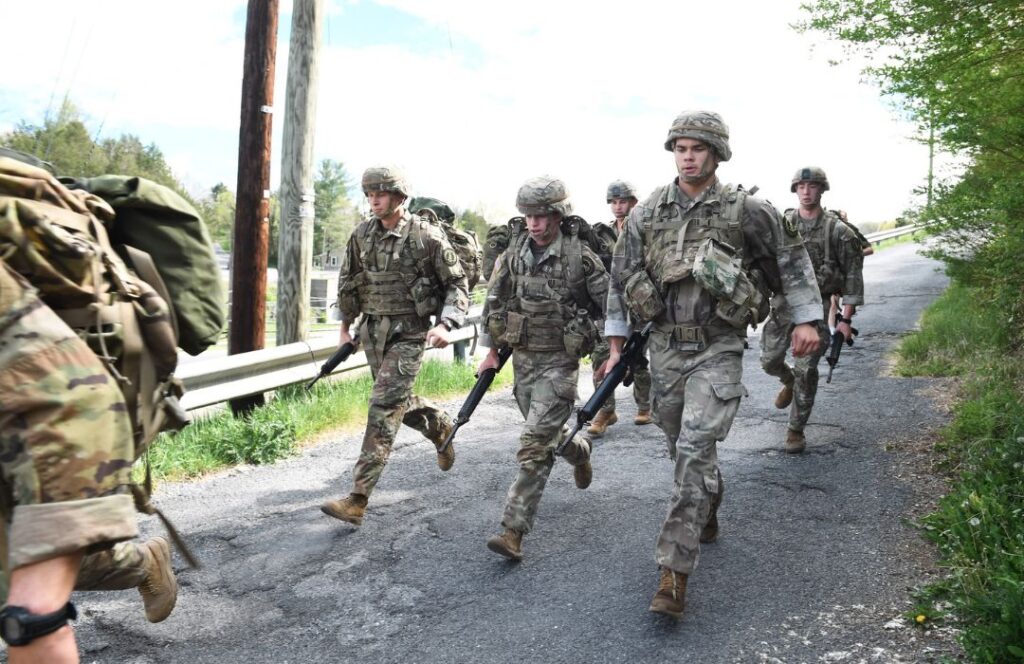
VMI cadets participate in Ranger Challenge, an elite Army ROTC program.

“It’s basically just like the military version of an internship,” Colantonio said. “You’re going to shadow like a [platoon leader] in a certain unit … so a certain job type or description that appeals to you that you’d be interested in. And you’re just seeing what the unit does, what you would do in the future in that specific job.” 

Most recently, the team placed fifth, winning a Sandhurst Medallion for the top five overall teams out of 48 teams in the annual Sandhurst Military Skills Competition April 28 and 29.   

VMI competed against teams from USMA, the Air Force Academy, and the Coast Guard Academy, as well as Army ROTC units across the United States including Texas A&M, Notre Dame University, North Carolina State University, Liberty University, and the University of Central Florida. In addition, 14 international teams competed including the Royal Military Academy Sandhurst (RMAS) in Great Britain, as well as teams from Brazil, Canada, Chile, Denmark, Germany, Korea, Japan, Latvia, Mexico, Poland, Thailand, and Sweden. 

Those competing spent two days running a myriad of obstacles including weapons disassembly/assembly, grenade assault, gas mask function, rifle and pistol shooting, programming a radio, carrying a casualty, land navigation, and lugging their minimum 35-pound rucks for approximately 30 miles. The winner of the competition is chosen based on performance at each of the obstacles as well as the speed with which they complete them.    

The takeaway, despite the arduous efforts in this club, is the relationships made with those who are part of it. 

“It’s people,” Thomas Marlow ’23 said. “The caliber of people that we wake up every single morning with is pretty substantial. That reflects in so many different aspects here at VMI, not just Army.” 

“I’d say a big thing even from the relationships that I formed as a freshman, even the seniors on the team at the time, they’ll reach out to me, or I’ll reach out to them and  that mentorship continues,” Fitzpatrick said. “And as they move forward in life, I kind of move in their footsteps.” 

The Extra Mile: Yearbook Club

The ability to flip through pages and be transported into the past is sort of magical.  

James Burns ’23 and his team spend the academic year scouring post for memories. They come in the form of pictures, words, moments, and more. From the Rat Challenge, Breakout to Ring Figure and graduation, the Virginia Military Institute yearbook, “The Bomb,” takes a snapshot in time that can be memorialized forever. 

“I think of ‘The Bomb’ as a way to remember what happened during the year when you look back in the book 25 years from now. It is truly putting together the collection of moments and people that make VMI special,” he said. 

The yearbook not only records events and cadets, but academics, clubs, sports, and shoutouts to the graduating class.  

For Burns, it’s the job of the editor of the yearbook to make sure those college moments are captured and put into print. It’s also a job he kind of just fell into. His fellow brother rat Sibi Bagavathy ’23 recruited him to help. 

“I showed up to a meeting and I got put directly to work. That was all she wrote,” the cadet-in-charge said. 

Now, he’s in charge. He works closely with Command Sgt. Maj. Suzanne D. Rubenstein with putting the actual yearbook together.  

“At the end of the day what happens to the yearbook is my decision, but I like to take a lot of input from my team in terms of cover, different spreads, themes, colors, etcetera,” he said.   

This year’s theme is “Shadows,” which will feature a series of shadowed photos around post.  

The yearbook was first published in 1885. After a nine year hiatus, it has been published continuously since 1895, with the exception of 1945 and 1946. VMI also digitized the yearbook collection from 1885 to 2010. 

“It is one of the oldest publications,” Rubenstein said. “It’s a year of history captured in the moment. You’re not going to get that back. You’ve got to publish this book and see faces and names.” 

The team spends the year ticking off boxes, hitting up all the clubs, activities, and more on post. It also allows participants to set their own schedule and work at their own pace — as long as deadlines are met. It’s an ongoing process, Anna Yemelianova ’25 said. Although things are wrapping up in mid-to-late April in terms of finalizing the yearbook, there are still things they have to document.  

“We still have so much of the year to get through and there are so many pictures and events that we could get into the yearbook,” Yemelianova said.  

The yearbook staff reiterated that Rubenstein tells them this is a cadet yearbook — not a staff yearbook — so the focus should be on those attending VMI.  

“She’s fantastic in that she allows us to have creative direction,” Bagavathy said. “Like what color it is going to be, or the overall theme of the yearbook. At the same time she’s basically kind of pushing us along where we need to be pushed along.” 

Bagavathy said the club is what you make of it, all depending on what your interests are.  

“For me photography, and I guess the creative direction of the yearbook design itself,” he said.  

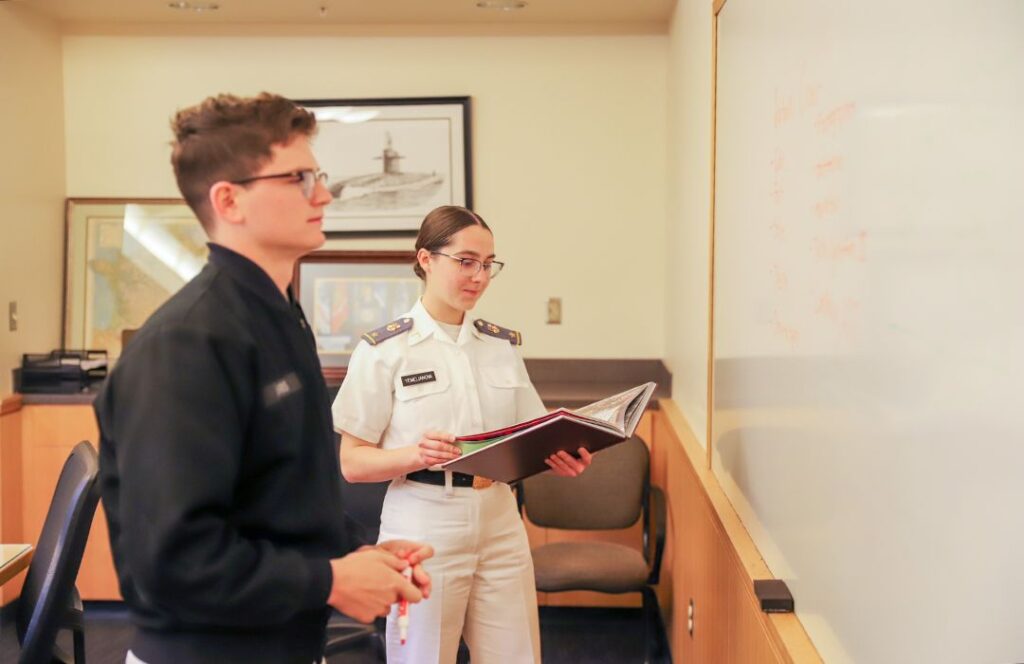
Two students plan out portions of the VMI yearbook, "The Bomb."

Bagavathy was involved with the yearbook while in high school. Overall, he enjoys the creativity of it.  

“Getting together and working in a team group environment … I was really excited to hear that there was something here at VMI just like that,” he said. 

The yearbooks, which are funded by the advertisements sold and placed in the back of them and by the purchases in previous years, are extremely popular.  

“My favorite thing about the yearbook is taking photos during the different events here. Especially when people don’t know the photos are being taken and they are living in the moment,” Burns said. “I think it’s awesome to be able to look at how far you and your class have come in just four short years here.” 

Bagavathy said VMI’s smaller size is a benefit.  

“I think VMI, given its size, is actually able to do a good job of capturing what cadet life is like, in addition to having biographies for each person laid out well. These bigger schools, you can’t really do that,” he said. “I think we do a good job of capturing all the different elements, rather than just making a glorified brochure.” 

It’s more personable, Yemelianova confirmed. 

“You can pick up a yearbook and just flip through it and be like, ‘Oh, I know so many of these people,’” she said. 

“It’s kind of nice having a platform to essentially make those memories into concrete, tangible objects that you can look at,” Bagavathy added. 

The Extra Mile: Drone Club

At 8 years old, Charles Malé ’25 had his eyes set on flight. “I’ve always loved drones, helicopters, and anything that moves,” he said.  

He spent years playing with toy cars as a child but eventually got bored with them. Moving onto toy helicopters, he finally landed on his true passion: drones. 

Malé, assistant cadet in charge of the VMI Drone Club, is a computer science major with a minor in cybersecurity, from Arlington, Virginia. Malé came to VMI with an associate’s degree in computer science and he plans to graduate early in 2024.  

“I’ve done a lot of work with drones over the years,” he said. “But they were quite expensive.” The cost of flying drones and professional gear can reach upwards of $1,000. Due to the expense of drones, Malé decided to take a break from his hobby.  

Luckily for Malé and other cadets at Virginia Military Institute, Dr. Sherif Abdelhamid had other plans for the Drone Club at VMI.  

Abdelhamid, assistant professor in the Department of Computer and Information Sciences, received a grant from the Commonwealth Cyber Initiative. Abdelhamid leads VMI’s Drone Club and has a fellowship from CCI that he uses to sponsor research and cadet development.   

More importantly, he has used the grant to sponsor all the Drone Club’s activities. “Using the grant, we have bought around ten drones of different types, sizes, and purposes, as well as other IoT devices and sensors,” he said.    

While attending a cybersecurity event, Abdelhamid became interested in drones and the role that they play in surveillance and protection. “The drones are no longer just flying toys,” he said. When asked if he would support the Drone Club, Abdelhamid thought it would be a great way to apply his personal and research interests to a cadet involvement opportunity.  

Last year, Malé was approached by Abdelhamid. “He knew I was into drones… we were talking about it in class one day,” Malé said. “He was like, ‘Oh you seem to be into drones.’”  

Malé had no idea that a Drone Club even existed at VMI. With little hesitancy, Malé joined forces with Abdelhamid and the two cadets –in charge, Kolby Quigg ’24 and Stone Summers ’24, to reignite the club.   

The club has a membership total of three to five cadets. Most members of the club are computer science majors. This common trait presents difficulties when cadets have overlapping group study sessions and cannot make it to the club meeting time.  

To accommodate the club’s demographic, and attract cadets from other departments, the club rearranged its schedule to host meetings on Mondays. “We’ve noticed a bigger turnout since then,” Malé said. “Next semester, we’re expecting to see at least five people consistently.” 

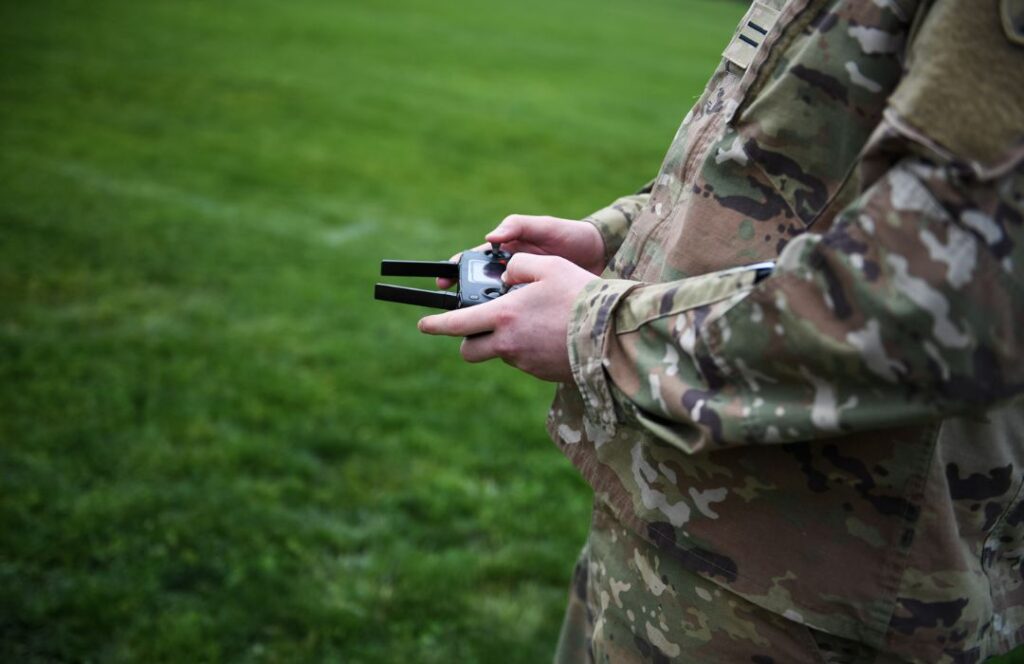
A cadet holds the controls to a drone in their hands.

Simulating flight  

Since the Drone Club had previously existed, the first step for the group was inventory – “We went on a treasure hunt for leftover drone parts,” said Malé.    

“We had to see what kind of drones were left behind and we found this really old brand called 3DR Solo,” said Malé. The club spent its first semester trying to update the software and firmware on these old-school drones.  

The software updates did not make a major difference, and the club moved on to purchasing DJI Phantom 3’s. Through this time, the club realized they were using a lot of large drones and ones that many cadets may be unfamiliar with. When the club came to this realization, Malé had an idea that would transform the club.  

“I introduced the idea of having people come in [to the club] and use my drone simulator,” he said. The Drone Club meets later in the day, around 8 p.m., and has had issues with flying at night.  

“So, we switched to simulators for the meantime, while we figured out the big drone situation,” said Malé.  

In addition to the drone simulator, the club has recently tapped into educational drones. Malé explained that the club is using educational software through a program known as “DroneBlocks.” The software uses visual programming concepts to help students learn to program drones, irrespective of their programming experience level. 

“We’ve been relying on their [educational] drones as a big resource for the first semester, as well as second semester,” said Malé. 

When looking to buy a drone, there are many classes to consider. Malé shared that there are educational-sized drones, racing-sized drones, indoor drones, and outdoor drones.  

Drone credentials and certifications 

To be considered “street-legal,” it is required to register drones that are over one pound. To register a drone and legally fly it, an individual must obtain a license from the Federal Aviation Administration (FAA). In addition to licenses and registrations, cadets in the drone club must work with post-police to make sure that they are following all airspace guidelines.  

This summer, the club hopes to increase its membership and will do so by sponsoring cadets to obtain their FAA licenses.  

“We’re going to sponsor cadets and faculty to apply for the FAA certificate,” said Abdelhamid. The club sent an email to all cadets informing them about this opportunity and has since received six applications.  

“We are planning to sponsor up to 10 cadets,” he said. Abdelhamid plans to use his grant to cover the test fees, study materials, and travel expenses for all interested cadets and faculty members.  

Aside from certification, the club has hopes of attending a drone competition soon. Next fall, the club plans to attend a gated drone competition, with teams competing from several different departments on post.  

Before then, the club received an invitation to participate in community cyber day May 13 in Natural Bridge.  

“On this day, we plan to showcase the work we are doing, the activities, and the drones we have,” said Abdelhamid.  

The Extra Mile: Theatre Club

Tori Wright ’24 was looking for anything to escape COVID-19 on post as a rat. The catch — there were not a lot of activities for rats to join due to the amount of work that was required of them in the Rat Line. Nevertheless, Virginia Military Institute’s Cadet Theatre was one she could.  

“My experiences with the theater were just always amazing. It was like this little safe place away from barracks,” she said. “It was honestly like a second home, so I kind of just stayed year after year.” 

With about four performances a year, the club is a little different than others offered on post. It’s technically two entities — the VMI Theatre and the VMI Community Theatre. Both involve cadets, but the community program wrangles in local participants when it’s tough to fill out a production. Cadet-in-charge Matthew Frazier ’23 said that usually happens for the holiday and summer productions, mainly because cadets have left to go home.  

Wright has been a key player in leading the summer sessions of theater for the past few years, something she says is a little bit more relaxed than when school is in session. She prefaces that it’s still very much a military school activity, but it’s different because they’re all in civilian clothes and can interact with the community on a personal level.  

“It’s a lot more relaxed. There’s a lot more time,” she said. 

Frazier said overall, VMI Theatre is a good escape for cadets — a point that Wright agreed with.  

“Because we’re here at VMI, it’s such a militaristic environment,” Wright said. “Even in classes, in other clubs, things like that, t’s very rigidly structured. There’s a set time, a set place, a set way of doing everything. But theater is so much more flexible.” 

The flexibility is in the creative freedom you get with performing or changing up a few props.  

“The general environment is so much more relaxed,” she said. “It’s a good way — especially during the Rat Line — of escaping to a much friendlier place.” 

Byron Rivey ’26 has been involved with theater since a young age. The first show he can remember being in was in sixth grade doing a rendition of “Beauty and the Beast.” 

“Ever since I can remember I was hooked,” he said.  

With the pandemic, he drifted from theater.  

“A distance grew between my fellow castmates,” he said. “This distance forced me to quit theater in high school. However, this year was the first time on stage for a while. My biggest supporter was my dyke, Ted Harris ’23, who is also in theater.” 

Both Frazier and Harris recently completed their last performance with VMI Theatre, performing “The Odd Couple.” A bittersweet exit, the two both said the club provided a place of refuge for them — something Rivey said as well.  

“Clubs like theater allow cadets and rats to escape from the daily stresses and portray a different person,” Rivey said. “Daily stresses include academic or Rat Line stresses. It also allows you to meet cadets from different companies.” 

VMI Theatre is in its 53rd consecutive year, according to director Joellen Bland. She’s been the director since 1982.  

“I have hundreds of treasured memories … but the thrill of seeing cadets blossom and grow on a stage before a live audience, and seeing the flush of pride on their faces when applause surrounds them, and their high-fives when they unwind after a performance is worth every moment of doing theater at VMI,” she said.  

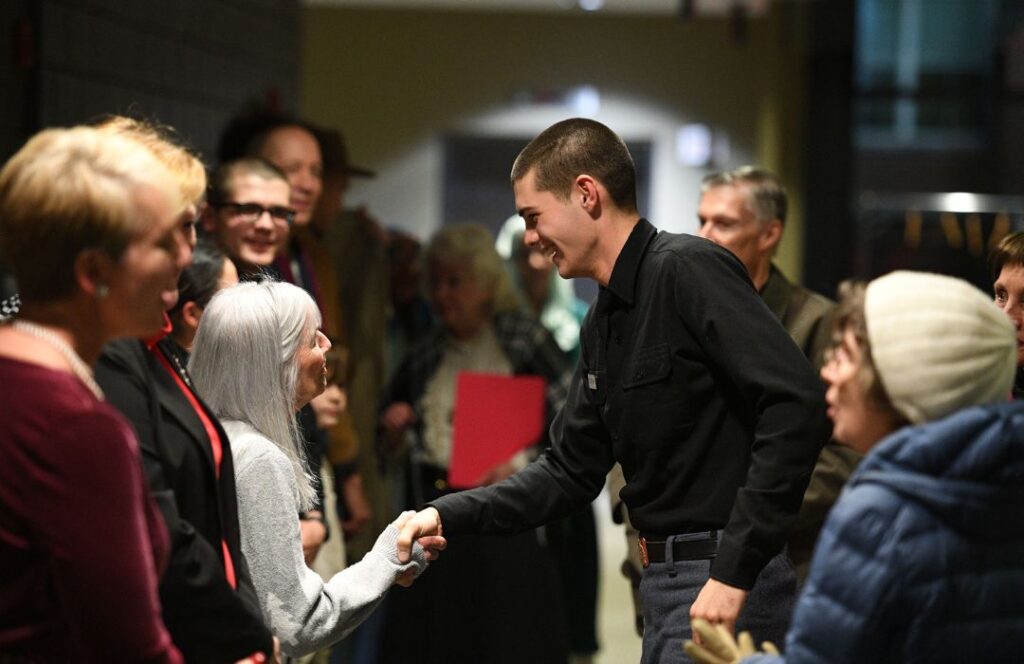
A cadet talks with audience members after a theater performance.

Bland said she doesn’t view VMI Theatre as a club but as more than that.  

“Even though we have never had a venue to truly call our own, and even though there is no theater course or major at VMI, and even though cadets do theater by choice and not by academic requirement, we are alive and continuing to struggle to stay alive at VMI today,” she said. 

Working with cadets is an adventure, she said, considering how many different directions they’re pulled in on a daily basis.  

“Doing theater is not like anything else they might tackle,” she said. “Auditions, rehearsals, learning lines-cues-entrances-and-exits for performances, set-building, prop-gathering, costume assembling, publicity selecting, etcetera, etcetera, are all part of getting a show together and performing it for the public. And guess what? All of this has absolutely nothing to do with handling a ball of any kind.” 

Colin J.M. Nicassio ’26 started acting on a whim with a production during his senior year of high school. After enrolling at VMI, he started getting emails about different activities and saw there was a summer theater — something that would be perfect for him while enrolled in VMI’s Summer Transition Program.  

“Being in theater at VMI is a very unique experience in the fact that few know about the program, and even fewer participate,” he said. “It is a small crew of 10 or so familiar faces that show up when their schedules allow them to and memorize their lines the day before opening night. It’s a challenge to be in the shows, but as Joellen always says, ‘Somehow, some way, we will do it because we’ve done it before.’” 

Nicassio said that VMI Theatre is crucial for the image of the Institute and also for breaking up the monotony of cadet life. 

“Perceptions are hard to change and improve, even when they should be. To the common person, activities like this or any of the things that go on around post are hard to portray to someone who is not in the system because of the overshadowing of those giant tan walls that encompass all of cadet life as many people think,” he said. “There should be a strong emphasis on these extracurricular activities at VMI because they’re much more than a time commitment, they’re a haven from the day-to-day monotony of life. It’s these cracks and holes in the image of the Institute that really help cadets stay engaged and strong at the Institute.” 

He said that activities like theater need to be emphasized at VMI.  

“Not only is this a military institute, but it is for developing leaders to grow and develop as characters themselves. That is what theater is all about. It’s about making friends backstage and working together to achieve a common goal that many others can enjoy. 

There is no point in making a show if there is nobody to watch it,” he said.