Post View Unavailable »
New Website Launched »

Behind the Balance: Whitney Tracy ’25 — Women’s Keydet Soccer

Virginia Military Institute’s cadet-athletes have to juggle cadet life, heavy academic course loads, and their NCAA Division I sport. Committed to both academic and athletic pursuits, balancing their rigorous schedule in both sports and school requires a certain level of commitment and discipline. Behind the Balance is a series that focuses on those cadet-athletes and how they handle the hurdles of the day-to-day. 

With a father as a soccer coach and two older sisters playing the sport, Whitney Tracy ’25 knew she’d be on the field. Except, her father didn’t expect her to be in goal. 

“I ended up, as I got older, wanting to play in goal rather than the field, because I didn’t like running. And my dad spent years trying to keep me out of it. He did not want me to be playing goal because he was a coach and that was one position he didn’t know how to coach,” she said. “Well, I don’t like listening to my parents being the youngest child, you know … rebellion. So, I did it anyway. Turns out I was pretty good at it.” 

Tracy, originally from outside of Philadelphia, knew she wanted to play Division I soccer, but she also wanted to attend a school that was more academic-focused and structured.  

“I started looking at the military route, because it just seemed like it fit for me, that discipline, that idea of everyone caring about where they are,” she said. 

She was looking at other military colleges, but realized she didn’t know which branch of the armed forces would suit her best. She wasn’t ready to commit to commissioning. That’s when one of the coaches from Virginia Military Institute reached out.  

“It kind of fit perfectly for me,” she said. 

Not only is she the starting goal for the team, she’s also a S4 lieutenant, and part of the VMI Institute Honors Program. Her duties as a S4 lieutenant are handling supply and logistics for the Corps and other programs within the Institute. That also means she’s on post before most of the Corps with soccer and her regimental duties.  

Tracy arrives a month before the fall semester starts. The first two weeks are devoted to soccer, then it’s onto her cadre responsibilities. 

It can get really busy to balance everything, specifically Cadre Week,” she said. “We were just kind of prepping. We set up all of the rat’s’ rooms. We made sure that each one had the proper amount of hays in it. My staff was making sure that all the rooms were proper.” 

Matriculation Week was also hectic getting supplies and organized, Tracy explained. That’s all while handling her soccer schedule too, which only gets busier when classes start. 

Cadet-athletes at VMI not only have their responsibilities with their selected sport but cadet duties on top of that. Cadets are also required to take physical fitness classes twice a week, participate in ROTC all four years, prepare for room and uniform inspections, practice for parade, guard duty, and more. 

Tracy’s busy schedule isn’t a hinderance, though. It has helped her. 

“I’ve always been big on being involved in things. I don’t like sitting on the sidelines,” she said. “I’m somebody who likes trying to figure out what’s going on and help organize stuff.” 

Her job as a lieutenant is directing her sergeants and corporals.  
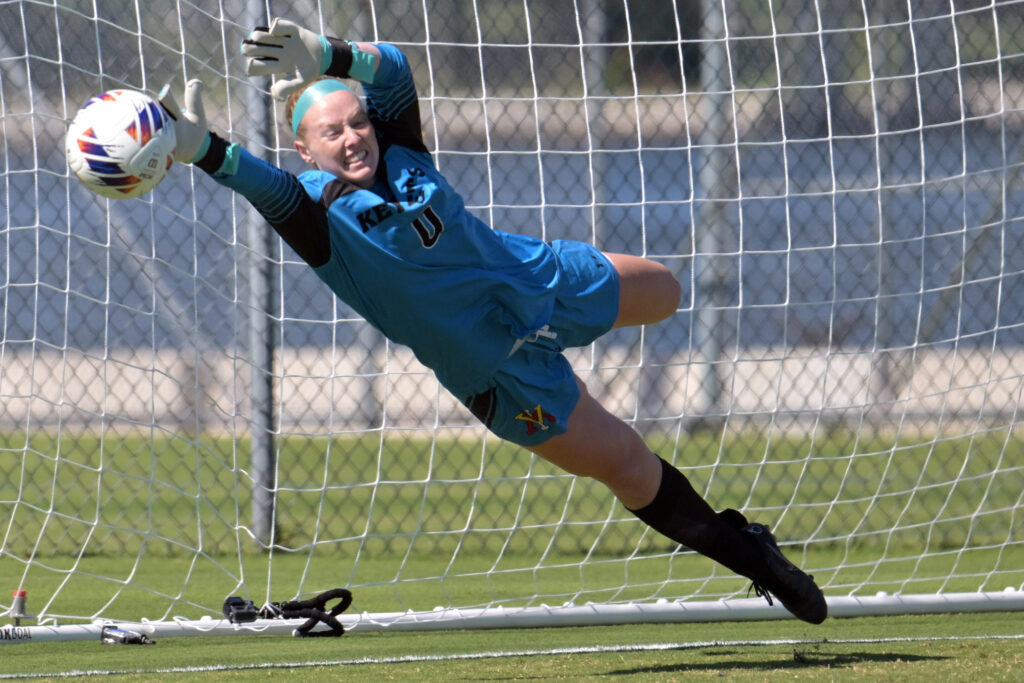
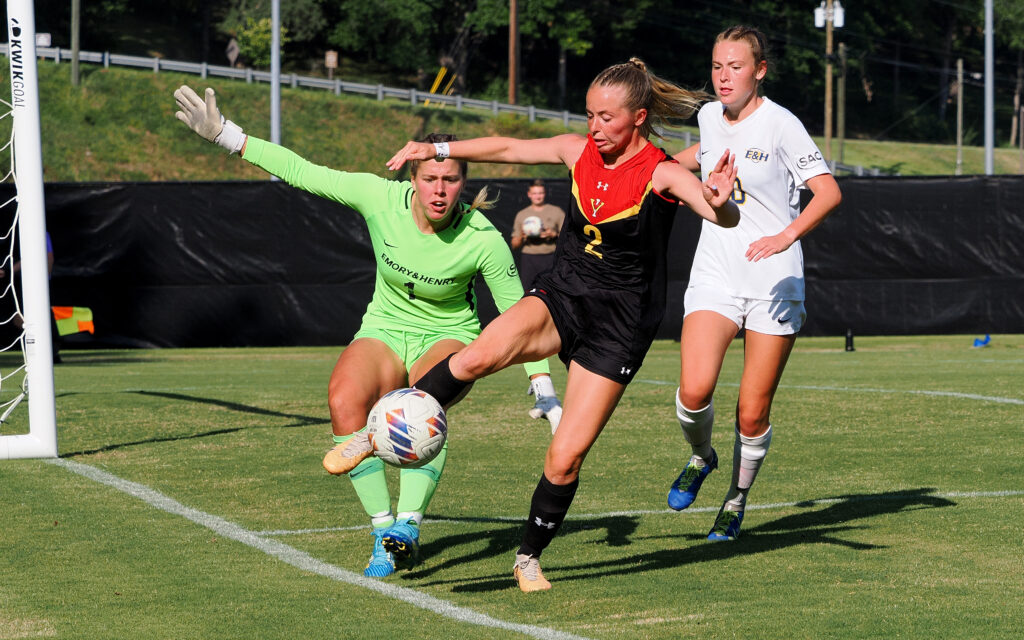
Whitney Tracy blocking a soccer ball during a Virginia Military Institute women's soccer game.
NCAA Women’s Soccer: Midshipmen prevail over VMI, 3-2

“That’s kind of where I thrive,” she said. “How do I disseminate it to get it done? How do I make sure that everything gets done? I can look at all the pieces and say, ‘Oh, this is not being done in an efficient way. How can we make this more efficient?’” 

Now in her final year at VMI as a biology major, she has a 12-credit semester for the fall, which is significantly down from previous semesters of 19 or more credits. She planned it this way, by taking heavier class loads previously, plus she did a summer abroad study program in Ireland last summer that gave her six credits.  

“I’ve taken the extra credits so that I can have that light semester,” she said. “I wanted my senior year to be able to say, I have rats, I’m finishing up my soccer career. I want to be able to go out on the weekends with my friends and go get dinner in town on Thursday night and not have to worry about six tests next week, and everything else. I kind of front loaded myself so then I could breathe my 1st Class year.”

Don’t let the 12 credits fool you though. She’s also working on her senior thesis that she will present in the spring. Her research is on the pathogenic fungal disease called White Nose Syndrome in the rock crevices of a species of bats called the Eastern small footed bats. 

Her days are still packed. She’s up at 6:30 a.m. daily for formation, then it’s breakfast, classes all day, and onto practice. By 8 p.m. she’s set in doing homework.  

“I would say I’m very big on writing things down. I have a pretty good memory when it comes to scheduling. But when it comes to homework assignments, I have to be able to see everything. I’m a very visual person.” 

She says it’s hard for her to get schoolwork done during the day because she’s so busy either talking to her professors or other tasks. But communicating with her professors is integral to keeping up with her studies and playing soccer — she’s able to work out missed tests or class assignments when she is in constant communication with them.  

Getting any work done on bus rides is a no-go for Tracy. It’s tough to get any real work done, she said. Instead, the team ends up doing a lot of work together at the hotel prior to game times. 

“The team is down in the lobby doing homework, we’re all very motivated academically that we want to make sure that we have stuff done,” she said. 

Her plans after graduation are to take a gap year, get her certified nursing assistant certification, work on contact patient hours, then apply to a physician assistant program. 
The Extra Mile: Pistol Club

The firing range is cold and dim, except for the lit-up lanes where you fire. Half a dozen cadets are gathering their equipment and setting up their targets. During a practice, they’re shooting air pistols at the range on North Post. 

The Pistol Club at Virginia Military Institute shoots Olympic style, which can consist of three disciplines: rifle, pistol, and shotgun. The club uses air pistol and .22 pistol in a shooting range, where participants aim at targets. They utilize three different shooting methods: air pistol, sport pistol, and standard pistol. Every Tuesday and Thursday, the club, made up of about a dozen cadets both male and female, will meet up at the range either at North Post or Kilbourne Hall. 

Everyone unlocks their guns and ammunition, and targets are assembled. During practice, they use a large sheet of paper with four small targets on it. It’s stapled onto a wood panel and set up at the end of the range.   

“We’ll start with slow fire, so it’s about five minutes for 10 shots and we just try and focus on groupings and getting kind of into a rhythm at the beginning of the night,” said Chris Olsen ’25, the cadet in charge for the club.  

The club is not a sanctioned NCAA sport, but they do compete nationally. The competitions consist of 60 shots fired in three different shooting disciplines: air pistol, sport pistol, and standard pistol, for a total of 180 shots fired. 

Earlier this year, the club competed in the National Collegiate Pistol Championship held at Fort Moore (formerly Fort Benning) Army post near Columbus, Georgia, in late March. The VMI contingent consisted of a team of four shooters: Olsen, Parker Hall ’24, Jacob Cook ’26, and Kate Patrick ’27, with Jamie Palacio ’27 competing as an individual. The club held a national rank of 11th place going into the competition. With 15 schools at the championship, VMI came in 10th place for air pistol, 8th place for sport pistol, and 10th place for standard pistol. The team finished the competition in 10th place, improving their national ranking. 

This was on the heels of the club’s attendance of the Scholastic Action Shooting Program Intercollegiate Pistols Nationals — the first time in club’s history — in 2023. 

They try to do six to eight matches a year, with stops at the Naval Academy and The Citadel. 

The club is run by cadets, specifically with Olsen in charge with an assistant cadet in charge, usually a 2nd Class cadet. This year, it’s Cook. The club also has a set of coaches — head coach Reese McCormick, assistant coach Norman Claytor, Master Seargeant Robert Coleman, and Jan Downs — that help guide the cadets. 

Olsen said you can join the club without any experience. They’ll teach you how to properly shoot. He said the club atmosphere allows for a more relaxed environment. 

“It’s a competitive but relaxed environment because I’m not directly competing against anybody else in a way. I’m competing against myself every time, because I’m just trying to get that one extra point that I didn’t get last time. It creates a healthy kind of competition,” he said. 

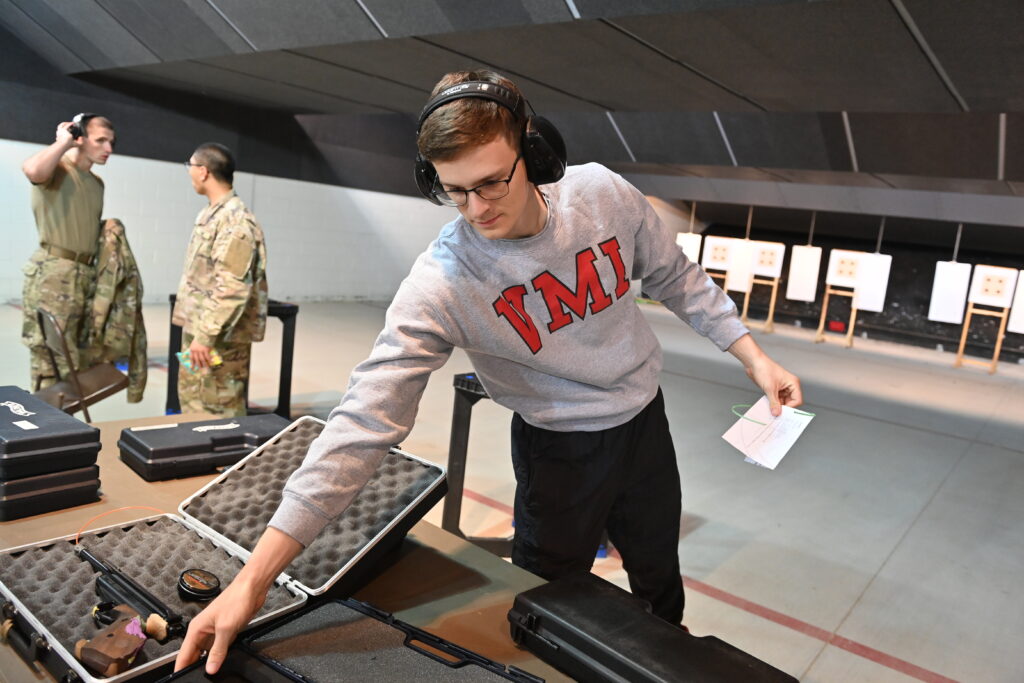
A cadet in the shooting range placing guns back in cases.

Olsen had always been interested in precision shooting. 

“I grew up in a little bit of a rural area, and my buddy had a farm,” he said. “It was just one of those things where after school for fun, you just take a bunch of shotguns or a couple rifles out and just go shoot at random things.”

The club has been on and off since the 1970s. Olsen joined as a rat and said clubs at VMI serve as a break in cadet life. 

“I think they’re extremely important because it acts as an outlet for the regular cadet, who might not be involved in other things,” he said. “Clubs are the last area where cadets can be involved and have a leadership experience at a leadership school, but also build their own little community and find their own little group.” 

Behind the Balance: Patrick Kiernan ’25 — Keydet Cross Country

Virginia Military Institute’s cadet-athletes have to juggle cadet life, heavy academic course loads, and their NCAA Division I sport. Committed to both academic and athletic pursuits, balancing their rigorous schedule in both sports and school requires a certain level of commitment and discipline. Behind the Balance is a series that focuses on those cadet-athletes and how they handle the hurdles of the day-to-day. 

Community is something Patrick Kiernan ’25 values in his life. It’s one of the reasons he chose to go to Virginia Military Institute and also a big part as to why he’s on the cross country team.  

He started running at a young age, thanks to a cross country camp he attended with his cousin.  

“I enjoyed it, not just the sport, but the community that camp built,” he said. “I decided to do it in high school, and I really enjoyed just that sense of community I had with my teammates. I think I was a lot closer than other sports teams I had been on in middle school and elementary school.”

He continued running through high school and by his junior year, he was contacting the coach at VMI to inquire about running there. He had to track his times and give the coach updates, to show the progress he was making. Then a couple days after Matriculation Week, he was able to join the team practices.  

When he first started on the team, he was averaging about 45 to 60 miles a week. Now, it’s between 60 and 80 miles.  

“The longest I’ll go is 16 miles, but it depends on the day. So, some — we call them a maintenance or a recovery run — will be, for me, around eight to 10 miles,” he said. “Our harder days will usually be around 10 to 13 miles. Then usually we’ll have one really long run of about 12 to 16 consecutive miles.”  

To keep occupied during the longer runs, Kiernan says he’s usually running in a group, so they’ll all talk to each other.  

“When I’m on my own, my mind just kind of wanders. On a busier day, I might just be thinking about planning out my week or my day, like how I’m going to get things done,” he said. “Every once in a while, I’ll have earbuds in and listen to music. ”

Kiernan keeps a tight schedule, as do most cadets. He’s asleep by 10:30 p.m. after a full day of activities. The history major has found the busier he is, the more time he has to finish tasks. The constant movement and busyness allow him to stay focused. He participates in several clubs and serves as a S7 lieutenant, which deals with cadet life and is responsible for the general well-being and morale of the Corps of Cadets. He’s also a cadet chaplain.

“Last year was probably one of my busiest years as a cadet, where I had a bunch of different obligations. I had my rank, being on the team, I was also president of the Newman Society, vice president for Pre-Law Society. I constantly had stuff I was doing,” he said. “I think a lot of it was trying to prioritize, my sleep and not staying up super late. I found those little bits in the day and figured out how long it took me to get an assignment for class done or get something done. It was more just figuring out the little moments in the day I can use to get a little bit of work done, and then that just built up.” 

Cadet-athletes at VMI not only have their responsibilities with their selected sport but cadet duties on top of that. Cadets are also required to take physical fitness classes twice a week, participate in ROTC all four years, prepare for room and uniform inspections, practice for parade, guard duty, and more.  

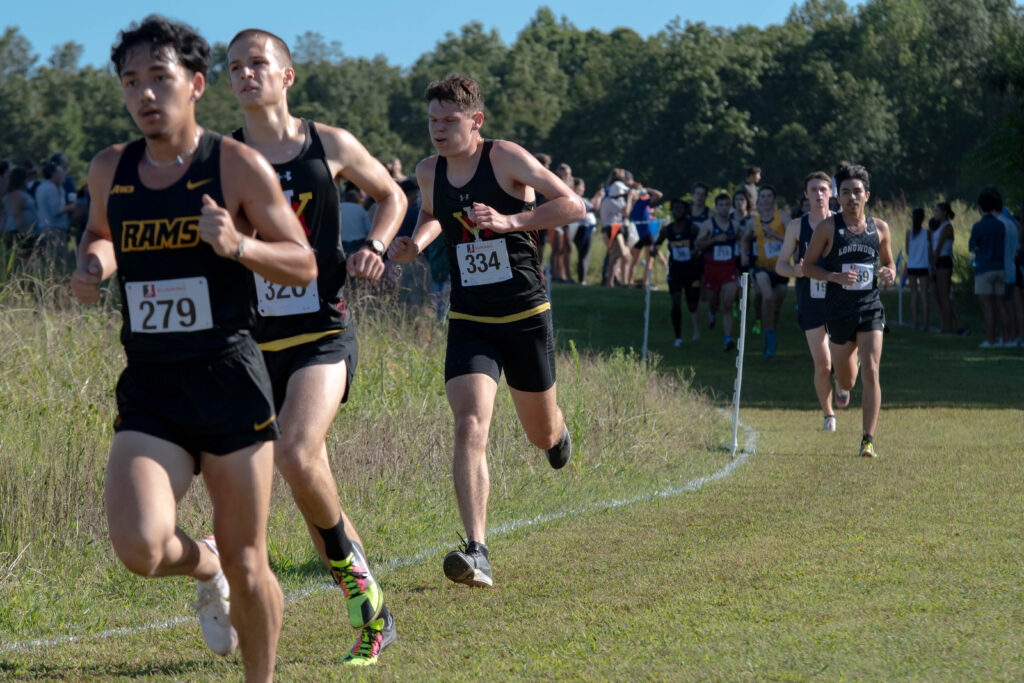
Patrick Kiernan running cross country for Virginia Military Institute.

“I think it was a lot about just me prioritizing getting work done in the day, so you have less to do at night,” he said.

He said being part of cadre has helped him establish a way to manage his time. During Cadre Week, he had to figure out what to make a priority due to multiple meetings and rank responsibilities.  

“It was deciding which ones were a higher priority that I needed to be at and then which ones I could just have someone fill me in on what it was about,” he said. “I think even throughout the school year, it’s a similar thing of figuring out what needs to be done immediately and what can wait, or what I should start on early, so it doesn’t become a problem later.” 

He believes VMI has built up a certain discipline in his work ethic and how he approaches problems.  

“I’ve noticed that being at VMI, when they talk about discipline, it’s not doing the insane hard, workouts and stuff every day. A lot of it’s just doing those small things you don’t really want to do, like getting up early,” he said. “I think that adaptability is a big thing. There’s a lot of sudden changes, military or non-military life, where things just come up. I think it’s helped me be fairly adaptable, where I can just on the fly make an adjustment in my schedule or in my day to figure out how to get a lot of things done.” 

Behind the Balance: Sedona Dancu ’25 — Women’s Keydet Soccer

Virginia Military Institute’s cadet-athletes have to juggle cadet life, heavy academic course loads, and their NCAA Division I sport. Committed to both academic and athletic pursuits, balancing their rigorous schedule in both sports and school requires a certain level of commitment and discipline. Behind the Balance is a series that focuses on those cadet-athletes and how they handle the hurdles of the day-to-day. 

Sedona Dancu ’25 said she wasn’t even looking at military colleges until she received a call from the women’s soccer coach at Virginia Military Institute. The psychology major, with a minor in exercise science and leadership studies, said once she learned about the vast alumni network VMI offers and the connections she could gain, she was in. That coupled with a soccer scholarship, it was the best move for her. 

At the age of two, she was handed a soccer ball and there was no turning back. It’s the competitiveness and team aspect she enjoys the most.  

“It’s hard to explain. I feel content when I’m on the field,” she said.  

But it’s the tightness of the team that’s kept her at VMI. 

“At VMI, with it not being a lot of girls, we will all do anything for each other,” she said of the girls on her team. “We will stand up for each other in any situation. I could trust all of them with my life. We go through so much, especially the girls in my class, starting with the Rat Line together.” 

She said from her first year, her class went from 14 women on the team down to eight.   

“All eight of us are really close,” she said.   

Cadet-athletes at VMI not only have their responsibilities with their selected sport but cadet duties on top of that. Cadets are also required to take physical fitness classes twice a week, participate in ROTC all four years, prepare for room and uniform inspections, practice for parade, guard duty, and more. 

Dancu is up at 5 a.m. during the week for practice. Then it’s breakfast and onto classes. This semester she has her lightest load with 12 and a half credits. Previously, most of her semesters were 18 credits or more. After classes end at 3 p.m., she’s rushing off to another practice until 7 p.m. Then it’s dinner, homework, and bed. Some nights she stays up past midnight doing homework, only to turn around and get up at 5 a.m. the next morning. 

“I think the quickest thing I had to learn was to manage my time and not procrastinate,” she said. “Procrastinating is huge, especially as a 4th Class cadet. You can easily procrastinate things because you get so loaded with all the Rat Line responsibilities, soccer, and getting used to being in college.” 

Managing time, and having discipline and accountability are high priorities for Dancu.  

“I usually write out a schedule … just managing every hour of the day. Because every minute of the day here is so precious,” she said.  

She feels that VMI has helped provide the structure that’s needed to follow a strict schedule. When Dancu compares her college life to her friends or siblings at more traditional colleges, there’s such a difference. 

“They have like one class every two days and then they can sleep in. It’s funny comparing schedules, because we’re literally up from 7 a.m. to midnight doing things every hour,” she said. “Even when you don’t have homework, we have military duty. In season, you’re traveling, and we get back at 4 a.m., then you have to go to class.” 

Sedona Dancu kicks the soccer ball at a Virginia Military Institute women's soccer game.
VMI’s women’s soccer team hosts Emory & Henry University at Patchin Field in Lexington, VA August 24, 2024. First half, VMI wins 2-0. (Randall K. Wolf/VMI)

Despite the rigorous schedule, Dancu pointed out that the women’s soccer team won an academic award for highest GPA among women’s sports at VMI last year. 

“It’s really motivating, because when we’re on the bus or in the hotel room, everyone is doing homework, and you’re like, shoot, I should probably be doing it, too,” she said. “They’re just so smart and on top of it. In a way, soccer helps with school, because you have the time to do class and then you have practice. If I didn’t play sport here, it would be difficult for me to focus. Being on the soccer team and having such a busy schedule, it makes it easier to get your homework done.”

Dancu said she’s someone who loves staying busy. When she’s on break from school, she’s on a mission to fill her days.  

“I can’t just sit around and not do anything,” she said. “It’s taught me what hard work looks like and I am very grateful for that, because I think it will really help me in the future.” 

Being at VMI has offered her discipline. 

“I’m more disciplined in all aspects of my life, especially my faith,” she said. “My faith has grown tremendously since I’m a cadet chaplain.” 

She’s already seen the alumni network work for her. This past summer she had an internship at the University of North Florida, working in the athletic marketing department. An alumnus got her in contact with the right people and she was offered the opportunity. 

Following graduation, she plans on playing soccer for one more year while attending graduate school. She wants to pursue leadership studies, ministry, or something in sports.  

Behind the Balance: Terrell Jackson ’25 — Keydet Football

Virginia Military Institute’s cadet-athletes have to juggle cadet life, heavy academic course loads, and their NCAA Division I sport. Committed to both academic and athletic pursuits, balancing their rigorous schedule in both sports and school requires a certain level of commitment and discipline. Behind the Balance is a series that focuses on those cadet-athletes and how they handle the hurdles of the day-to-day. 

When Terrell Jackson ’25 got to Virginia Military Institute, he was assigned an academic advisor through cadet athletic development. With resources like the Miller Academic Center, Jackson said VMI provides opportunities for those who may fall behind on academic studies. 

“It really comes down to just using the resources that VMI provides,” he said. 

Academic advisors are standard in a college environment, Jackson said.  

“They help you arrange your schedule in the beginning of the semester. But also, after you arrange it, they help you stay on top of all the work that you have, keep track of your grades, let you know what you’re slipping up or getting behind on, and what you need to do to get back to it,” he said.  

They even help you find tutors, which Jackson did for history. The psychology major said the extra guidance helped him with his VMI journey. 

Cadet-athletes at VMI not only have their responsibilities with their selected sport but cadet duties on top of that. Cadets are also required to take physical fitness classes twice a week, participate in ROTC all four years, prepare for room and uniform inspections, practice for parade, guard duty, and more. 

As a captain on the defensive line, his responsibilities go beyond the field. He’s one of seven captains for the 124-player team. He says it’s an honor to see his teammates hold him in a higher regard and have respect for him.  

Being captain also means meeting with several different organizations on post. From meeting with the regimental staff, the general committee comprised of a board of cadets, to meeting with Maj. Gen. Cedric T. Wins ’85, superintendent, Jackson and the other captains are there to maintain a relationship between athletics and the Corps, while also providing support to rats on the team. 

His days start and end with football, while carrying a 15 and a half credit course load. Waking up between 6 or 6:45 a.m. each day, he goes through the motions of a cadet — rolling his hay, heading to morning practice, then onto breakfast before a full day of classes. By 3:50 p.m., it’s time for the team meeting to start where the head coach addresses the team.  

“The whole team gets together, and the head coach talks about what we’re doing for the day: what we have planned for our game, how the other team looks, the game plan, and what each position or unit needs to do for us to win the game,” he said. 

Then they all break out into specific meetings where it’s dedicated to their positions on the field. That’s where they spend time watching game film to learn either their own strengths and weaknesses or that of the other team they are set to play. By 5:30 p.m. they’re out on the practice field.  

Everything is wrapped up after 7 p.m. after the players do cool downs, treatments, and showers. Jackson oversees accounting for everyone as they line up to head to Crozet Hall for dinner. He turns in a sheet of names to the commandant’s office for accountability.  

There’s a lot of moving parts that Jackson must account for daily, so staying on top of everything takes dedication. 

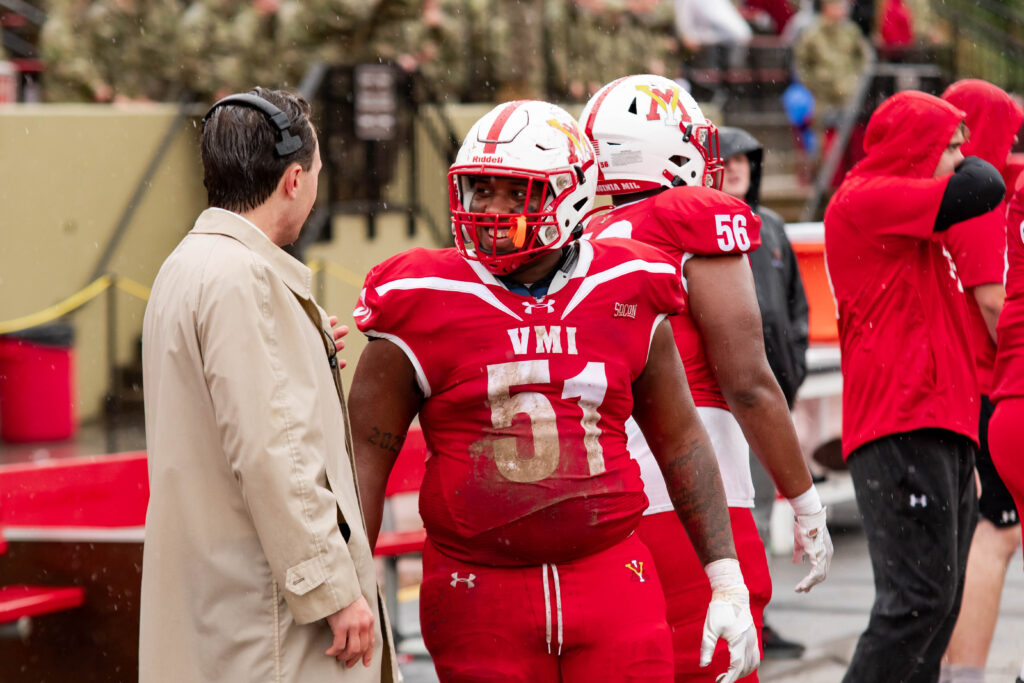
Terrell Jackson at a Virginia Military Institute football game.

“It’s just about putting in effort. There’s no special trick or secret magic to it,” he said. “You’ve got to not complain about it and just keep going. You were put here for a reason; you’ve got to embrace your role. Our biggest thing on the football team this year is just building a legacy. We might not win a playoff game or win a championship. If my class and the captains that we have now start building a legacy so we could come back in four years and we’re on top of the SoCon, or win the national championships, I’ll be happy to say, I started that. That came from our class.” 

The discipline and routine that VMI has instilled in Jackson is something he will carry throughout his life.  

“It’ll force you to get some time management skills. Either you get them or you’ll get left behind,” he said. “VMI is a tough place to be, especially to last. A lot of people could come here, but can you last?” 

Behind the Balance: Abby Fiorillo ’25 — Keydet Cross Country

Virginia Military Institute’s cadet-athletes have to juggle cadet life, heavy academic course loads, and their NCAA Division I sport. Committed to both academic and athletic pursuits, balancing their rigorous schedule in both sports and school requires a certain level of commitment and discipline. Behind the Balance is a series that focuses on those cadet-athletes and how they handle the hurdles of the day-to-day. 

It wasn’t love at first run for Abby Fiorillo ’25. She said her father made her do cross country when she was in high school, but the longer she ran, her love for the sport grew.  

It brought her community, and it was something that she was excited to continue to do while at Virginia Military Institute.  

“I love the competition,” she said. “It’s challenging, and I like the community around it.”

The physics major chose VMI for the ROTC aspect; she will be commissioning into the U.S. Army after graduation next year.  

“I chose VMI for a lot of reasons,” she said. “My brother came here, so it was familiar. And then I really wanted the community that VMI has to offer.” 

That community can be found in the Corps and within the cross country team. She said when she’s training during the week, she’s often running with a friend or finding time to reflect on her own. Her daily runs average between seven and eight miles, while she’s doing between 40 and 45 miles weekly.  

“My favorite part about cross country is practicing. I love working out, and I don’t have to plan when my workouts are going to be. I already know I have a specified time,” she said. “It’s consistent. When I’m not studying or when I’m stressed, cross country gives me that outlet and that mental focus.” 

She’s chatting it up when she runs with friends. Other days, she opts to listen to music on her phone.  

“Some of the time, it’s like meditation,” she said. “And sometimes I don’t even think about anything. I’m just running.” 

It’s become sort of routine for her, she said. 

“I really don’t pay attention to it anymore because I’m so used to running it,” she said. “Now I just want to just go into my little mental state and clear my mind, or think about what happened that day, or something that’s on my mind, or what I want to do in the future.” 

Abby Fiorillo running cross country for Virginia Military Institute.

It can also serve as a planning period for her. Cadet-athletes at VMI not only have their responsibilities with their selected sport but cadet duties on top of that. Cadets are also required to take physical fitness classes twice a week, participate in ROTC all four years, prepare for room and uniform inspections, practice for parade, guard duty, and more. 

Her regimented days begin at 6:45 a.m. and don’t end until after 8 p.m. She does set a hard stop at 10:30 p.m. 

“I try to get as much sleep as I can, just because it’s taxing on your body and I enjoy it,” she said about her sport. 

She said having a plan and system is important, especially knowing your priorities.

“I love my sport, but I’m here for academics. I’m really getting a degree out of this. It’s having priorities and knowing how to schedule it all, staying on top of homework, practicing every day and doing everything you can, just to fit it all in,” she said. “I think I was pretty good at routine in high school, but VMI made me realize that I can fit so much more into my routine than I thought.”

Fiorillo said the constant go of VMI will help her become a great leader. With her desire to commission into the Army, the ability of coming up with a plan and procedure will lend itself to her leading a platoon, she said.  

“Knowing that there are going to be early days, late days … every day is going to be different. But making sure that you have your priorities straight is going to help with that,” she said. “I think VMI fosters that shared suffering of everyone doing the same thing. No one wants to wake up at 7 a.m. every day. But it shows that we’re a little bit more responsible, and it instills those characteristics.” 

Behind the Balance: Colin Blandford ’26 — Men’s Keydet Soccer

Virginia Military Institute’s cadet-athletes have to juggle cadet life, heavy academic course loads, and their NCAA Division I sport. Committed to both academic and athletic pursuits, balancing their rigorous schedule in both sports and school requires a certain level of commitment and discipline. Behind the Balance is a series that focuses on those cadet-athletes and how they handle the hurdles of the day-to-day.  

Becoming one of the co-captains of Virginia Military Institute’s men’s soccer team, Colin Blandford ’26 didn’t expect to carry so much weight. It was a stark contrast to him serving as captain in high school.  

“I took a lot more responsibility than I thought,” he said. “It’s nothing like what I actually thought.”

It meant meetings, engaging with people he hadn’t expected, boosting morale, spreading the message of their coach, and more. He said, as a captain, you’re acting as the liaison between the commandant staff and the team.  

“There are different issues that arise every day, because there’s so much going on here,” he said. “You’re advocating for somebody one day, you’re trying to figure out a new rule, sign-outs, how things are going to work, and you’re working with the coach as well to make sure that the team is successful on the field .” 

Blandford said he puts in extra time talking with his coach to ensure his messages are properly portrayed to the team.  

“I think the biggest thing I picked up on is how much more communication and my input are valued —  a lot more than I thought,” he said. 

It’s added to the responsibility as a team player and puts a heavier load on him as a cadet, but that’s the VMI way, he added.  

“Honestly, you’re so forced to be on a schedule here, and they teach you so well how to manage your time and how your whole day is structured that it hasn’t been too hard,” he said. “You go to practice in the morning, go to school all day, go to practice in the afternoon again, then after dinner, the rest of your night is for homework. That’s kind of the schedule I follow every day.” 

Structure is what he needed. 

“I chose VMI because I knew a normal college wouldn’t have suited me well, just based off how I was in high school,” Blandford said. “I knew that if I wanted to be serious about playing sports, that I need to be somewhere where structure was built in.” 

Cadet-athletes at VMI not only have their responsibilities with their selected sport but cadet duties on top of that. Cadets are also required to take physical fitness classes twice a week, participate in ROTC all four years, prepare for room and uniform inspections, practice for parade, guard duty, and more.  

Learning proper communication has become a skill that Blandford relies on. He’s traveling a lot during the season, which means missing classes.  

“I’d say a lot of the problems that I ran into in my earlier years were solved just through communicating with my teachers more effectively,” he said. “The teachers here are very understanding of obligations and especially understanding of time management, because everybody here is strained for time. This year, I’ve noticed that it’s not as difficult to keep up my work, as I found in the past, and that’s based just off communication.” 

Blandford, an English major with a minor in business, has 18 and a half credits this semester, which means he must stay on top of his studies. With a heavy load of classes on Tuesdays and Thursdays, he spends the rest of the week tackling most of his work.  

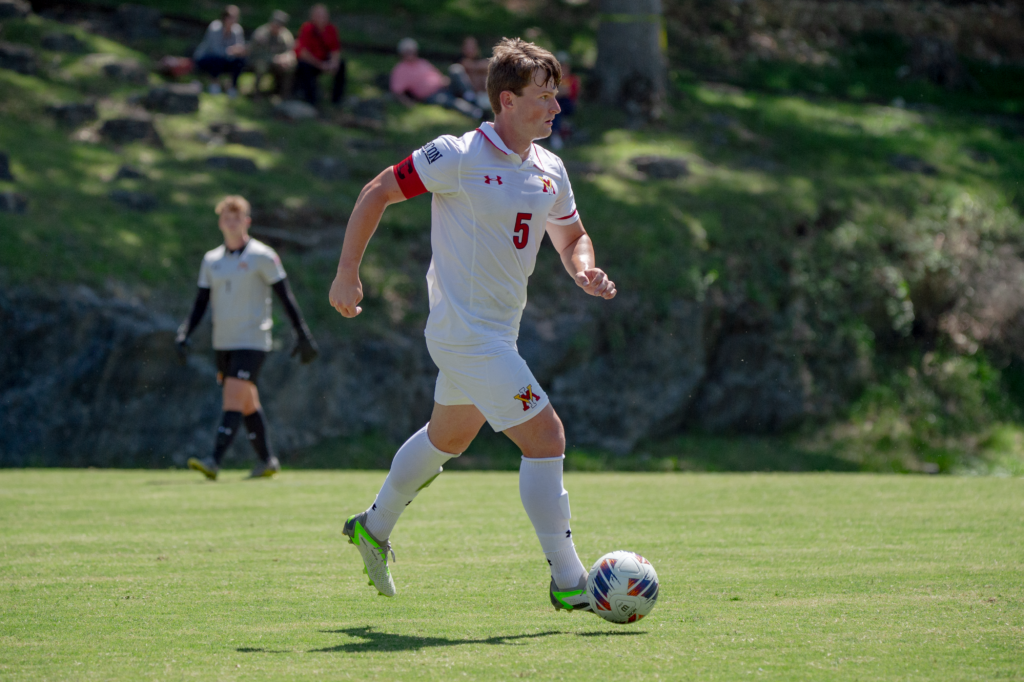
Colin Blandford kicks the soccer ball on the field during a Virginia Military Institute men' soccer game.

Finding his goal

Blandford has been playing soccer since he was three years old. He played several sports growing up, but soccer was the one that stuck out — it was the one he excelled at. He likes the constant flow of action and how the game can change in just seconds. Mainly, he likes being part of the team. 

“As the years progressively go on, I think being part of the team is amazing. Those are my best friends,” he said. “I spend the most time with them. It’s huge that this group gets along. It’s a tiny school, so you see them at school all day. You go to sports with them all day. You live with them.” 

He credits his coach for bringing the group together. 

“All the guys within the group have done a great job of taking care of each other and buying into what we’re trying to do,” he said. 

Montenegro selected as Coach for USA Water Polo Olympic Development Team

VMI Water Polo Head Coach Danielle Montenegro will work for USA Water Polo this upcoming year, as she was asked to be the head coach of one of the organization’s 16 and Under Olympic Development Program (ODP) Teams.

“I’m excited to be a part of the ODP process,” Montenegro said. “It is an opportunity to help mentor and coach athletes attempting to enter the Olympic pipeline in the U.S. I will get to work alongside current and former national team members, and hope to learn a lot along the way.”

Montenegro, who started her duties this past weekend by working a camp at Brown University, is the Head Coach of the Cadet Team in the Northeast Region.

“Each camp is in a different area,” said Montenegro. “This first one was at Brown University, the next at will be held at Marist, and the third is to be determined. I am coaching at the camps and evaluating the athletes that attend, to create a team of the top athletes in the Northeast zone. From there, we will compete at Regionals in Salt Lake City, Utah, with Nationals being held in Dallas, Texas.”  

A native of Rowland Heights, California, Montenegro is entering her fifth year at the helm of VMI Water Polo. The Keydets scored some big wins and showed major statistical jumps in the pool last year, and are primed for a strong season this year with six freshmen integrating into the program.

Read more about the USA Water Polo Olympic Development Program on their official website.

This article and image originally appeared on vmikeydets.com.

Behind the Balance: Gretal Shank ’25 — Keydet Cross Country

Virginia Military Institute’s cadet-athletes have to juggle cadet life, heavy academic course loads, and their NCAA Division I sport. Committed to both academic and athletic pursuits, balancing their rigorous schedule in both sports and school requires a certain level of commitment and discipline. Behind the Balance is a series that focuses on those cadet-athletes and how they handle the hurdles of the day-to-day. 

Gretal Shank ’25 started running cross country when she was in seventh grade. She almost quit two weeks in. 

“I didn’t like it,” she admitted. “It was hard, but then I realized I was pretty good at it, so I stuck with it and did it all through high school. I did pretty well, I’m still running.” 

She averages running 30 to 40 miles a week. During that time, she treats it as meditation. Shank, an English major, says she spends her runs sometimes formulating stories.  

“I’m also a writer. I do a lot of my thinking about ideas for what I’m going to write, while I run, also just ideas for anything,” she said. “I got a lot of time on my hands.” 

During the harder workouts, though, she’s not thinking about anything. 

“I think a big part of it is mental. It gives me a mental break in the middle of the day. I get a lot of my thinking done while I’m running,” she said. “Also, it keeps me fit, obviously. It gives me goals to work on, from personal goals to team-oriented goals. A big aspect of that is teamwork, but it’s also an individual sport.”

She applied to West Point, but didn’t get in, so she shifted to VMI. Without even seeing post first, she decided to commit. It took one call to the cross country coach for her to get on the team with a partial scholarship. 

“I wanted a college experience that wasn’t going to be ordinary,” Shank said. “But it initially started whenever I was looking into commissioning, because my parents are both in the military.” 

With plans of commissioning into the U.S. Army, Shank’s days are filled and regimented — much like other cadets at VMI. The schedule she keeps ensures she’s able to get all her tasks done. On top of a sport, she’s taken a heavy credit load her entire time at VMI — taking 20 credits this semester, three of which are dedicated to her honor’s thesis. Due to her psychology minor, she must tack on six more classes to fulfill requirements.  

Gretal Shank running cross country for Virginia Military Institute.

Her academic schedule is packed. Mondays, Wednesdays, and Fridays, she has five or six classes, then heads to practice from 3:30 to 7 p.m. Tuesdays and Thursdays, she has Army ROTC lab and classes. 

Cadet-athletes at VMI not only have their responsibilities with their selected sport but cadet duties on top of that. Cadets are also required to take physical fitness classes twice a week, participate in ROTC all four years, prepare for room and uniform inspections, practice for parade, guard duty, and more.   

The continuous activity is something Shank likes. Besides being a DI athlete and having cadet responsibilities, she’s the visual editor for Cadence, the Institute’s fine arts publication. She also works at the VMI Writing Center and is the president of Sigma Tau Delta, the International English Honor Society.

“I think for me, it might make it easier. I haven’t known any different, but I think it’s easier because I have a consistent schedule,” she said.  

Each day has a specific schedule that Shank doesn’t deter from. When it comes to a slower day or a day off, she often doesn’t know what to do with herself. She needs constant activity to push her along.  

“I find that on days that I don’t have practice, which is pretty rare, I actually don’t get more work done,” she said. 

VMI has kept her busy and helped create a lifestyle of structure, she said. She needs to have a designated time for everything, otherwise she’d get nothing done.  

“Honestly, the busier I am, the more I will be able to get done, because otherwise it’s easier for me to just be lazy,” she admitted. “I’ve kind of run into that problem on Tuesdays and Thursdays a little bit to where I just kind of want to relax, because my Monday, Wednesday, Fridays are so busy, but it’s been fun. I’ve gotten all the work done that I need to get done, so that’s what matters.”

Stealing a Moe-ment With VMI’s Mascot

Atop the kangaroo head, there’s a small vent and a fan. Bowlman “Tee” Bowles IV ’26 says it gets hot under there. The fan helps, but it’s often sweltering inside the faux kangaroo costume.  

He also needs a handler walking him around — he can barely see.  

Bowles is one of two cadets who serve as the mascot, Moe, during functions at Virginia Military Institute. The history major, who will be commissioning into the U.S. Army following his time at VMI, joined the Corps of Cadets S9 regimental staff his 3rd Class year. S9 staff are responsible for all issues related to NCAA athletics and club sport events. 

He chose S9 because he had similar duties in high school — working with the sports team, commentating on games, doing social media, and so on. A big draw was the opportunity to become Moe.  

“Every time I watched basketball games, I saw mascots doing stupid things and fooling around with other teams and stuff. I got inspired by seeing those mascots on TV, which gave me interest to do the Moe costume,” he said.  

Moe is a staple around post. He’s present for home football games, pep rally, and other home sporting events. The mascot is around for pictures and overall, a boost in morale.  

“We’re there for the rats,” Bowles said.  

Moe is a key part of the Keydets, specifically with family, friends, alumni, and other guests in attendance at events, Bowles said. That means a lot of pictures being taken — aided specifically by Moe’s handler — and overall hyping of the crowd. This year features a new costume for the mascot. Bowles said the previous suit was falling apart and needed to be replaced. He came in this year and a new suit was there. 

“In the Moe costume, you have to look down when taking pictures. The eyes are looking up. Whenever I’m taking pictures, I’m literally looking at the ground,” explained Bowles, hence the need for the handler.  

Bowles says the handler will tap him on the shoulder when people ask for photos and help him maneuver around the crowd, especially at Foster Stadium.  

“The steps are really steep and hard to get up in those big feet,” he said. 

Moe, VMI's mascot, outside of barracks.

Bowles shares the responsibility with Carter Rees ’27. Rees just started as Moe at the start of the 2024-25 academic year.  

“I love feeling the energy of a crowd, so the opportunity to be at the center of creating that energy was an easy decision for me,” Rees said. “My favorite part of being Moe is making people happy. Whether that’s getting the Corps hyped up or taking pictures with people, I love seeing smiles on people’s faces.” 

Bowles said he tries to break some of the tension during the games, especially any stresses that the rats are facing.  

“It’s super easy to interact with the rats,” he said. “I love going up there and messing with them. Like I’d sit down next to rats and take their drinks and stuff, act like I’m drinking it.” 

He’s also trying to bridge the divide that can sometimes be seen between the Corps and athletics. 

“There’s this stigma that the Corps is detached from athletics, that athlete, non-athlete divide,” he said. “I think Moe can definitely help unlock that by interacting with them as rats, because I can help them unlock interest in athletics.” 

The history behind Moe 

The history behind Moe and the Keydets is a little complicated.  

Keydets have been the term to describe VMI’s athletic teams, although where it originated isn’t clear. While a Keydet is not a kangaroo, the animal was chosen as the mascot in 1947, when two VMI cheerleaders saw a picture of a kangaroo on the front of a magazine and realized how uncommon the animal was as a mascot. Originally named TD Bound, the mascot was renamed Moe later, to appeal to all VMI athletics, not just football. 

It’s said that the term Keydet could have come from the United States Military Academy’s term used to denote the gray of the standard uniform of a cadet. Another definition, one that hasn’t been factually substantiated, due to the Southern drawl of some members of the Corps, the pronunciation of cadet morphed into Keydet.  

VMI has been associated with several nicknames, one of the longest was the Flying Squadron, which referred to the football team. The Flying Squadron nickname started in 1917 at a football game between VMI and North Carolina and it stuck, becoming most popular during the 1920 season. It wasn’t until the 1930s that the term Keydet became associated with VMI athletic teams.  

Learn more here.