Post View Unavailable »
New Website Launched »

Natural Bridge Visit a Highlight for Introductory Biology Classes

A short drive from VMI is Natural Bridge State Park, featuring the 215-foot-tall wonder, Natural Bridge. While so close, many cadets have never visited the site. Maj. Peter Neofotis, lecturer in the Department of Biology and native of Rockbridge County, saw an opportunity to weave in some of his biology lessons with the local attraction during the spring semester. He took three sections of his Introductory Biology class to Natural Bridge in late April, as trees and flowers were blooming and animals were coming out of winter hiding. From a park ranger, the cadets learned about the formation of the bridge and the environment’s animal inhabitants, including several types of snakes. Neofotis then talked to the cadets about how the limestone that makes up the bridge and much of Rockbridge County traces its origin to the natural impacts and activity of ancient algae. Neofotis also discussed how the ancient arborvitaes in the vicinity of the park are holdovers from a community of conifer trees from the last ice age, 12,500 years ago.

Neofotis acknowledges the value of the park, landmark, and history of Natural Bridge, but emphasizes the trip exceeded his expectations. “I think part of me felt the cadets would benefit from seeing the iconic landmark and further welcome them into the landscape of Rockbridge County. The trip was so relevant to the course content and the perfect topical cap to the year. By the end of the semester, having made it through so much animal physiology, when we got to plants and the planetary carbon cycle—which is my area of expertise—it was a real gift to take the students to Natural Bridge and share with them, not only the tales and legends of George Washington and Thomas Jefferson’s connection to it, but also discuss how all the limestone of the structure—as well as the county that is named after it—was created by the activity of humble algae half-a-billion years ago, well before even the dinosaurs came to be, when the whole area was covered by a shallow ocean. And it was a joy to see the cadets interested in evolutions of yesteryear, as well as enjoy just interacting with the natural environs we were currently in.”

The cadets agreed with the value of the trip as they wrapped up their semester in the course. “At first, I thought this was just going to be some regular field trip I went on in middle school, but I was completely wrong,” shared Stone Gardner ’28. “Seeing Natural Bridge itself was one of the coolest pieces of nature I have ever seen. I highly recommend going to it. The whole tour was awesome, the park staff were great, and it had a nice walk so we could sightsee and just enjoy nature.”

Isabelle Haer ’28 enjoyed seeing the material studied in class right in front of her. “It was a hands-on experience where we took the content we were learning in class and saw how it has been practically applied to our environment around us.”

On his final trip to the park with a class, one comment in particular by Malik McNeely ’28 caught Neofotis’ attention. “As we approached the structure, Malik called out ‘Thar she blows!’ while he pointed to it with a stick, like he was holding a harpoon. I found shivers of amazement going up my spine,” explained Neofotis. “Malik had never read ‘Moby Dick,’ but he was reciting words most often ascribed to Herman Melville, who, 175 years ago, penned the great epic where a man cries the very same phrase when he sees a leviathan emerging out of the sea with a high arch, like Virginia’s Natural Bridge.”

Neofotis expressed sincere gratitude for all who supported the trip, including the Department of Biology; Julie Lozier, who supports much of the biology faculty’s research; and the knowledgeable rangers at Natural Bridge State Park.
Behind the Balance: Caden Plummer ’25 — Keydet Baseball

Virginia Military Institute’s cadet-athletes have to juggle cadet life, heavy academic course loads, and their NCAA Division I sport. Committed to both academic and athletic pursuits, balancing their rigorous schedule in both sports and school requires a certain level of commitment and discipline. Behind the Balance is a series that focuses on those cadet-athletes and how they handle the hurdles of the day-to-day. 

Time management is a common theme for many cadets, especially as a cadet-athlete. Caden Plummer ’25 is no stranger to figuring out his time and schedule. 

“You get dealt certain inconveniences that you just have to figure out how to deal with,” he said. “You can feel sorry for yourself in the moment, but that doesn’t do anything. You’re weighing yourself down more. Having the ability to be able to turn the page and be like, alright, I’m just going to deal with this, I’m going to figure out how to get it done and then you go in and just do it.”

Determination is what Plummer has in spades. His goal heading to college was to play baseball. Not only that, he wanted to play as a pitcher and a hitter, which can be difficult to be offered. Part of choosing Virginia Military Institute was that he was offered to do both. Now, just a pitcher, he’s glad he chose the Institute. He’s a civil engineering major — another draw to the school was its robust engineering program.  

What really sealed the deal was after an overnight from a VMI open house, he could feel the brotherhood and camaraderie that came with it.  

“That really drew me to it,” he admitted.  

Now in his final semester, he’s taking his lowest credit hours of 14 and a half, but previously he was tacking on 18-19 credits a semester. The lighter load has allowed him to head down to the baseball field early for some individual practice.  

Cadet-athletes at VMI not only have their responsibilities with their selected sport but cadet duties on top of that. Cadets are also required to take physical fitness classes twice a week, participate in ROTC all four years, prepare for room and uniform inspections, practice for parade, guard duty, and more. 

He’s down on the field around 1 or 2:30 p.m. for practice daily, while in season. 

“Pitchers, then hitters will hit in small groups. It’s more individualized work with the coaches,” he explained.  

Practice, while in season, runs until about 6 p.m., while out of season it can go as late as 8 p.m. Plummer said the practices are shorter while in season to conserve energy due to the number of games they’re playing.  

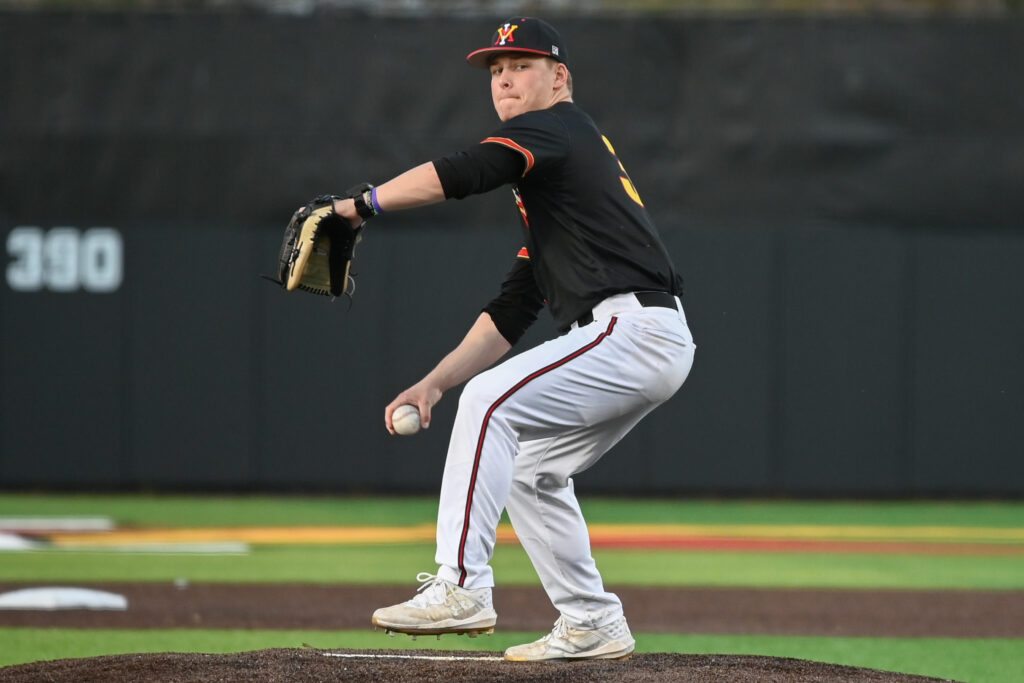
Caden Plummer throwing a baseball during a Virginia Military game.

“It’s to try and give us a little bit of rest.” 

His time at VMI has given him the fortitude to get things done efficiently. 

“People can get lazy and if you do that here, then there are a lot of consequences,” he said. “It’s important to stay on top of your stuff, if you can have the mental fortitude to do it.” 

Plummer said that type of attitude will help in the real world with project deadlines or work responsibilities. Considering he has already landed a job for post-graduation, he knows he can’t slack off. He has accepted a position with Kimley-Horn in Richmond as an engineer.  

He credits his faith in keeping him strong and pulling him out of tough times. Keeping a positive mindset has also created a strong foundation for himself. He also doesn’t take his experience at VMI for granted. 

“That’s a huge thing for me, my relationship with the Lord,” he commented. “I’m just lucky to be able to get to experience these things, because there’s plenty of people that would like to be in my spot or would like to go to college.”  

Honors Week: Exploring Global Rivalries and Climate Change

During VMI’s annual Honors Week, Earl Filgo ’25 presented research that bridges global strategic competition and climate change. 

Filgo, an international studies major with minors in national security and Arabic, plans to commission into the U.S. Army as a military intelligence officer after graduating this spring. His presentation, “Strategic Rivalry and its Implications for Climate Change Mitigation,” brings together his academic interests and his drive to confront complex global challenges. 

“I chose this topic because of my interest in international relations theory, its ties to national security, and my concern over climate change,” Filgo said. “Climate change deserves more scrutiny outside the scientific community, especially from those studying security and diplomacy.”

His thesis explores how rivalry between states affects their willingness to cooperate on global environmental initiatives. The research required a hybrid of qualitative and quantitative methods, evolving over time as Filgo engaged more deeply with data and theory.  

“Initially, I thought it would be mostly qualitative,” he said, “but as I progressed, I realized how powerful quantitative research could be for this topic.” 

Filgo found the thesis process to be intensive.  

“It takes time, loads of time,” he said. “You need to understand different theories and studies, then link them together into one cohesive project. It’s not enough to have a great research question. You need solid data to back it up.” 

Filgo’s advisor, Col. Patrick Rhamey, observed Filgo’s growth throughout the process.  

“Once he got started, he showed initiative and diligence,” Rhamey said. “He learned to work with limited and sometimes poorly coded data, using both statistical software and theoretical frameworks to produce a well-rounded study.” 

Rhamey highlighted the relevance of Filgo’s work for the VMI community. “His research connects global environmental priorities with military spending, a subject directly tied to the paths many of our cadets pursue.” 

“I gained credibility and confidence in my research skills, and a way to show my capabilities to future employers,” he said about how the experience expanded his academic and practical skill set. “It’s a burden, but also an exciting challenge not many cadets get to experience.” 

Honors Week: Cadet Completes Work on App

Parents of newborns often struggle to understand the needs of their baby. How often should they eat? How long should they sleep? How does one know if they are sick? So, it isn’t unusual for parents of babies with hearing impairments to be confused. Col. James Squire, professor in the Department of Electrical and Computer Engineering at Virginia Military Institute, was faced with that very issue 25 years ago when his oldest son was born and diagnosed with a hearing disorder.

Squire’s first thought as a new parent was, “What was the world like that he was experiencing?” Squire and his wife were given an audiogram, but they didn’t know what it meant. Thankfully, his son’s hearing disorder was a misdiagnosis, but it inspired Squire to begin research to help young parents of children with hearing loss. “I thought it would make a good honors project for cadets. I was wrong. It made a terrible single honors project, but it made three really good honors projects because there was so much background work with theoretical development, open-source work, working with audiologists, and figuring out how to get programs that could be used practically by the audiology community.”  

Work on the project has spanned over nine years and began with Will Flathers ’09, who primarily focused on filtering audio. Binh Tran ’23 continued with the project and created an open-source sampling frequency filter. Tran won an award for his contribution at the Institute of Electrical and Electronics Engineers (IEEE) Southeast Regional Conference two years ago.

Cole Bowyer ’25, who took up the mantle as the third honors student to work on the endeavor, placed the capstone on the project in his presentation, “Audiogram Emulator,” a free app available to parents that allows them to hear as their child hears.  

Bowyer explained that roughly 9,000 children are born each year in the United States with some type of hearing impairment, and only half of those children receive treatment.

“If a child does not receive any treatment before the age of 1, it’s shown to significantly hurt his ability to learn in the education system and keep up with his peers,” he said.  

Why do parents not seek treatment? Bowyer believes there are several reasons. “For one, parents do not want a label attached to their child. Second, often the child can hear sounds and react, so his parents think he is hearing properly, but he’s not. Since his hearing is impaired, he is not receiving a true understanding of what is being said. And third, parents may not understand hearing loss and its ramifications.”  

In his research, Bowyer consulted with many professionals in their respective field including Lindsey Richard, Au.D., CCC-A, educational audiologist at The Virginia School for the Deaf and the Blind in Staunton. “She provided helpful feedback on how to improve the app. Without her, I don’t think that we would have been able to make the best possible app.”   

Squire and the three cadets who developed the app have no intention of profiting from their work. “We want it easily assessable and free to parents so they will fully grasp how their child hears, and increase the chances of the child getting medical help,” stated Bowyer. The app can be downloaded from the Squire’s website.  

Bowyer will present the project at the IEEE Southeast Regional Conference in Charlotte, North Carolina. His hope in the future is that the app will be commonly used by audiologists and other medical professionals  

Bowyer is an electrical and computer engineering major from Daleville, Virginia, where he attended Lord Botetourt High School. He is the son of Tara Tice and Sheldon Bowyer. Following graduation, he will work for AECOM in Roanoke. 

Honors Week: Analyzing U.S. – China Conflict Asymmetries

John Kennedy ’25 used his Virginia Military Institute Honors Week presentation to tackle how asymmetries between the United States and China shape the potential for conflict in his thesis titled, “Asymmetries Between the U.S. and China in the Context of Conflict. 

Kennedy, an economics and business major, will marry after graduation and commissioning, before heading to Fort Moore for infantry officer training. 

“I started VMI the same week Abbey Gate was bombed during the Afghanistan withdrawal,” Kennedy said. “That moment made it clear to many of us that peace isn’t guaranteed. I wanted to examine what future conflict could actually look like, especially with China.”

Kennedy focused his research on China’s conventional military capabilities, strategic doctrine, and economic leverage.  

“Public rhetoric makes China seem like a looming military threat,” he said. “But my research suggests that their economic power may be the more serious concern.”  

“Cadet Kennedy has done a remarkable job of taking a very large topic and reducing it to its bare bones,” Col. Atin Basuchoudhary, Kennedy’s faculty advisor, said. “He has combined various elements of his learning experience to answer his thesis question.” 

The thesis process began during Kennedy’s 2nd Class year with topic selection and continued through a series of formal submissions. Most of his work was done this spring.  

“I spent about three hours a week on it, mostly reading and refining ideas,” he said. “The Rat Line made it tough to make real progress last fall.” 

Kennedy says he’s gained both insight and perspective through the process of his thesis.  

“This research helped me think critically about the reality behind the headlines,” he said. “It’s easy to be alarmed by military posturing, but understanding the economic side gives you a fuller picture.” 

Kennedy also acknowledged the importance of mentorship throughout the project.  

“I want to thank Colonel Basuchoudhary and Colonel [Spencer] Bakich for their guidance,” he said. “Their support helped make this project possible.” 

Honors Week: Cadet Explores Democracy in African Monarchies

Jonah Jurack ’25 spent the summer before his 3rd Class year at Virginia Military Institute studying abroad in Morocco. Jurack was drawn to the unique perspective of non-democratic governments, sparking the beginning of what would become his senior thesis. 

For Jurack, an international studies major, his first experience outside the United States raised important questions about how U.S. citizens perceive democratization efforts in non-democratic nations.

“It was fascinating to see how the Moroccan people addressed King Mohammed VI,” said Jurack. “He was widely venerated, and it was frowned upon to critique him in public.” 

That experience fueled a broader interest in the Middle East and North Africa, ultimately leading Jurack to his Honors Week presentation titled “Institutional Heritage and Satisfaction with Democratic Practices in African Monarchies: Evidence from Eswatini, Lesotho, and Morocco.” 

His research asked what factors explain citizen satisfaction with democratic practices in autocratic monarchies. 

Jurack challenged conventional understandings of governance in allied monarchies, an important consideration when evaluating U.S. foreign policy and democracy promotion abroad. 

“I started planning my thesis in the spring of my 3rd Class year,” Jurack said. “I spent five weeks this past summer working with my advisor on my quantitative data through the Summer Undergraduate Research Institute.” 

Jurack employed quantitative analysis using advanced statistical techniques to explore his topic in depth. He worked under the guidance of Dr. Salih Yasun, assistant professor in the Department of International Studies and Political Science.  

“Cadet Jurack’s research is valuable because it illuminates how authoritarian regimes—some of which are America’s closest allies—strive to ensure their survival by employing quasi-democratic methods to elicit different forms of engagement from their citizens,” Yasun said. 

Yasun, who first worked with Jurack in a Middle East politics course, said he developed his thesis largely on his own, seeking guidance only when necessary. He described Jurack’s continued academic growth, noting improvements in theory-building, data analysis, and integrating findings within broader political discussions. 

“I am confident that Cadet Jurack has a bright future and will make valuable contributions to his surroundings, including his country,” Yasun said. “Honors Week has been a great event showcasing the critical and, indeed, cutting-edge research conducted by cadets here at VMI.” 

Jurack plans to commission into the U.S. Army as an infantry officer after graduation. He said the research process has strengthened his critical thinking, sharpened his analytical skills, and taught him the value of persistence. He believes these qualities will serve him well in his military career. 

VMI Brings Home Another Record from War Conflict Scenario Competition in Italy

A team of Virginia Military Institute cadets recently participated for the 14th time in the Competition on the Law of Armed Conflict in Sanremo, Italy. This year’s competition brought together over 100 cadets from 29 military academies drawn from 17 different countries. VMI continued its exceptional form at the competition, winning four gold awards and one silver. For the second year running, this was the most awards won by a single academy.  

VMI was one of six U.S. military colleges involved in the competition, with others including West Point, U.S. Air Force Academy, U.S. Naval Academy, Coast Guard Academy, and the Citadel. 

The event, hosted by the International Institute of Humanitarian Law, places cadets in mixed teams to provide legal analysis on a fictional war scenario. Cadets spend three days in “Joint Operations Command” centers advising their commanders on how the war should be conducted in accordance with international law.  

Four cadets – Audrey Davis ’25, Delilah Martindale ’25, Aaron Metz ’25, and Christian Walker ’25 — won gold medals for their mixed team performances, while Walker won the overall individual silver medal.   

Cadets are chosen for the competition after completing a course on the Law of Armed Conflict with Maj. Tim Passmore, assistant professor of international studies, and then receive additional training and preparation as a team before the competition. In 2012, VMI started participating in the competition under Col. Robert James’ direction, who now serves as a judge. 

The competition consists of cadets serving as legal advisers to a commander in a fictional war scenario simulation, according to Passmore. Cadets are divided into mixed teams of three, where they work with cadets from other academies. Each team is given a scenario, which develops over the week as new information is revealed. The teams must advise the commander on the legality of the various actions their military can take. 

“This year’s competition was a wonderful experience in a variety of ways. It was the largest, and most diverse, year in the competition’s 23-year history, with cadets coming from as far as Japan, Thailand, and Mozambique, while new teams traveled from Burundi, Lebanon, and Kosovo,” Passmore said. 

The competition allowed VMI to showcase talented cadets in an international setting, Passmore said. Those participating were able to display their high academic standards, as well as the character of VMI cadets.  

 “It is also a formative, and, in many cases, life-changing, experience for our cadets. Beyond just international travel, they spend a week interacting with foreign cadets, many of whom will be leaders in the future,” Passmore explained.  

He also noted the experience has provided some inspiration for those who attended.  

“Cadets have decided to attend law school after attending the competition, while others have gone on to excel as commissioned officers with some of the skills honed during this experience,” he said. “I regularly hear from former cadets who tell me how much this experience impacted them personally and professionally.” 

This year was also different than in the past, with more cadets representing more academics than ever before in the competition’s two-plus decades.  

“The standard of knowledge and preparation also seems to rise every year, continually pushing our cadets to a higher level,” Passmore commented. 

This year’s team had less time to prepare than in recent years, Passmore shared, since he was on sabbatical last fall. He had to give two cadets a crash course in the material since they were unable to take his Law of Armed Conflict class. 

“Their phenomenal performance largely comes down to the intensive work they completed in the weeks leading up to the competition. They worked extremely well as a team and showed tremendous initiative in studying and preparing for practice exercises in their spare time,” he said. “They also gleaned knowledge from last year’s team about the competition experience. During the competition, they remained focused and engaged until the very last session.” 

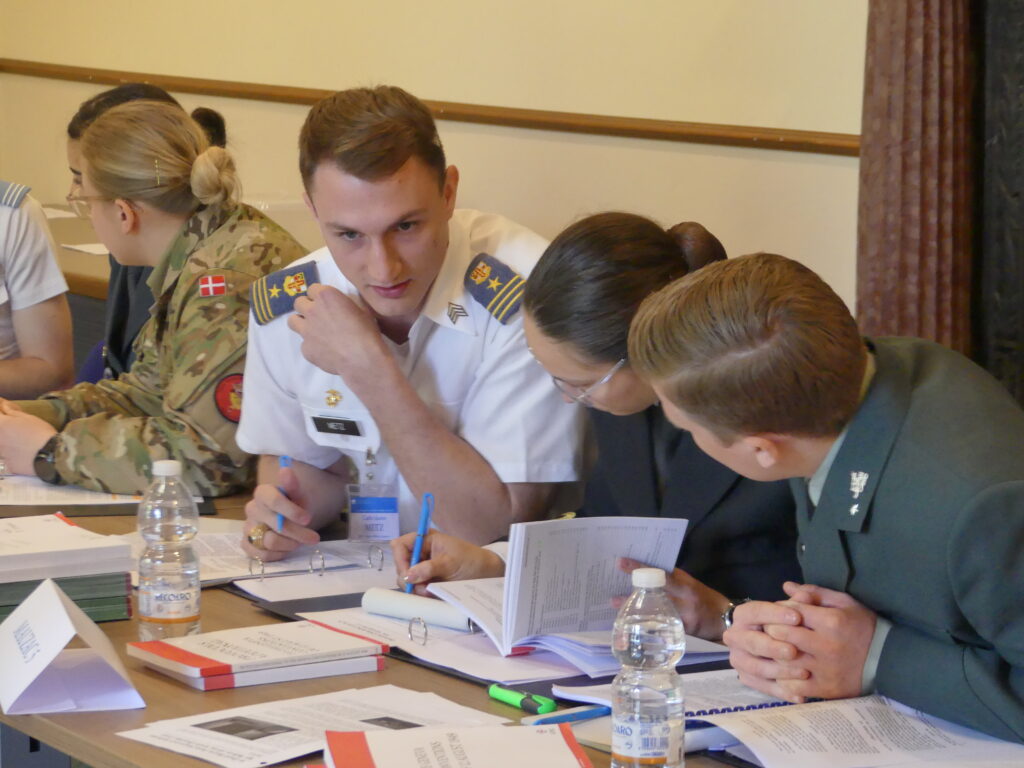
A cadet speaks with others during a competition.

Walker said the conference is a once-in-a-lifetime opportunity. He was intrigued to take the class because of his love for law and with his intent to attend law school next year. His goal was to increase his knowledge of different sectors of the law. It was also his first time out of the country.  

“Once we began the competition, I found myself interacting with cadets from all over the world who, although they had different experiences, all had the same interest in regard to the Law of Armed Conflict,” he said. “Every day, we would be thrust into new situations that made us think critically about legal questions that arose during the planning of a simulated operation. Through asking these questions, we had to work together to ensure that our answers were crafted to address the legal intricacies of the matter at hand.”  

He urges anyone who would be casually interested in this type of competition to take the plunge and do it. 

“This is an experience that will stay with you for the rest of your life and will allow you to build bonds with people who you may interact with as a part of your future career, whether you commission or enter the private sector,” he explained. “It also allows you to increase your ability to think critically regarding a very difficult subject which is something that is invaluable as a young leader.” 

Davis was one of the cadets who didn’t take the Law of Armed Conflict class. Instead, she applied for the team and ended up with a slot. She said the competition was based around a theoretical situation involving the outbreak of an international war. Competing in teams of three, they were assigned to a country in the coalition.  

“Although most of us will not become legal advisors, it gave us great insight into joint operations and what our roles as military officers would be,” Davis said. “I think experiences like this teach future officers that those from other countries are just allies we do not know yet, rather than people to fear because we do not know them.”

Martindale said the competition was a bit outside her comfort zone. 

“It really pushed our team to socialize and work with others with whom there was a huge language barrier,” she admitted. “However, it was also one of the best experiences of my life. You get to be immersed in all the different cultures that attend the conference, which is a learning experience in itself. Then, for the actual competition aspect, it was definitely a challenging situation, but we were trained so well, we knew how to handle it.” 

 In the end, Passmore said he was incredibly proud of the cadets who competed. 

“From beginning to end, they conducted themselves with the utmost character and maturity, and were a true credit to VMI,” he said. “They continued the great work our cadets have done in recent years to in strengthen VMI’s reputation among foreign military academies.” 

Honors Week: Tavenner Performs Stellar Research

Cassiopeia is a constellation in the northern sky named after a Greek mythological queen. Its distinctive “W” shape formed by its five brightest stars, makes the constellation easily recognizable. In the center of the “W” is the star, Gamma Cassiopeia, which Brian Tavenner ’25 researched for his honors thesis, “Polarization and Interstellar Extinction in the Vicinity of the Star Gamma Cassiopeia.”  

Polarization of starlight, first observed in 1949, is when the star’s energy travels through space in just one direction instead of random patterns. Interstellar extinction refers to the dimming of starlight, making the distant objects appear fainter and redder. Both polarization and extinction are due to dust and gas particles.    

Tavenner’s work at the VMI Observatory at McKethan Park was enjoyable but limited due to the telescope needing repairs. Using other tools and computer programing, he was able to deduce that the region of space he analyzed is most likely filled with emission line stars, that is stars with material around it that can influence its measured polarization. He recommends that more cadets continue his research to discover the reason for his conclusions.  

According to Tavenner’s advisor, Col. Gregory Topasna, professor in the Department of Physics and Astronomy, the project had several moving parts.

“Brian worked diligently to see everything to completion. Obtaining the images was a little more complicated than usual since the telescope needed repairing, but he was able to image a region that has stars with interesting characteristics. The fact that there is a concentration of emission stars northwest of Gamma Cassiopeia is very interesting and worth following up on. Before graduation, I’m hoping Brian can rustle up a cadet who wants to extend his work. He also knew LaTeX, a typesetting routine that is heavily used by astronomers when writing papers,” he said. 

Tavenner submitted his research to the European Astronomical Society in hopes that it will be presented in poster form at the annual general meeting in June at University College Cork in Ireland.  

Tavenner is an electrical and computer engineering major from North Prince George, Virginia. He is a graduate of Midlothian High School, and the son of Andrea and James Tavenner. Following graduation, he plans to work with an engineering firm in Richmond.  

Honors Week: Cadet Researches AI as a Hiring Manager

Artificial intelligence (AI) is everywhere. From health care to finance, transportation, customer service, and manufacturing. Many people rely on AI without really realizing it for their smartphones and smart home devices. But is AI as reliable and accurate as humans in all cases? Jude Roberts ’25, a cadet at Virginia Military Institute, sought to find the answer in his honors presentation, “Assessing the Efficacy of an LLM for Resume Selection and Human Talent Management.”

Roberts, a computer science major from Cloverdale, Virginia, was introduced to AI research when he interned at the U.S. Army Cyber Command at Fort Eisenhower, Georgia, last summer. For his honors project, he conducted an experiment looking at business hiring processes using the AI program, ChatGPT, specifically the GPT-4o mini, a cost-efficient small model. He explained that people generally believe that time efficiency and lower costs are a huge upside to automation. “If a company doesn’t have to pay an employee to look through a lot of resumés, it frees their staff’s time to focus on more high-level strategic tasks. Sometimes ChatGPT and other large language models (LLMs)—software designed to generate human-like, conversational language—provides completely nonsensical, out of context, or just wrong information, known as hallucinations, which is problematic.” Roberts continued to point out that because there is no human interaction to evaluate a potential employee’s interpersonal and character traits, AI may show a bias based solely on particular words appearing on a resumé.  “Some of us very soon will be applying for our first jobs and we want a fair shot at the hiring process. What I’m examining here is whether AI is consistently capable of selecting the best applicants for jobs,” he explained.

Roberts took 1,000 resumés and instructed ChatGPT that it was taking on the role of a hiring manager, and it was to consider the applicants’ skills, experiences, and qualifications, and choose the applicant that best fills the job role. Categories included data science, arts, web design, and engineering. An additional category, not applicable (N/A), was designated for any resumé data that contained nonsensical or misleading information or that did not match any of the categories.

Roberts found that AI was less accurate and less reliable than a human hiring manager in finding the best candidate, and he determined that the LLM was vulnerable to malicious interference and bias propagation. “These are very concerning aspects for the reliability of these models, and administrators should be concerned about these issues when implementing this technology. Hiring managers should never solely rely on the technology to automate any portion of resumé screening.”

Sherif Abdelhamid, Ph.D., assistant professor in the Department of Computer and Information Sciences and outreach liaison officer for the Cyber Defense Laboratory, served as Roberts’ advisor on the project. Abdelhamid noted Roberts’ exceptional skills of problem solving, ability to work in a team, and analytical skills. “I see him as a unique, special student. He was able to independently identify the research problem and objectives, and came up with a unique design for his research. He carefully and critically studied how LLMs can impact our lives, and identified their benefits and drawbacks,” said Abdelhamid.

Roberts, who is minoring in applied mathematics and philosophy, is a graduate of Lord Botetourt High School in Daleville. He is the son of Kevin and Lori Roberts. Following graduation, he will commission into the U.S. Space Force where he hopes to do work in cybersecurity or electromagnetic warfare.  

Honors Week: Exploring the Complexities of Desegregation

Patrick Kiernan ’25 started exploring different civil rights cases at the Supreme Court level during a class in high school. He found it interesting to see how different cases were and how civil rights progressed.  

Jumping forward to his time at Virginia Military Institute, he started exploring more education-based civil rights cases. His interest then formed into a plan for this honors thesis, “The Courts and Educational Equality: The History of the Court’s Role in Desegregation, Integration, and Equality in American Public Schools,” which he presented during VMI Honors Week.

His thesis was centered on the enforcement of desegregation post-Brown v. Board of Education, focusing on the 1960s and 1970s. Divided into five key Supreme Court cases, Kiernan explored the complexities of desegregation, focusing on: Griffin v. Prince Edward County, Swann v. Charlotte-Mecklenburg, Milliken v. Bradley, San Antonio v. Rodriguez, and Regents of the University of California v. Bakke.  

“Overall, I was trying to look at the challenges of desegregating,” he explained. “The way it’s taught in schools is that it was almost overnight. There was more going in, it was a lot more complicated. I was looking at what made it so complicated and what made it difficult to desegregate and all the other problems that kind of came with it.” 

Kiernan dedicated between three to seven hours a week to reading, research, and writing in order to tackle a 70-page paper. 

“I think it’s helped me develop my writing skills a bit more, because I’ve been able to write that long and able to make it more of a coherent thing,” he said. “Because, even with some of my other classes where it’s like a five- paragraph essay, it’s easy to keep it coherent when it’s that short. But when you’re trying to navigate something that’s almost the size of a small book, it takes a lot more thought and care to be able to put that all together.” 

Lt. Col. Mark Boonshoft, associate professor in the Department of History, was Kiernan’s academic advisor for his thesis. The history department requires a longer thesis and additional preparatory semester of work during a cadet’s 2nd Class year, Boonshoft explained.  

Boonshoft started working with Kiernan last spring with an independent study, where Kiernan studied school desegregation as it relates to courts specifically. Through that, the two refined Kiernan’s topic to identify primary sources, settle on research methods, and discuss writing.  

“Compared with other disciplines, history requires a lot of independence in research for undergraduates,” Boonshoft said. “Cadet Kiernan’s project is on a subject I know a lot about from teaching it for years, but it is not something on which I have done independent research. I am not reading the hundreds of pages of primary sources from Supreme Court justices’ private papers that Cadet Kiernan is. I can keep tabs on his work, look at his notes, review drafts frequently, discuss the research weekly, but this is not collaborative research. Cadet Kiernan deserves the credit for having produced 70 -pages of carefully researched, well-sourced, original work.” 

Kiernan said that the process of research and writing his thesis sparked new ambitions for him. He previously had an interest in law school, but this experience has prompted him to shift to potentially graduate school. Although Kiernan will be commissioning into the U.S. Army after graduating in May, he said the future prospect of grad school has become more alluring.  

As part of the Institute Honors program, the history major said it’s allowed him to explore other concentrations and widen his academic discoveries. He said it’s made him more intellectually curious. 

“If you really want to learn more about the world in general, I think Institute Honors has helped,” Kiernan admitted. “I’ve been able to learn a lot, even if it wasn’t necessarily something in my discipline.” 

Boonshoft said that Kiernan’s research will help him when he commissions into the Army. He said that constitutional history has become an area of focus at VMI to help train its citizen-soldiers.  

“Research like this brings important constitutional issues to cadets’ attention. It’s research that also bears on VMI’s own story of racial integration in the 1960s, of affirmative action, and so forth,” Boonshoft said. “I think this research shows his commitment to the citizenship side of the citizen-soldier ideal. More concretely, it has given him a chance to hone important skills of analysis, of writing, and most importantly of formulating clear questions and strategizing ways to answer them. He has also had to synthesize huge amounts of information into a coherent narrative. That skill of separating what is important and what’s just noise will serve him well in the military and beyond.”