Post View Unavailable »
New Website Launched »

Honors Week: Freeman Compares Philosophers

Brooks Freeman ’25, an English major at Virginia Military Institute, sought a common core between the philosophies of Jalāl al-Dīn Rūmī, a 13th century Middle Eastern Sufi mystic and poet, and SØren Kierkegaard, a 19th century Danish philosopher, theologian, and poet, in his honors presentation, “Varieties of Mystical Experience: Encountering the Absolute in Rūmī and Kierkegaard.”  

Freeman found inspiration for his research after traveling to England and Morocco in the summer of 2023. In England, he studied existential philosophy and comparative religion.

“Going into the existential philosophy class, the first person we read was Kierkegaard, who is regarded as the original existentialist. He wrote extensively about faith, and I became interested in his ideas. In my comparative religion class, I learned a little about Sufism and Christian mysticism, and found those to be very interesting,” shared Freeman. Upon returning to VMI the following fall, he decided he wanted to compare the two thinkers for his honors thesis. 

Freeman cited Pseudo-Dionysius, an ancient Greek theologian, for his definition of mysticism. “‘The experiential encounter with the utterly transcendental reality that God is.’ Basically, a meeting with God.” 

He described some differences between Christian mysticism and Sufism.

“The first and most obvious difference would be their foundations; Sufism founded from Islam, and Christian mysticism from Christianity. They also have different end goals. Christian mysticism is about union with God while keeping one’s individual characteristics, and Sufism is about annihilation of oneself to form a kind of oneness with God.”

Similarities he listed between the two philosophies include the individual taking an internal journey toward divine union, poetry rich in symbolism, and teaching and guidance.

“Then the final thing is this idea of the absurd that you can see in Kierkegaard’s writing. It has to do with something that cannot be comprehended logically, but is believed through faith, which Kierkegaard wrote is extremely difficult. It is something that is present in Rūmī’s writing as well,” Freeman explained.  

Freeman defended the premise of comparing the two authors because they are still relevant, they are widely read outside of their faith tradition, there is a lack of research comparing them, and they both sought a similar mystical path.  

Freeman concluded that the paths of Kierkegaard and Rūmī are similar, but warned that the commonalities are steeped in their respective traditions, so context must be appreciated. Studying them in conjunction displays that mystical experiences can at once be common and contextualist. 

Freeman’s advisor, Lt. Col. Patrick Eichholz, associate professor in the Department of English, Rhetoric, and Humanistic Studies, has known Freeman for four years.

“I first met Brooks through the adopt-a-rat program, and it’s been a real pleasure to watch him develop as a scholar. I knew there was something different about Brooks the first time he came over to my house. When the other rats asked for the Netflix password, Brooks asked for book recommendations. After Breakout, I saw a lot less of Brooks, but I was not surprised when I heard all the updates that Brooks was joining the honors program, preparing for the LSAT, and traveling overseas for various study abroad opportunities.”  

Freeman is from Noblesville, Indiana, and minoring in Arabic. He is an alumnus of Culver Academies and the son of Lee and Rose Freeman. He plans to attend law school following graduation. 

Behind the Balance: Jillian Sisk ’27 — Keydet Women’s Track and Field

Virginia Military Institute’s cadet-athletes have to juggle cadet life, heavy academic course loads, and their NCAA Division I sport. Committed to both academic and athletic pursuits, balancing their rigorous schedule in both sports and school requires a certain level of commitment and discipline. Behind the Balance is a series that focuses on those cadet-athletes and how they handle the hurdles of the day-to-day. 

Her love of math and science propelled Jillian Sisk ’27 to pursue a STEM major. At first, she thought veterinary school would be the right path, but found it wasn’t the right fit for her. Instead, she discovered engineering, which pointed her to Virginia Military Institute.  

“I started out as a mechanical engineering major my first semester and realized that was not for me, and I switched to civil and I loved it,” she explained. “I love the teachers. They are so nice and they’re always making sure that you’ll succeed. They know your name. They know your face. And civil engineering is just so interesting because it’s you’re directly working with people.” 

She said choosing civil engineering as her major allowed her to see the direct effect her work could have on the community. She’d be working with the infrastructure of the state, for example. 

“I’m doing things for people — the water, the bridges, the roadways,” she said. “It’s a serious job, because if you build something and it breaks, that would be bad.” 

Sisk was recruited to VMI for track and field as a long-distance runner. She hadn’t heard of the Institute until then.  

“Everyone was welcoming and kind, and they answered all my questions,” she said about her first visit. “I met so many people that seemed like they’d be the type to uplift you if you’re having a hard day or a bad day. And I just felt like it was a family.”

She’s also found that family within her teammates, who offer her support on and off the track. Sisk, who runs the 3K, 5K, the mile, and the steeplechase race, got into track and field in middle school when she was looking for a sport to play. She said the minimal equipment was an incentive, especially for a new sport to try out. Turns out, she was a natural. 

“I just loved it. I love the competition. I love the discipline it requires to get out there and do it every day,” she admitted. “I love the process of training.” 

She’s dedicated to training, which takes up a good portion of her day.  

Cadet-athletes at VMI not only have their responsibilities with their selected sport but cadet duties on top of that. Cadets are also required to take physical fitness classes twice a week, participate in ROTC all four years, prepare for room and uniform inspections, practice for parade, guard duty, and more. 

She’s up just after 6 a.m. when she grabs breakfast to-go and heads back to her room.  

“I’ll check to see what type of homework I have for that day, and I’ll make myself a list of things I want to get done,” she said.  

Jillian Sisk runs track during a meet for Virginia Military Institute.
VMI’s Jillian Sisk during the 3000 meter run. The VMI Invitational indoor track and field meet at the Corps Physical Training Facility in Lexington VA January 27, 2024. (Randall K. Wolf / VMI)

With class until just after noon, she has time to tidy up her quarters, check-in with teachers, and catch up on work before she heads to practice at 3:30 p.m. By 7:30 p.m. it’s dinner time and the more studying. Her days usually wrap up around 10 or 11 p.m. 

With 18 and a half credits, it can get overwhelming at times. During her rat year, Sisk admitted she struggled to stay on top of her studies and saw her grades slip.  

“School always came really easy for me in high school, I never really studied or anything, but you have to study here,” she stated. 

Talking with her mom, her roommates, classmates, and teammates offers good stress relief for Sisk. She said if there’s any time she feels overwhelmed or needs to talk, they’re there. Running offers solace for Sisk.  

“If I’m ever having a really bad day, usually going out for a run helps that a lot. I love running. It makes me feel happy that at the end of the day, no matter what, I have running,” she said. “I can run and that’s one of my strengths and it makes me feel good about myself. I can go out there and just run eight miles and it feels like nothing.” 

She has the mental fortitude thanks to enduring long distances, which can be applicable to her life at VMI and after. 

“I think that they are really preparing me for the future, with the busyness and the strict deadlines,” Sisk explained. “I’m way better at planning things.” 

From last year alone, she’s seen a difference within herself in how she is able to use time wisely. 

“It’s made me have to be more of a self-advocate,” she stated. “If I’m struggling with something in class, I have to be brave enough to ask for help or go to office hours. You have to be able to stand up for yourself. Because at the end of the day, it’s your education … you’ve got to be able to do that for yourself.” 

The Vanguard — Nickole Chavez ’26

The Vanguard series highlights cadets of Virginia Military Institute who exemplify promise, perseverance, and the true spirit of leadership. While they may not be the top-ranking students or those in prestigious positions, these individuals’ dedication, resilience, and growth embody the essence of being a VMI cadet. By sharing their stories, including the challenges they’ve faced and overcome, we shine a spotlight on the diverse paths to success at the Institute, proving that leadership and excellence come in many forms. 

Writing is something that comes easily for Nickole Chavez ’26. She says she enjoys writing essays, which may seem like an odd thing, but when English and writing is something that comes easily, it’s a no-brainer. Science and math, she’s not a big fan. But, when she finds something she’s passionate about, it’s simple.  

“It’s always been something I’ve excelled at,” she admitted. “I feel like it comes naturally to me.”

It’s a trait that her professors have noticed. Lt. Col. Michelle Iten, associate professor in the Department of English, Rhetoric, and Humanistic Studies, said Chavez is a highly focused, self-disciplined, and determined learner.  

“She prepares fully for each session, and her high level of attention and engagement in class activities show a determination to stay on task and to learn all she can,” Iten explained. “She has the same demanding schedule as her peers, but if she is ever fatigued, I would not know it from her demeanor and level of engagement in class; she is active and attentive from beginning to end. She stands out among her peers in the class with this tough constitution for learning.” 

Chavez is disciplined in her studies; she spends a lot of time in the library until the late hours trying to get ahead.  

“That’s mainly how I try to set up my week, just seeing what’s coming up soon, getting that done, and then, if there’s anything coming up on the weekend, I’ll try and get ahead on those assignments during the week.” 

She may not hold rank at Virginia Military Institute, but she tries to stay involved as much as possible. The English major has a minor in Spanish, along with concentrations in literary studies, art history and visual culture, and rhetoric and writing. She’s also the women’s soccer team manager and facilitates Spanish group study sessions. 

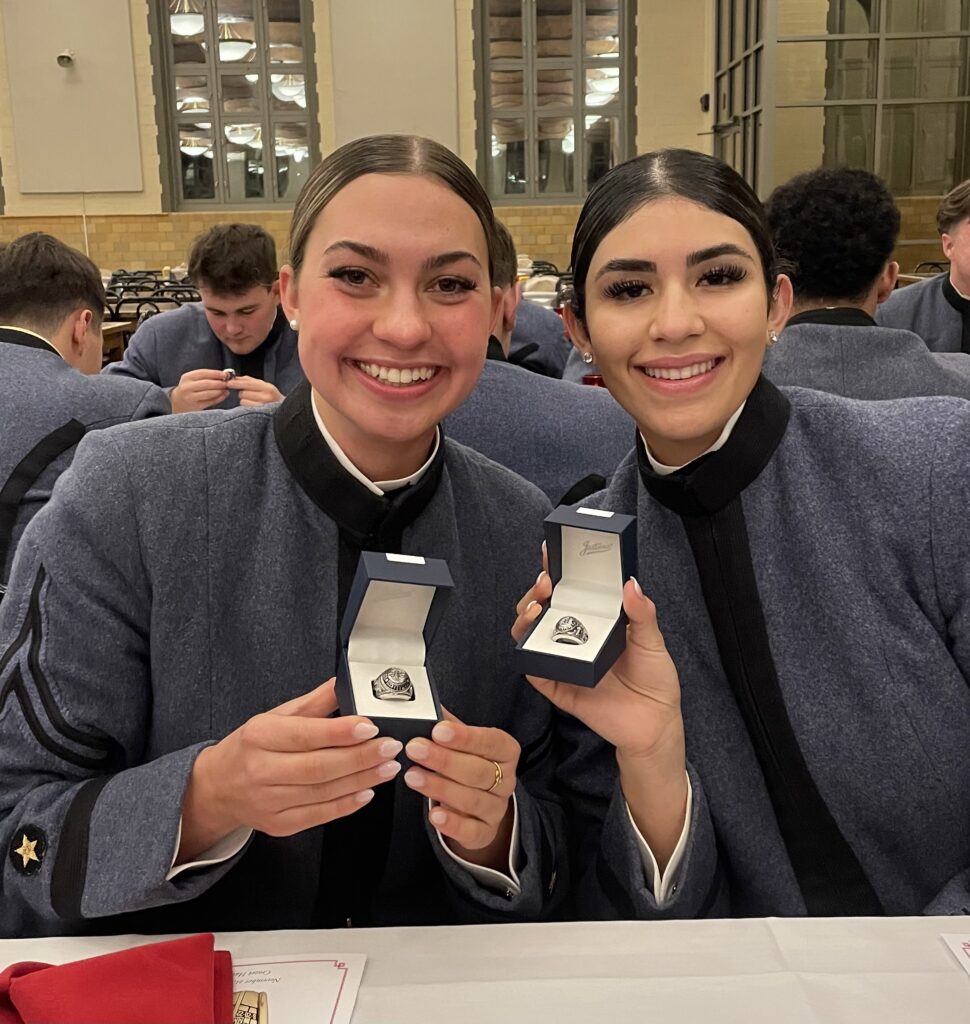
Nickole Chavez showing off her Virginia Military ring.

“I like the school. I like what it stands for, the values. I really try and play into the system as much as I can. I’m just a private and as much as I can, I try to be involved,” she said.

As a 3rd Class cadet, she said she’s seen her growth as a student.  

“I know I need to get my assignments done. I can’t stay in bed all day. Being here has helped me become more motivated and determined,” she said.  

Iten explained that Chavez stands out to her for her level-headedness. 

“In addition to having excellent stamina for learning, Nickole also stands out for her level-headedness and stable self-possession. If she encounters a tough spot or problem in her coursework, she remains calm, articulate, and solution-oriented,” she said. “Cadets can, understandably, get rocked off-balance by the demands of their coursework combined with navigating VMI, but not Nickole. I had a corporate career before becoming a professor, and Nickole is exactly the type of person I would have gladly hired for her capacity to stay grounded and articulate in fast-moving, high-pressure conditions.” 

The routine at VMI has been beneficial for Chavez. She said with the set schedule, it has not only benefitted her during her time at VMI, but outside of it.  

“I feel like I’m already on a set schedule. Even when I’m at home, I’m getting my day started early.” 

She said the schedule she and other cadets must keep has helped her become better with time management. 

“There’s a lot of stuff here we have to participate in, like practice parades, parades, meetings that we need to go to. I feel like just all that stuff kind of pushes you to manage your time a little bit better. During your day, if you get a break, take advantage of that break,” she said. 

Days can be overwhelming, but Chavez’s outlook remains steady. 

“I just try to take a step back and think about why I’m here, because this school can be stressful,” she said. “I just try to think back on why I’m here and what’s my purpose.” 

Honors Week: Do Comedy and Political Rhetoric Mix?

Is it the role of entertainers to take on serious issues and use their celebrity status to sway opinion? Johnny Carson, host of The Tonight Show for nearly 30 years and one of the most famous comedians of the 20th century, once argued that comedians should not use their fame for influence. Rather, their job is to entertain.

Suzanne Leaptrot ’25, an English major with a concentration in rhetoric and writing at Virginia Military Institute, asked, “Where do we situate comedy in our understanding of political rhetoric?” in her honors thesis presentation, “Conventional Comedy: Analyzing Stephen Colbert’s Live Monologues from Democratic and Republican National Conventions.”

According to Leaptrot, comedy is not exempt from providing news. In fact, people are increasingly getting their news from comedy shows like Saturday Night Live, Last Week Tonight with John Oliver, and The Daily Show. “Comedians don’t have the same journalistic obligations that reporters do. Journalists can be called out when they provide false information and are expected to redact their statements and admit when they are wrong. When a comedian provides false information, he can say, ‘Oh, it was just a joke.’ Yet these comedy shows still frame opinions, so I sought to evaluate comedy with the analytic framework of demagoguery,” she said.

Leaptrot referenced the Oxford English Dictionary when defining a demagogue as, “someone who seeks support by appealing to the desires and prejudices of ordinary people instead of using rational argument.” She studied two theories of demagoguery and settled on her own theory, and applied those principles to comedian Stephen Colbert’s live monologues from each side of the Democratic National Conventions (DNC) and Republican National Conventions (RNC) in 2016, 2020, and 2024.

The first theory Leaptrot studied was that of Patricia Roberts-Miller, author of “Demagoguery and Democracy,” who stated that demagoguery is always bad, and the main indicator of demagoguery is when arguments are reduced to an “us versus them” problem. The prime example is Adolf Hitler. The second theory Leaptrot researched is that of Charles Zug, author of “Demagogues in American Politics.” “Zug argues that Americans live in a society that thrives on populism and demagoguery. It paradoxically claims to hate demagoguery, but there is a time and place for political leaders—and political leaders only—to engage in demagogic rhetoric that is beneficial to democracy. He says in a civic emergency when there’s no time for politicians to explain the rationale behind their decisions, they are obligated to engage in demagoguery,” reported Leaptrot.

After comparing the two theorists, Leaptrot concluded that a good demagogue does not exist because a good demagogue isn’t a demagogue at all. “There’s a type of good demagoguery that is only valid in a rhetorical emergency. Someone may use demagoguery as a rhetorical device one time, but demagoguery is not a part of his character. This is where Stephen Colbert comes in.”

Leaptrot, who is a fan of Colbert’s comedy, viewed five hours of his monologues from both the DNC and RNC in 2016, 2020, and 2024. “In theory, they are identical events, but from opposite sides of the political aisle. What better place to look for a disparity in how he talks about each side?” She found that Colbert consistently belittled and criticized republicans, but praised and was favorable of the democrats. She concluded that her parameters of demagoguery apply to Colbert’s monologues in 2020, but not for 2016 nor 2024.    

Maj. Adam Cody, assistant professor in the Department of English, Rhetoric, and Humanistic Studies, served as Leaptrot’s advisor on the project. Cody stated that she reflects some of the noblest aspirations of the liberal arts educational program. “It is in Suzanne’s nature, when confronted with a challenge, to advance toward it, not to retreat from it. She has a fondness for learning and takes joy in discovering new answers to old questions,” he said.

Leaptrot is from McLean, Virginia, where she attended Langley High School. She is the daughter of Jeanne Peck. After graduation, Leaptrot hopes to teach English in Lithuania through the Fulbright Program. She also wants to pursue a master’s degree in intelligence and security studies.

Honors Week: Why Live? Cadet Researches Philosopher’s Personal Resilience

Simon Moore ’25 was drawn to Arthur Schopenhauer’s pessimistic views and honesty about pain and suffering. He said it might be considered a taboo subject, but it intrigued him.  

He presented his thesis, “Why Live?: An Analysis of Arthur Schopenhauer’s Life and Philosophy,” during Virginia Military Institute’s Honors Week. The psychology major decided to commit his time outside his department to a philosophy-focused thesis.

“There’s not really a lot of opportunity to read and learn about philosophy,” Moore admitted. “That was something that I kind of wished that I had.” 

He essentially willed that and was allowed to pursue the topic of Schopenhauer’s life due to his desire to explore something more reading and writing intensive — something he hadn’t really done during his cadetship.  

Moore’s thesis explored why Schopenhauer, despite his pessimistic life and work, did not commit suicide, focusing on his denial of the will through art, philosophy, compassion, and detachment. He analyzed Schopenhauer’s life, including his daily routine, his relationships, and his philosophical pursuits, to determine if he lived up to his own ideals.  

The research involved extensive reading and writing, with a focus on understanding Schopenhauer as a man and the alignment of his life and work.  

Moore pointed out Schopenhauer’s philosophy offers four key principles for personal resilience: art and aesthetic pleasures, philosophical thinking and reading, compassion, and detachment. 

In his thesis, Moore emphasizes that these principles are always available, regardless of life’s circumstances. They provide tools for maintaining perspective and finding meaning, even during personal struggles. The core idea is to consciously choose how to respond to suffering — through art, reflection, compassion, and detachment — rather than being overwhelmed by life’s challenges. 

He began his research last spring, spending about four to five hours a week on reading materials. That amped up in the fall and this spring to about eight to 10 hours a week of research. By February, he was writing his thesis in full force.  

Moore said that this research opportunity allowed him to diversify himself as a student at VMI.  

“That’s something that I’m really proud of doing. Nearing the end of this project, I did something that maybe a lot of other cadets aren’t necessarily willing to do,” he said. “I intend to sort of continue this philosophical interest of mine into my career after VMI.” 

Moore plans to continue exploring philosophy, particularly in the context of wealth management, where understanding individual suffering and resilience is crucial. 

Dr. Duncan Richter, professor in the Department of English, Rhetoric, and Humanistic Studies, was Moore’s academic advisor for his thesis. Richter met with Moore once a week to make sure he was on track, while providing feedback on what he had written and suggesting other readings. 

“He is pretty self-motivated and hasn’t needed much correction, so I feel as though I have been relatively hands-off,” Richter said. “It’s my job as a professor to try to get cadets to think more and better, and this project has certainly got Cadet Moore thinking very carefully about the nature of reality and the meaning of life. If he can share some of his enthusiasm for philosophy and some of the insights he has gained, then that’s good for everyone here.  

“I hope he has enjoyed doing it, but, above all, I think he has really been thinking critically about important questions. That can only be good for his intellectual development,” Richter added. 

Behind the Balance: Dyson Dunham ’26 — Keydet Wrestling

Virginia Military Institute’s cadet-athletes have to juggle cadet life, heavy academic course loads, and their NCAA Division I sport. Committed to both academic and athletic pursuits, balancing their rigorous schedule in both sports and school requires a certain level of commitment and discipline. Behind the Balance is a series that focuses on those cadet-athletes and how they handle the hurdles of the day-to-day. 

It’s a mental game for Dyson Dunham ’26, not just while he’s wrestling, but during his day-to-day. He sacrifices a lot when cutting weight for matches, staying on top of assignments, and fitting in his cadet duties. On the mat, he says he’s doing it for himself.  

“It’s kind of like a pride thing,” he admitted. “I want to prove something to myself.” 

Wrestling wasn’t his first choice of sport. It took his older cousin doing it and getting stronger that pushed him to try it.  

“I would go to my cousin’s wrestling tournaments, but then my cousin would beat me up,” he joked.  

The sport became something he enjoyed. It also introduced him to a coach he became close to, who became a mentor. It was his high school coach who suggested Virginia Military Institute to Dunham because he was an alumnus.  

“I wanted to know what connections I could build here and what network I could grow,” he said. 

Sometimes, he struggles with compartmentalizing things, often going on autopilot to get through the day. He’s a big proponent of just pushing forward, especially when stressed.  

“I kind of found ways to shut my brain down and just kind of deal with it.” 

He says he has a high stress tolerance. It pushes him to work harder. It’s paid off, last year, he competed in the NCAA Wrestling Championships in 2024 and secured a win over a Big 10 opponent. He also came in third in the SoCon Championships in 2024.

“I believe that I thrive on that pressure,” he said. “Going into wrestling, I’m a little antsy, a little anxious. That makes me better, makes me get stuff done faster, get to what I want to do.” 

This year, he’s proved that hard work pays off. Dyson was the top wrestler at 133 pounds and earned one SoCon win, to name a few. 

With 18 and a half credits and a being a DI athlete, communication and organization are top priorities for Dunham.  

“I make sure I turn in all my work, coordinate with professors on how I can make things up,” he explained. “Usually, they’re pretty understanding.” 

Dyson Dunham during a wresting match at Virginia Military Institute.
VMI Wrestling vs. Seton Hill Action Shot

Cadet-athletes at VMI not only have their responsibilities with their selected sport but cadet duties on top of that. Cadets are also required to take physical fitness classes twice a week, participate in ROTC all four years, prepare for room and uniform inspections, practice for parade, guard duty, and more. 

His days can start early with morning workouts, then onto class until the afternoon, and then back to practice. Since his days are so filled, he sometimes has to take the losses — a lower grade on an assignment — to find some downtime to reset. 

“I find relaxing times very important,” he commented. “They’re hard to come by for me. So anytime that I can push something off and give myself time to just take a break from either wrestling or academics, I do it.” 

It doesn’t mean he’s not committed to his studies or sport; he emphasizes the need to find time for yourself to prevent burnout. Luckily, as a civil engineering major, he stays engaged in class.

“I really enjoy engineering, so I find it easy to pay attention in class. I kind of figure that time is already allotted to class, I’m already using that time anyway. I might as well absorb and pay attention,” he stated. “I just make sure I’m staying engaged in my classes, talking to my professors so they know that I know what I’m doing.” 

The pressures of VMI will serve him well in the future, he stated. The balancing act he performs daily can be applied to his future work environment, especially after graduation when he commissions into the U.S. Army. Even if his daily life isn’t as busy, he has the tools to succeed.  

“I’m learning how to juggle a lot of things at once, like stress management, being able to work under that sort of pressure, and being able to deal with it,” he said. 

The Vanguard — John Gibson ’26

The Vanguard series highlights cadets of Virginia Military Institute who exemplify promise, perseverance, and the true spirit of leadership. While they may not be the top-ranking students or those in prestigious positions, these individuals’ dedication, resilience, and growth embody the essence of being a VMI cadet. By sharing their stories, including the challenges they’ve faced and overcome, we shine a spotlight on the diverse paths to success at the Institute, proving that leadership and excellence come in many forms. 

High school was a breeze for John Gibson ’26. He thought coming to Virginia Military Institute, he wouldn’t have to put in any extra effort. 

Except, he was wrong.

“My GPA the fall semester of my rat year was just atrocious,” he explained. “I thought I’m having so much fun here, being a rat with my friends, taking these classes, that I can’t really afford to lose it just because I’m not willing to do my homework. I need to do the work. That spring semester, I just really put the axe to the grindstone and did the work. Then I fell in love with doing the work as well.” 

He was drawn to economics and business as a major because it applies to a lot in his life. 

“I’d say it’s applicable to everyone’s lives,” he stated. “Whether it’s you’re learning about inflation rates or unemployment, you can read the news and understand it.” 

As his classes went on and became more major-focused, his interest and devotion to learning grew. 

He said his classes became more competitive and his professors found interesting ways to engage cadets. In his business finance class with Col. Jeffrey Smith, they’re presented with academic sporting events. Gibson explained that the approach to these events is not to be seen as studying for an exam but working hard and treating it like a race. He said switching the way he thought about preparing for it was more geared toward steady preparation. 

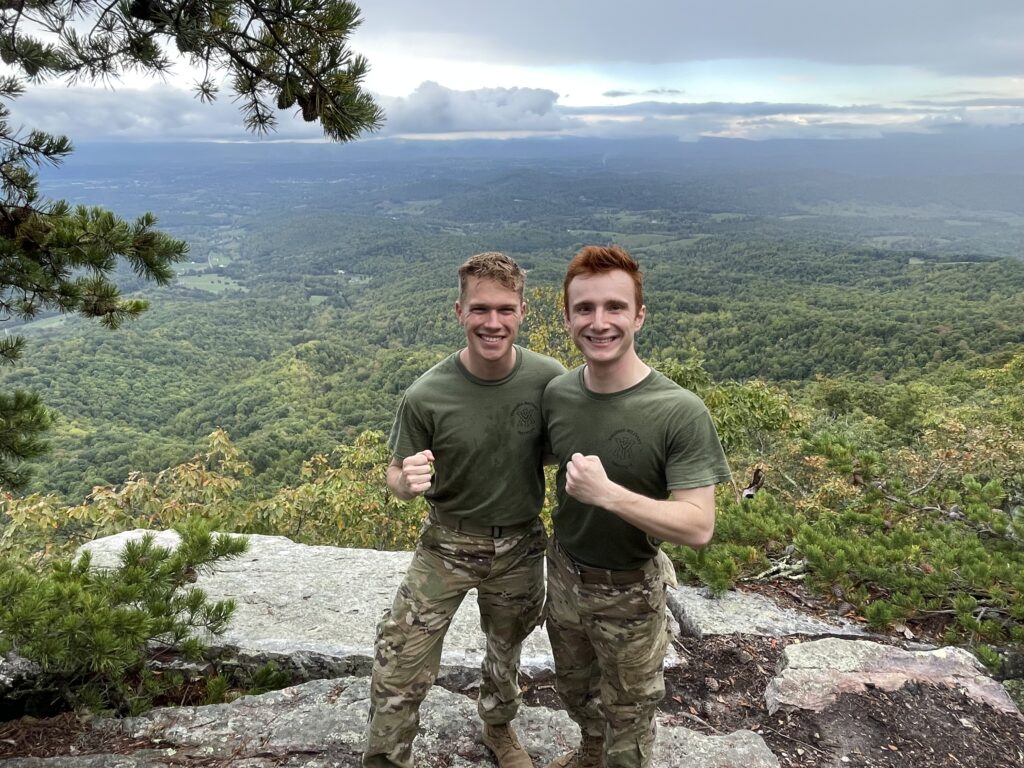
John Gibson atop House Mountain in Lexington during a hike with the Corps of Cadets at Virginia Military Institute.

“I think of it as practicing for the exam in the same way as when I go for a run,” he explained. “I’m not just running to tire my legs out, but it’s to prepare for my upcoming race. It’s like building endurance in both instances.”

Col. Samuel Allen, professor in the Department of Economics and Business, said Gibson is thoughtful and good at asking questions that will help him, along with the rest of the class, better understand the content. 

“John shines without taking the spotlight away from anyone else,” Allen said. 

Allen said he saw great promise in Gibson when he was on the Rat Line and it was a challenging first semester.  

“The rigors of being a rat knocked him down, metaphorically, yet he rebounded, redoubled his efforts, and emerged committed growing as a scholar,” Allen said.

Gibson said he knows the difference between when it’s time to work and time to play.  

“I’ve become a much harder worker, and not just because I have to, but now I enjoy hard work,” he admitted. “When I matriculated, I was lazy. But with one of my brother rats, we joke about how we have figured out how to use all 24 hours of our day.” 

Gibson tries to stay as involved as possible, with participating in cadre for Charlie Company and working at the Miller Academic Center. 

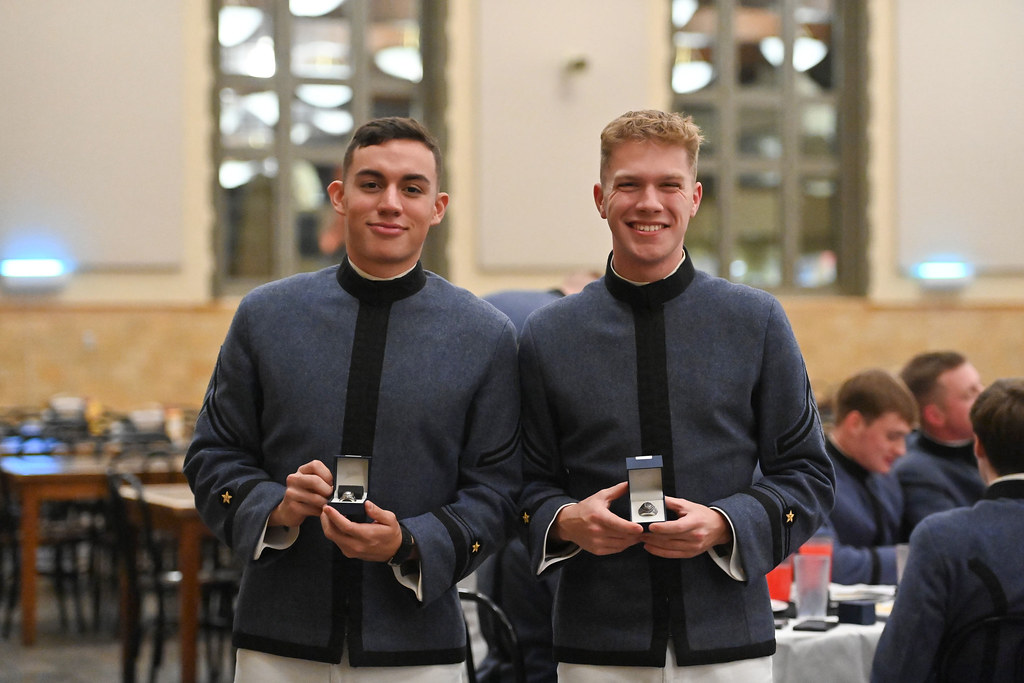
John Gibson shows off his Virginia Military Institute ring.

“I try and interact with as many people as I can,” he said. 

Capt. Meghan Ferguson, academic support coordinator at the Miller Academic Center, said Gibson is a highly sought-after peer tutor. This year he’s conducted nearly 50 tutoring sessions, she said. He also serves as the cadet facilitator for a health and performance wellness group study session.  

“Through his work for the Miller Academic Center, he exemplifies both exceptional leadership and academic achievement,” Ferguson said. “As a further example of Gibson’s leadership, he has guided a struggling new cadet to the Miller Academic Center for advising and academic support. Cadets have great influence over one another, and we appreciate Gibson’s mentorship and promotion of our academic services. When he observes concern or struggle, he provides resources, support, and a plan of action. We are thankful that he uses his academic skills and leadership for the benefit of others.” 

Honors Week: Cadet Looks at U.S. Debt

American investor and philanthropist Warren Buffett said, “It’s never paid to bet against America. We come through things, but it’s not always a smooth ride.” Harrison Williams ’25, a cadet at Virginia Military Institute majoring in economics and business, researched the wisdom of investing in the United States for his honors project, “Sustainable Debt Limit Estimates for the U.S. and 20 Other OECD Countries.”

The goal of Williams’ project was to estimate the debt level of the U.S and how much money the country can continue to borrow before a default occurs.

Williams opened his presentation by reminding his audience that the nation was founded in 1776 with the idea of the American dream, allowing people from all over the world to immigrate to the foundling nation, start businesses, and grow wealth to provide better lives for themselves and their families. “One way to grow your wealth in the U.S. is by investing in stocks and bonds. U.S. bonds provide a guaranteed return on investment because the U.S. has never defaulted on debt. However, this guaranteed payment on U.S. bonds may not last forever. The U.S. currently has $36 trillion in gross debt. This is more than the combined debts of China, Japan, France, Germany and the United Kingdom (UK). How much is $36 trillion? Thirty-six trillion one-dollar bills stacked on top of each other will reach the moon and back over nine times, spanning 2,200,000 miles. That’s the distance of traveling from Lexington to San Francisco and back nearly 500 times. To put it in another perspective, between 2020 and 2024, the U.S. government spent $320,000 every second,” Williams stated.

He pointed out that when a country’s interest payments on debt begin to exceed its defense budget, that marks the beginning of the end for that country, and that happened for the United States in 2024. “If you look at countries or empires like the Ottoman Empire, Great Britain, Spain, and France, the beginning of their demise started as soon as their interest payments on debt began to exceed their defense budget. So why is this important? If the U.S. defaults on its debt, the beginning of one of the most catastrophic economic disasters since the Great Depression will occur,” predicted Williams.

His research was based off a paper released by the American Enterprise Institute (AEI) from September 2024, in which the debt limits for the U.S. and 26 other countries in the Organization for Economic Cooperation and Development (OECD) were calculated. “OECD countries are generally considered high-income economies, European countries, Canada, Japan, the UK, and the U.S. I modeled my equations off of that paper, but the main difference between mine and theirs is that they covered a different time period. Their debt limits included variables spanning from 1984 to 2022. My data covered 1996 to 2022. The AEI paper used 26 OECD countries, I only used 21 due to data limitations. I also took the U.S. out of the sample because the U.S. is the greatest economy in the world, so its numbers have a great impact in the sample. With the U.S. taken out of the equation, the debt limits for each country decreases,” explained Williams.

After running a series of complex calculations, comparing gross debt and net debt, Williams completed his research. He shared his concern for the U.S. economy at the conclusion of his presentation. “This debt ratio hasn’t been this high since World War II, and if it’s already this high, what if the U.S. gets in World War III today? Will we be able to afford to fund it in the long run? That is troubling.”

Maj. Steven Landgraf, assistant professor in the Department of Economics and Business who served as Williams’ advisor on the project, stated that a few studies in this field have been criticized for lack of reproducibility. “The fact that Harrison used similar methods and confirmed some results of past research is valuable, but his work also shows that economists should be more careful about using U.S. data to calibrate models meant to inform non-U.S. countries.”

Williams is the son of Lang and Lucy Williams of Norfolk, where he graduated from Norfolk Collegiate School. Following graduation, he hopes to go into the field of finance and eventually become an entrepreneur.  

Honors Week: A Look into VMI Recruiting Efforts

Adam Hoffman ’24 was sparked by the strategic enrollment initiatives of Virginia Military Institute, and his instinct to help led him to his honors research topic. 

As an honors student, he’s required to research a topic, so when he started thinking about enrollment numbers and recruitment efforts at VMI, he knew he found something he was interested in.  

“I found out answers to three questions — how cadets found out about VMI, why they decided to come and how they’re doing once they got here,” he said.

He was surprised by his findings, especially regarding how prospective cadets found out about the Institute.  

“The most common way people are finding out about VMI is through their parents, which is surprising. Alumni and current cadets played a smaller role than I thought they would,” he said.  

As part of VMI’s Honors Week, Hoffman presented his thesis “Virginia Military Institute Recruiting: How Cadets found their Way Here.”

He started his research last spring. He averaged about three hours a week on research, which spanned from learning how VMI recruits, sending out surveys to cadets, and talking with administration. From his research he said he’s gained a better understanding of statistics and clarity on the issue at hand. His goal now is to focus on a messaging plan moving forward to present to administration.  

“For big things to change, we need to fix things between the Corps, the administration, and the alumni. I think it’s a great opportunity right now, since we’re getting a new commandant next year, having a working group of cadets involved,” he said. “It would be a good thing to change the perception of what’s going on here.” 

He saw that VMI had a hard recruiting season for the Class of 2026. His research was aimed to look at the effectiveness of past resources in recruiting, specifically by studying cadets of the past four years. His thesis also touched on how cadets who were recruited prior to COVID-19 compared to post-COVID Rat Mass of 2027. 

“With this and many other variables, I will seek to find the highest yield strategy for prospective cadets,” his thesis stated. “I will also look to find the cadets who are high achieving and are doing well at VMI and see how they were attracted specifically.” 

Col. Sara Whipple, assistant professor of psychology, was Hoffman’s advisor for the research. The two met weekly to make sure everything was on track. When they first met, it was mostly about fleshing out the specific research questions for Hoffman’s project.  

“Though Adam already had his own ideas, we worked together to meld his college recruitment interests with psychological concepts,” Whipple said.  

The largest step was crafting his Institutional Review Board application, which Whipple said is required any time there’s human participants in research.  

Whipple said she was both hands-on and hands-off with Hoffman’s project. She also recognized his passion for understanding effective recruiting methods. She said this experience has allowed Hoffman to connect his interest in VMI recruitment efforts with the skills he’s learned as a psychology major, specifically: ethics training, reading and critiquing empirical papers, designing study methodology, analyzing data, and ultimately writing and presenting a research paper.

“Adam’s research has implications for VMI recruiting, which was his main motivation for completing this particular project,” Whipple said. “Adam’s research examines the most common ways cadets first learned about VMI, their main motivation for attending, and their levels of well-being once at the Institute. Among other things, he finds a connection between family as a motivator and well-being. That said, although his sample is a reasonable size (300 cadets), further research using a fully representative sample is needed before we can be confident in the replicability of these findings.”

Whipple said that Hoffman was highly motivated for this topic. Despite some roadblocks concerning writer’s block and statistics, Hoffman persisted.  

“Adam expresses confidence when he talks about his research methodology and results. He knows he can go from conceiving of an idea/question to getting the answer,” she said. 

Honors Week: Cadet Researches Suicide Prevention

Advertisers have long known that a celebrity’s endorsement of a product can increase sales, but does that marketing strategy hold true for a health care campaign, more specifically a mental health campaign? That is what Delilah Martindale ’25, a Virginia Military Institute cadet, researched for her honors thesis, “Preventing Suicide: The Effect of Visibility on Mental Health Infrastructure.”

Martindale chose the subject of suicide prevention in order to merge her major in international studies with her minor in psychology. Martindale’s advisor, Vera Heuer, Ph.D., professor in the Department of International Studies and Political Science, whose area of expertise is social movements, encouraged her to take a look at mental health care.

“Essentially, we embraced this political sociological approach and came up with a project where she examined the degree with which the visibility of an organization in trying to raise awareness for suicide prevention actually impacts tangible outcomes. It’s truly in the spirit of the Institute honors program by merging various disciplines, and she did quite a wonderful job with that,” Heuer said. 

Martindale’s research question asks, “What effect does visibility have on mental health infrastructure?” She defined mental health infrastructure (MHI) as the physical and organizational structures, facilities, and systems that collectively support the delivery of mental health care services. She hypothesized that the more visibility a campaign can create, the higher the rate of increasing MHI, and if a campaign can obtain a celebrity endorsement, it will enhance its visibility and therefore positively impact MHI.

“There is a psychological phenomenon where repeated exposure to a stimulus leads to an increased liking or preference for that stimulus. So essentially, familiarity breeds liking. The more familiar you are with something, the more likely you are to like it or have it in the forefront of your brain when you’re making decisions,” explained Martindale. 

She tested her hypothesis by examining five case studies: The Trevor Project, a leading suicide prevention/crisis intervention nonprofit for young people ages 13 to 24 of the LGBTQ+ community; The Jed Foundation, an organization established by a couple following the suicide of their son; Active Minds, a program launched by the sister of a man who committed suicide; Hope for the Day, a prominent nonprofit movement in Chicago that influences proactive suicide prevention and mental health education; and Project Semicolon, an organization founded by a woman whose father took his own life, and in which Selena Gomez, a very prominent A-list celebrity is involved as executive producer.

Martindale assigned each case study a score based on their facilities, services, resources, education, and patient interaction compared to their social media presence, celebrity endorsement, news coverage, advertising and published literature.  

She concluded that the first part of her hypothesis, “The more visibility a campaign can create, the higher the rate of increasing MHI,” is correct most of the time. “Clearly it was correct, four out of five times that I did the different case studies.”

The second part of the hypothesis, “If a campaign can obtain a celebrity endorsement, it will enhance its visibility and therefore positively impact MHI,” was inconclusive. “It seems to be more about what type of celebrity involvement there is, how actively engaged they were, what kind of endorsements they were doing, rather than general celebrity involvement,” she clarified. 

Martindale is from San Bruno, California, where she attended Capuchino High School. She is the daughter of Mary Lefevre and Dave Martindale. In addition to minoring in psychology, she also minors in Spanish and leadership studies. After graduation, she plans to commission into the U.S. Army.